How to Make the Most of a Spanish Property Viewing Trip
A viewing trip is one of the most valuable steps when buying in Spain. Online listings help you start the search, but they can’t show you how a neighbourhood feels, how the light moves through a home, or what the area is like at different times of day.
A well-planned trip lets you compare properly, adjust expectations, and make decisions based on real experience rather than photos alone. Below is a simple, low-stress way to prepare — and get the maximum clarity from your time on the ground.
In short: the goal isn’t to see as many homes as possible. It’s to understand locations, spot patterns in what you like (and don’t), and gain the confidence to move forward — whether now or on a future visit.
Before you fly: define your priorities and keep the plan calm
The most successful trips start well before you arrive. You don’t need perfect clarity — but you do need a basic “north star” so you can compare properties fairly.
Start with use-case. A holiday home, a full-time residence, and a long-term investment all pull you in different directions. Schools, winter sunshine, beach access, walkability, rental rules and year-round services matter in very different ways depending on how you’ll live.
Then set a realistic budget. Remember that Spanish prices are listed before purchase costs. As a rule of thumb, many buyers allow roughly 10–13% on top of the price for taxes and fees (property type dependent). If you want the clear breakdown, start here: Purchase costs in Andalucía.
A calm schedule beats a packed one: decision fatigue is real. If you overload the day, everything starts to blur and the trip becomes stressful instead of useful.
A simple approach is to group viewings by location and keep each day light enough to leave time for driving, coffee stops, and seeing the area without pressure. If you’re mortgage planning at the same time, it’s also worth sanity-checking affordability before you book flights: Financing & mortgages in Spain.
During viewings: what to look for (and what to ask)
It’s easy to focus on finishes and décor. However, long-term satisfaction usually comes down to practical details — the kind you only notice in person.
Pay attention to orientation and light. Sun, heat and shade vary dramatically by aspect — especially in winter vs summer. Also look at outdoor space as a “real living area”: privacy, wind, noise, and how usable the terrace or garden feels in practice.
Check condition with a calm eye. Minor cracks are common, but damp, insulation issues, poor ventilation, or rushed construction deserve attention. Don’t be shy about asking what has been updated and when.
Then zoom out to the community and surroundings. Shared areas and maintenance standards can make or break the experience. If you want a clearer picture of what community fees usually cover, this explainer helps: Community fees: costs & services breakdown.
Questions worth asking early (so you don’t waste time on the wrong options):
Legal status: Is it registered correctly and free of debts or planning issues?
Running costs: Community fees, IBI, basura/waste, utilities — and any known upcoming works.
Rental rules: If relevant, is holiday letting permitted and under what conditions?
Your lawyer will confirm everything formally, but understanding these points during viewings helps you filter out unsuitable properties early. For a broader overview of taxes and ongoing obligations, see: Taxes when buying & owning in Spain. If you’re curious how the process typically works with agents here, this explainer can also help: How estate agents work on the Costa del Sol.
Record your impressions (so properties don’t blur together)
After several viewings, homes can start to blend into one. A quick system makes the trip far more valuable when you’re back at home.
Take photos or short videos (where permitted).
Write a few notes immediately after each viewing — what you loved, what concerned you, and what felt “off”.
Separate emotion from practicality: both matter, but they’re different signals.
After the trip: turn the visit into clarity
Once home, review your notes calmly. Many successful purchases don’t happen on the first trip — instead, the first trip sharpens your understanding of what you truly want.
If a property stands out, request further details or plan a second viewing. If nothing feels right, that’s still progress — clarity is invaluable.
If you want a practical structure for the days after you return (documents, timelines, and offer approach), this page is useful: Viewing etiquette & offer strategy.
Final thoughts
A Spanish property viewing trip is about more than houses. It’s about understanding neighbourhoods, lifestyle, and long-term comfort. With thoughtful preparation and an open mind, even a short visit can move you significantly closer to finding the right home.
If your focus is Benahavís, a viewing trip can be especially efficient with the right local coordination. We collaborate with all other agencies and developers active in the municipality, which means we can arrange viewings for any property currently available for sale in Benahavís — not just our own listings.
Rather than juggling multiple agents, we design a tailored viewing itinerary around your priorities, grouping properties by area and timing to maximise your time on the ground.
We accompany all viewings, provide local context, and help you compare options calmly and objectively. When a purchase completes, we receive an introducer’s fee from the vendor or listing agent. There is no cost to you for arranging or attending viewings, and no obligation to proceed.
In short: one point of contact, full access to the Benahavís market, and a viewing trip designed around your time — not multiple sales agendas.
Spain is not the only country offering a digital nomad visa, but it has quickly become one of the most talked-about options in Europe. For many applicants, the decision is not simply about eligibility — it is about lifestyle, long-term security, tax clarity and ease of relocation.
In this guide, we compare Spain’s Digital Nomad Visa with other leading European programmes to help you understand where it stands — and whether it is the right fit for your plans in 2026 and beyond.
Portugal has long been one of the most popular destinations for digital nomads, particularly due to its lifestyle appeal and established expat communities. However, recent changes have shifted the balance slightly.
Portugal’s digital nomad pathways typically require higher minimum income levels and, importantly, the removal of the well-known Non-Habitual Resident (NHR) tax regime has reduced its tax advantage for new applicants.
Spain, by comparison, offers a clearer framework under its Digital Nomad Visa. The application process is generally more structured, with defined income thresholds and a faster turnaround when handled correctly. Moreover, Spain’s tax regime for eligible applicants can provide a competitive flat-rate structure, offering greater predictability.
In lifestyle terms, both countries perform strongly. However, Spain’s broader infrastructure — particularly in regions like the Costa del Sol — often appeals to those seeking international schools, healthcare access, and year-round connectivity.
Spain vs Greece & Italy
Greece and Italy both offer digital nomad visas, but they tend to involve more administrative complexity. Application processes can be slower, and requirements are sometimes interpreted differently depending on the region or consulate.
While both countries offer exceptional lifestyle appeal — from Mediterranean coastlines to cultural heritage — they can be less predictable in terms of immigration timelines and long-term planning.
Spain benefits from a more modernised and centralised approach. Its Digital Nomad Visa was introduced as part of a broader strategy to attract international professionals, which means supporting services — legal, tax, relocation — are already well established.
For applicants prioritising clarity and efficiency, Spain often emerges as the more straightforward choice.
Spain vs Other European Options (Estonia, Croatia, Malta)
Countries such as Estonia, Croatia and Malta were early adopters of digital nomad visas and remain attractive for short-term stays. Estonia, in particular, is known for its digital-first infrastructure, while Croatia offers a relaxed lifestyle with relatively simple entry requirements.
However, these programmes are often designed for temporary residency rather than long-term settlement. Renewal pathways can be limited, and integration into the local system — including tax residency — is not always as seamless.
Spain stands out for those looking beyond a short stay. Its visa allows for longer-term planning, potential residency progression, and a clearer route to establishing a base in Europe.
Lifestyle Comparison: Why Spain Stands Out
Beyond visa mechanics, lifestyle plays a defining role in choosing a destination. Spain consistently ranks highly due to its climate, healthcare system, connectivity and overall quality of life.
Areas such as Marbella and Benahavís offer a particularly compelling balance — combining international infrastructure with a relaxed Mediterranean lifestyle. This is especially relevant for families or professionals planning to relocate for several years rather than a short-term stay.
Additionally, Spain’s accessibility — with major international airports and strong transport links — makes it easier to maintain global business connections.
Who Spain’s Digital Nomad Visa suits best
Remote employees working for established international companies
Freelancers with consistent, recurring income streams
Entrepreneurs seeking a European base with long-term potential
Families looking for stability, schooling and healthcare access
Applicants planning to stay for multiple years rather than short-term travel
In particular, Spain appeals to those who want a structured and predictable relocation pathway, rather than a temporary or experimental move.
Key takeaway: Spain’s Digital Nomad Visa offers one of Europe’s most balanced propositions — combining lifestyle, legal clarity and long-term planning potential. While other countries may suit short stays or niche profiles, Spain consistently stands out for professionals seeking a stable base in Europe.
Digital Nomad Visa Comparison Table
The table below offers a practical comparison of some of Europe’s best-known digital nomad and remote worker routes. Rules, thresholds and processing can change, so applicants should always confirm the latest position with the relevant consulate or official authority before applying.
Country
Route
Income Guide
Initial Stay
Who It Suits
Main Watch-Out
Spain
Digital Nomad Visa / International Teleworking
Often presented as one of Europe’s more accessible professional thresholds
1 year visa, with longer in-country residence options
Remote employees, freelancers and applicants planning a longer European base
Documentation must be well prepared; Spanish-source work is limited
Portugal
D8 Digital Nomad Visa
Generally higher income threshold than Spain
Can support temporary stay or residency route depending on application
Applicants who prioritise Lisbon, Porto or Portugal’s established expat scene
Tax and residency planning needs careful review following recent rule changes
Greece
Digital Nomad Visa
€3,500 net per month for the main applicant
Up to 1 year, with residence permit route for longer stays
Remote workers focused on Mediterranean lifestyle and a lower-cost base
You cannot work for a Greek employer during the visa period
Italy
Digital Nomad / Remote Worker Visa
Around €28,000 annual income guide
1 year, renewable
Highly skilled remote professionals wanting an Italy base
Italy’s route is more selective and specifically geared to highly specialised workers
Estonia
Digital Nomad Visa
€4,500 gross per month
Up to 1 year
Tech-focused nomads who value digital infrastructure and clarity
Climate and lifestyle may be less appealing for applicants prioritising year-round warmth
Croatia
Temporary Stay of Digital Nomads
Proof of sufficient means required under Croatia’s official formula
Up to 18 months
Applicants wanting a relatively straightforward lifestyle-based temporary stay
It is a temporary-stay route rather than the strongest long-term residency platform
In simple terms, Spain stands out for balance. Portugal remains attractive but often asks more financially. Greece offers a clear Mediterranean alternative. Italy is appealing but more selective. Estonia is excellent for digital systems, while Croatia suits applicants looking for a simpler temporary lifestyle move.
Is Spain’s Digital Nomad Visa Income Requirement Gross or Net?
One of the most common questions from Digital Nomad Visa applicants is whether Spain’s income requirement refers to gross income or net (after-tax) income. The distinction matters — and misunderstandings can delay approvals.
In practice, Spain’s immigration authorities assess gross income. The key question is whether your
earnings — before personal tax — meet or exceed the required threshold.
This approach aligns with how income is defined in contracts, invoices and payslips, which are the primary documents
used during DNV assessment.
Freelancers/self-employed: invoices, client contracts and bank statements
For freelancers, authorities often look for consistency across documents rather than a single high-income month.
Common mistakes to avoid
Using net income after personal tax deductions
Failing to convert foreign currency into euros clearly
Submitting irregular or incomplete invoices
Relying on future income projections instead of proven earnings
Key takeaway: Spain’s Digital Nomad Visa income requirement is assessed using gross income.
Clear, consistent documentation matters more than headline figures.
Where Are Spain’s Digital Nomad Visa Holders From?
Since its introduction in 2023, Spain’s Digital Nomad Visa (DNV) has attracted thousands of remote professionals. While the programme is open to non-EU nationals worldwide, certain nationalities consistently dominate application numbers.
Based on official releases, press briefings and regional immigration data, the majority of Digital Nomad Visa holders
typically come from:
United States — tech, consulting and remote corporate roles
United Kingdom — post-Brexit demand for EU residency options
Canada — freelancers and remote employees seeking lifestyle mobility
Argentina & Latin America — Spanish language advantage and family ties
Australia & New Zealand — long-term remote professionals
Why these countries dominate
Several factors explain why applicants from these regions are particularly common:
Strong remote-work cultures and high digital employment penetration
Favourable time-zone overlap with Europe
Higher average salaries that comfortably meet DNV income thresholds
Existing cultural, linguistic or historical ties to Spain
Does nationality affect approval chances?
In principle, nationality does not affect eligibility. Applications are assessed on documentation, income stability and compliance with visa criteria — not passport ranking.
However, applicants from countries with clear banking systems, standardised employment contracts and easily verifiable income sources may find the process smoother.
Key takeaway: Spain’s Digital Nomad Visa attracts a global audience, but applicants from the U.S., UK, Canada and Latin America currently make up a large share due to income levels, remote work norms and lifestyle appeal.
If you’re planning your move this year, Spain DNV income 2026 is one of the first numbers to understand — because the Digital Nomad Visa threshold is linked to Spain’s minimum wage (SMI). In plain terms, when SMI increases, the income requirement usually moves with it. That’s why we built the calculator on this page: it lets you model realistic 2026 scenarios, add a partner or children, and include a buffer if you’re paid in USD, CAD or GBP.
We keep the figures updated, but always verify the latest official SMI before you submit. The BOE is the definitive source for legal updates, and the European Central Bankis useful for reference exchange rates.
Use the calculator above to estimate the monthly income you’ll likely need for your application.
What Spain’s State Budget Rejection Means for Non-Lucrative Visa Holders in 2026
If you live in Spain — or are planning to move here — on a non-lucrative visa (NLV), one of the key questions heading into 2026 is whether you’ll need to demonstrate higher savings or passive income.
In short: the latest budget situation in Madrid makes it more likely than not that the financial threshold will remain unchanged.
The non-lucrative visa is one of the most common ways for non-EU nationals to reside in Spain without working locally. It’s often used by retirees or those with reliable passive income, because the core requirement is to prove you can support yourself (and any dependants) without a Spanish salary.
The minimum savings / passive income required for the NLV is based on Spain’s IPREM (Indicador Público de Renta de Efectos Múltiples). IPREM is a government reference index used across multiple areas (subsidies, grants, legal aid thresholds and more).
In 2025, the IPREM is:
€600 per month
€7,200 per year
NLV holders must generally demonstrate:
400% of annual IPREM for the main applicant (€28,800)
+100% of annual IPREM for each dependant (€7,200 per year)
As a simple example, a couple applying together typically needs to show around €36,000 in qualifying savings or passive income for the first year.
For renewal periods (commonly two years), the requirement is generally higher because you must cover a longer timeframe.
If you want a deeper dive into what counts as acceptable proof (bank statements, pensions, investment income and how consulates interpret them), read: Spain visa financial requirements (2025).
This is the key point: IPREM is updated through Spain’s General State Budget. Without an approved budget, IPREM typically remains frozen at its current level.
Spain is entering 2026 without a newly approved national budget, following another failed attempt in Congress in December 2025.
As a result, it is highly plausible that IPREM — and therefore the NLV financial threshold — stays the same throughout 2026.
Could the Rules Still Change in 2026?
Yes, it’s possible. If a budget is later approved, the government could update IPREM during the year. However, given recent voting dynamics, many observers expect the status quo to continue unless there is a significant political shift.
It’s also worth noting that IPREM has not increased every year since it was created. That’s why the non-lucrative visa threshold often remains stable, unlike the digital nomad visa where financial requirements are tied to salary benchmarks that tend to move more frequently.
What This Means for Non-Lucrative Visa Holders in 2026
Barring an unexpected budget agreement, the practical takeaway is straightforward:
Most applicants and renewals should expect no increase in the NLV financial threshold during 2026
IPREM-based requirements are likely to remain aligned with 2025 figures
Planning is easier, because the goalposts are less likely to move mid-process
Even so, consulate and immigration office interpretations can vary, and documentation standards can be strict.
If you’re preparing a move (or renewal) it helps to have the wider “buyer’s admin” checklist covered too: Buyer’s checklist and the step-by-step Buying process in Spain.
For many buyers, living on a golf course in Benahavís is the ultimate Costa del Sol lifestyle. You swap traffic noise for golf buggies in the distance, trade city views for fairways and mountain backdrops, and keep the clubhouse, practice area and walking routes just a few minutes from your front door.
Benahavís stands out because it combines serious golf with a relaxed, year-round residential feel. Courses such as La Quinta, Los Arqueros, El Higueral and Marbella Club Golf Resort sit in low-density valleys and hills, with modern communities wrapped around the fairways. Many homes enjoy sea views as well as green views.
This guide looks at what day-to-day life is really like on a golf course in Benahavís, the difference between frontline and “on-course” homes, and the practical points to weigh up before you buy. It also links out to our dedicated Golf in and around Benahavís guide and the main collections of golf course homes and frontline golf properties.
What It’s Like to Live on a Golf Course in Benahavís
Daily life on a golf course in Benahavís is calmer than many buyers expect. Early mornings tend to be peaceful, with greenkeepers out first and the first tee times starting quietly. As the day warms up, you notice golfers on buggies in the distance rather than crowds, especially on low-density courses.
Most golf communities in Benahavís are gated and landscaped, with shared pools, gardens and often a gym or spa. You can walk or drive a short distance to the clubhouse for coffee, lunch, a practice session or dinner on the terrace. In the evenings, the fairways fall quiet again and many homes enjoy sunset views across the course towards the sea.
It’s a setting that suits year-round residents as much as second-home owners: you feel close to nature but are only a short drive from beaches, schools and town centres like San Pedro de Alcántara, Puerto Banús or Marbella.
Frontline Golf vs Homes Inside Golf Communities
Not every golf property is the same. In Benahavís it helps to distinguish between frontline golf homes and homes that simply sit within a golf course urbanisation.
Frontline golf: the property directly overlooks a hole, fairway or green with minimal visual
barriers. Views are often spectacular and resale demand is strong, but you should consider privacy, stray
balls and the orientation of terraces.
Golf course homes: properties located inside a golf community or on the perimeter roads of
the course. They still benefit from the setting, security and facilities, but may have more partial or
elevated views rather than “grass at your doorstep”.
Who Living on a Golf Course in Benahavís Works Best For
Living on a golf course in Benahavís is not just for low-handicap players. It also appeals to buyers who simply enjoy wide open views, mature landscaping and a quieter atmosphere than many coastal strips.
Year-round residents: people who want a primary home with fresh air, space to work from
home, and easy access to clubs, gyms and walking routes.
Second-home owners: buyers seeking a lock-and-leave apartment or townhouse in a secure,
well-maintained community with a reliable management structure.
Families: parents who like the safety of gated communities, on-site facilities and the option
to combine golf with nearby schools such as Atalaya International College or CEIP Daidín.
Investors: buyers interested in rental demand from golfers and winter sun seekers, particularly
in well-known venues like La Quinta and Los Arqueros.
The right match depends on how often you play, how much time you spend in Spain and whether you see the property as a pure lifestyle purchase or as part of a broader investment plan.
Practical Things to Check Before You Buy
Before committing to any golf course home in Benahavís, it is helpful to walk through a simple checklist with your agent and lawyer. A few small details can make a big difference to how the property feels once you move in.
Orientation & views: when does the sun hit your terrace, and are you looking onto tees, fairways or a quieter green?
Community fees: what do the annual charges include and how do they compare with similar golf developments in Benahavís?
Club membership: does ownership include any playing rights or discounts, or is membership separate and optional?
Noise & privacy: how close are paths, tees and buggy tracks to your outdoor areas, and are there any screens or planting in place?
Rental rules: if you plan to rent, are there any community or municipal limits on short-term lettings or touristic licences?
A good viewing schedule will include visits at different times of day so you can feel how the course and community operate in real conditions, not just at a single quiet moment.
Popular Golf Course Neighbourhoods in Benahavís
Several areas in and around Benahavís have become reference points for golf course living. Each offers a slightly different balance of views, facilities and price points.
La Quinta: a 27-hole course with established communities and new developments, close to Nueva Andalucía and San Pedro. A favourite for year-round residents and second-home owners.
Los Arqueros: hillside golf course with a mix of apartments, townhouses and villas, popular with residents who want easy access to Ronda road and the coast.
El Higueral & Capanes corridor: scenic nine-hole course with communities such as Capanes del Golf offering lush gardens, indoor pools and a tranquil feel.
Marbella Club Golf Resort: low-density, luxury homes on large plots with wide open views and a strong country-club atmosphere.
Villa Padierna / Los Flamingos: resort-style environment with hotel, spa and three courses, appealing to those who want full facilities and quick coastal access.
If you are just starting your search, it can help to compare a couple of these areas in the same day to decide which version of golf course living in Benahavís really fits your lifestyle.
Benahavís vs Marbella’s “Golf Valley”
Many buyers compare living on a golf course in Benahavís with properties in Marbella’s Golf Valley (Nueva Andalucía). Both areas offer multiple courses, strong international communities and good access to schools and amenities.
Broadly speaking, Benahavís tends to feel a little more spacious and rural, with lower-density plots and a slightly quieter atmosphere once you return home. Golf Valley, by contrast, is more compact and closer to Puerto Banús nightlife and central Marbella.
Neither is “better” – but if you value open views, hiking routes and the village feel of Benahavís, living on a golf course here can be an ideal middle ground between countryside and coast.
Planning to Live on a Golf Course in Benahavís?
Darren & Angelina — your Personal Property Concierge — will help you compare frontline golf villas with homes in wider golf communities, explain fees and club structures, and match you with neighbourhoods that fit your lifestyle, budget and school needs.
Share your requirements and we’ll curate a shortlist of golf course homes in Benahavís and arrange private viewings around your travel plans. Get in touch →
Nurseries & Early Years Options in Benahavís & Surroundings
For families with babies and toddlers, one of the first questions when considering a move is: what childcare and early years options will we have?
Benahavís and the nearby coast offer a mix of Spanish guarderías, bilingual preschools and early years classes at international schools.
This guide gives a practical overview of how early years education typically works on the Costa del Sol, with a local focus on Benahavís and the Atalaya corridor. It is designed to sit alongside our broader Education & Childcare guide and the specific school pages for older children.
Many families use these early years stages to help their children become bilingual and to build friendships before starting at primary or international schools such as Atalaya International College or CEIP Daidín.
Guarderías (Daycare) for Ages 0–3
Guarderías are nurseries for children roughly from birth to age three. You will find both municipal
and private options around Benahavís and along the coast, often with flexible schedules to suit working parents.
Opening hours typically cover the core working day, with early drop-off or late pick-up options.
Some guarderías offer basic English exposure; others are fully Spanish-speaking environments.
Fees vary by location, hours and whether the centre is private or subsidised.
For many international families, this stage is where children first absorb Spanish, songs and routines, making later transitions into local or bilingual schools much smoother.
Infantil (Preschool, Ages 3–6)
From ages three to six, children usually move into Infantil – the Spanish preschool stage. This can be at a local public school or at a private nursery or international school with early years provision.
Public Infantil classes, such as those connected to village schools, are typically Spanish-speaking with strong socialisation and early literacy.
International schools offer early years programmes following British, IB or other curricula with English as the main language.
Some families combine a Spanish Infantil setting with after-school activities in English to balance both languages.
Your choice here often shapes your child’s main language at school, so it is worth thinking about long-term plans for primary and secondary education.
Benahavís, Atalaya & Nearby Early Years Hubs
Families who choose Benahavís often divide their early years routine between the village, Atalaya and nearby coastal areas. Many eventually move on to Atalaya International College or other international schools while keeping strong links with local Spanish-speaking friends.
Benahavís village offers a close-knit community feel and easy drop-offs for local early years settings.
The Atalaya corridor provides quick access to both nurseries and the main international school campuses.
Estepona and Marbella add further nursery and preschool choices within a realistic drive.
After-School Activities & Sports for Kids in Benahavís
In Benahavís, the school day rarely ends at the classroom door. Instead, it flows effortlessly into an afternoon rhythm shaped by sunshine, sport and social connection — a lifestyle that feels as natural as it is enriching.
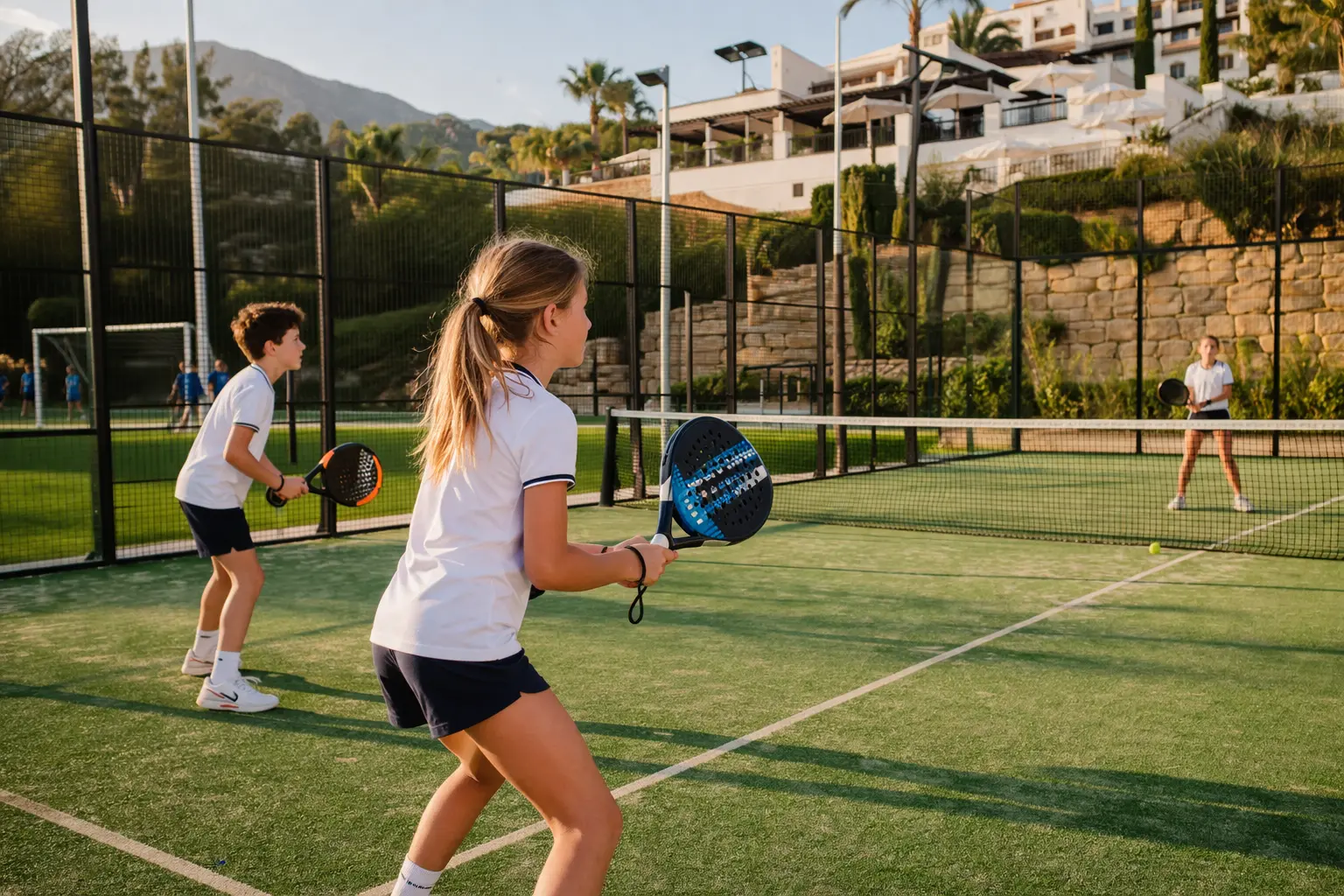
For families relocating to the area, one of the immediate joys is how easily children can stay active. Whether it is an early evening football session, padel under the fading light, or a swim before dinner, the pace of life encourages movement, independence and balance.
This is particularly true for families connected to Atalaya International College, CEIP Daidín and other nearby schools, where after-school routines are not an afterthought — they are an essential part of daily life.
Sport forms the heartbeat of after-school life in Benahavís. It is here, on pitches, courts and poolside terraces, that friendships are built and confidence quietly grows.
Football training sessions run throughout the week, often followed by weekend matches that take families along the coastline. Meanwhile, padel — the region’s signature sport — is as much a social ritual as it is a game, with children quickly finding themselves part of a wider community.
Swimming, too, plays a central role. From early water confidence classes to competitive squads, the Costa del Sol climate makes it possible to train year-round, adding another layer of consistency to a child’s routine.
Nature as a Playground: Equestrian Life & Outdoor Adventure
Set between the valley, mountains and open countryside, Benahavís offers something increasingly rare — a childhood shaped by nature as much as by structure.
Horse riding is a natural extension of this lifestyle. Nearby equestrian centres introduce children to riding in a calm, confidence-building environment, while older riders progress to longer hacks through the surrounding hills.
Weekends often evolve organically: a morning ride followed by a walk along a river trail, or a picnic overlooking the valley. It is this blend of freedom and landscape that defines the area.
Beyond Sport: Creativity, Language & Academic Balance
While sport may dominate the afternoons, many families also weave in quieter, more focused pursuits — the kind that support both creativity and academic confidence.
Music and dance academies offer everything from piano and guitar to contemporary movement, while tutoring and language support help international children settle into bilingual education with ease.
There is also a growing ecosystem of smaller, specialist activities — coding clubs, chess sessions, even cooking workshops — reflecting the international nature of the community.
Together, these experiences create a well-rounded rhythm where learning continues naturally beyond the classroom.
Where You Live Shapes the Week
In Benahavís, choosing a home is as much about lifestyle flow as it is about design or views. The proximity to schools, sports clubs and outdoor spaces can quietly transform the ease of daily life.
Village homes offer a walkable, community-led atmosphere, where children can move between activities with a sense of independence. Meanwhile, areas such as Atalaya and La Alquería provide quick access to both schools and coastal sports clubs, making busy schedules feel manageable.
For families balancing multiple activities each week, these small differences quickly become meaningful.
What defines Benahavís is not simply the range of activities available, but how naturally they fit into everyday life.
As parents ourselves, we understand that a successful move is about more than choosing the right school. It is about creating a rhythm where children can thrive — socially, physically and academically — without the day feeling rushed or fragmented.
When you share what matters most to your family, we can help you find not just the right home, but the right lifestyle to match it.
Driving in Spain for Non-EU Visitors — Costa del Sol Guide (2026)
Exploring the Costa del Sol by car is one of the easiest ways to discover beaches, villages and mountain views.
Exploring the Costa del Sol by car is one of the most enjoyable ways to experience Andalucía’s beaches, mountain roads, white villages and historic towns. Whether you are visiting from the UK, US, Canada or any other non-EU country, the rules for driving in Spain are straightforward once you know what to expect.
This guide focuses on the Costa del Sol, but the core rules apply across Andalucía and the rest of Spain. Below, you will find the essentials on licence rules, age requirements for car hire, insurance, mandatory safety equipment, speed limits and how to exchange your licence if you decide to become a resident.
Visitors from the UK, US, Canada and most non-EU countries can drive in Spain using their valid national driving licence for short tourist stays. The same basic rules apply whether you are exploring Marbella, Benahavís, Estepona or other parts of the Costa del Sol.
However, additional requirements can apply depending on your country of origin and the type of licence you hold.
UK visitors
Modern UK photocard licences are accepted for short visits to Spain.
An International Driving Permit (IDP) is usually only needed if you have an older paper licence or a licence issued in the Isle of Man, Jersey or Guernsey.
Your licence must be valid and unexpired for the entire duration of your trip.
US, Canada and other non-EU visitors
Many car hire companies in Spain ask US and Canadian visitors to present both their national licence and an IDP.
Practically, carrying an IDP is strongly recommended even where it is not strictly mandatory.
If your licence is not in the Latin alphabet, an IDP or official translation is generally required.
Whatever your nationality, your licence must be valid, legible and cover the category of vehicle you intend to drive. If in doubt, confirm the requirements directly with your chosen car hire company before you travel.
Always carry your driving licence, passport, insurance and rental documentation when driving in Spain.
Key Driving Rules in Spain
Once you are on the road, driving in Spain is generally straightforward, but a few rules differ from the UK and North America. Understanding these in advance will make your Costa del Sol trip smoother and safer.
Drive on the right-hand side and overtake on the left.
Roundabouts: vehicles already on the roundabout normally have priority.
Seat belts are compulsory for all passengers, front and rear.
Using a hand-held mobile phone while driving is prohibited and heavily fined.
Children must use appropriate child seats or restraints according to their height and weight.
You must carry your personal and vehicle documents with you at all times when driving:
Passport or national identity document
National driving licence (and IDP if required)
Proof of insurance
Vehicle registration document, or rental agreement if hiring
Mandatory safety equipment
If you are driving your own car in Spain, you are expected to carry:
Reflective jackets for all passengers, accessible from inside the car
At least one warning triangle (two are often recommended)
Headlamp beam deflectors for non-EU right-hand-drive vehicles, if driving at night
Rental cars on the Costa del Sol usually come equipped with the required safety items, but it is still wise to check at pick-up.
Spain’s road network is modern and well-signed, but roundabout and priority rules may differ from your home country.
Speed Limits, Toll Roads and Low-Emission Zones
Spain’s speed limits are clearly signposted, but it helps to know the general rules before you set off from Málaga Airport or along the AP-7.
Typical speed limits
Motorways (Autopistas / Autovías): 120 km/h
Non-urban single carriageways: 90 km/h (sometimes 100 km/h where signposted)
Built-up areas: 50 km/h
Residential or calming zones: 20–30 km/h
Speed cameras are common. Fines may be applied on the spot for foreign drivers or sent later to your home address.
Toll roads on the Costa del Sol
Parts of the AP-7 and other sections of motorway near Marbella and Estepona operate as toll roads (peajes). You can usually pay:
With cash or card at crewed booths
Automatically via Telepeaje / Via-T tags (often used by frequent drivers)
Low-emission zones (Zonas de Bajas Emisiones)
Major cities such as Madrid and Barcelona already operate low-emission zones where access is restricted based on a DGT environmental sticker (0, Eco, C or B). Foreign-registered vehicles cannot easily obtain these stickers, so access to certain central streets may be limited.
Málaga is progressively preparing its own low-emission measures. If you plan to drive into the very centre of larger cities, it is sensible to check the latest rules in advance or park outside the core and use public transport.
Some Costa del Sol motorways are toll roads; watch for peaje signs and choose routes that suit your plans and budget.
Driving a Foreign-Registered Car in Spain
Many visitors choose to rent a car locally, but some drive to Spain from their home country. In that case, you must pay close attention to insurance, stickers and safety equipment.
Insurance
Before you travel, confirm exactly what level of cover your policy provides:
UK policies often include at least third-party cover for driving in the EU, including Spain.
US and Canadian policies typically do not cover driving in Europe; you may need to rely on rental insurance or specific international cover.
Consider adding comprehensive cover for extra peace of mind, especially if you are unfamiliar with the roads.
Stickers and vehicle requirements
UK-registered cars must display a UK identifier; the old “GB” stickers are no longer valid.
Ensure your number plates and any stickers are clearly visible and compliant with current rules.
Check that you have warning triangles, reflective vests and beam deflectors where required.
Car Hire on the Costa del Sol: Age Limits & Practical Tips
Málaga Airport is the main gateway to the Costa del Sol, with multiple car hire companies on site.
Hiring a car at Málaga Airport or along the Costa del Sol is usually straightforward, but the small print matters—especially age limits and surcharges.
Typical age and licence rules
Minimum age is often 21, with a full licence held for at least 12 months.
Some vehicle categories (SUVs, premium or luxury models) require drivers to be 23–25+.
Drivers under 25 frequently pay a young driver surcharge.
In some cases, drivers over 75 may need additional cover or medical documentation.
Always read the rental terms before you book. If you are unsure, contact the rental company in advance to confirm requirements for your nationality and age.
Practical tips for Costa del Sol car hire
Book well ahead for peak periods (summer, Christmas, Easter and long weekends).
Check fuel policy—“full-to-full” is often the fairest option.
Inspect and photograph the car at pick-up and drop-off, including wheels and windscreen.
If you plan to explore inland villages, Ronda or mountain roads near Benahavís, consider a car with good torque and braking performance.
Becoming a Resident in Spain: Exchanging Your Licence
Long-term residents usually need to exchange their foreign licence for a Spanish one.
If you decide to make the Costa del Sol your long-term home, your status changes from visitor to resident, and the rules for driving on a foreign licence change as well.
Driving on your foreign licence as a resident
Once you become a legal resident in Spain, you can usually drive on your foreign licence for up to six months from the date your residency is recognised. After that, you are expected to exchange it for a Spanish licence or obtain a new Spanish licence via the theory and practical tests.
Licence exchange agreements
Spain maintains reciprocal agreements with certain non-EU countries and regions:
UK: A full reciprocal agreement allows most UK licence holders to exchange without taking a driving test, provided the licence is valid and meets the criteria in force.
US & Canada: Exchange options depend on specific states or provinces; in some cases, you may need to take Spanish tests if there is no direct agreement.
Other non-EU countries: Eligibility varies; always check the current list on the DGT website or speak to a gestor (local administrative adviser).
Documents typically required include:
Valid foreign driving licence
Proof of residence in Spain (e.g. TIE card)
Passport or national identity document
Application form and payment of the corresponding fee
A basic medical and eyesight check (psicotécnico)
Procedures and fees can change, so it is wise to confirm the latest requirements with the DGT or an experienced gestor before you book appointments.
FAQs: Driving in Spain as a Non-EU Visitor
Do I need an International Driving Permit?
It depends on your country and your rental company. UK visitors with modern photocard licences generally do not need an IDP for short trips. Many US and Canadian visitors are asked to present one, and travellers from countries using a non-Latin alphabet almost always need an IDP or official translation. If in doubt, obtain an IDP before you travel.
Can I keep driving on my foreign licence after becoming a resident?
Only for a limited period. Typically, you may drive for up to six months from the date you become resident. After that, you must exchange your licence or obtain a Spanish one, depending on the agreement between Spain and your home country.
What safety equipment must I carry?
At minimum, expect to carry reflective vests for occupants, at least one warning triangle and, for non-EU right-hand-drive cars, headlamp beam deflectors if using your lights. Rental cars usually include these items, but it is worth checking at pick-up.
Are there strict drink-driving rules?
Yes. Spain’s drink-driving limits are stricter than in many countries, and enforcement is taken seriously. The safest approach is simple: if you are driving, avoid alcohol altogether.
How do I handle parking on the Costa del Sol?
In resort areas, you will find a mix of free street parking, blue-zone paid areas with time limits and underground car parks. Always check the signs carefully and pay attention to local rules, especially during busy summer months and major holidays.
Key Takeaways for Non-EU Visitors Driving in Spain
For most non-EU visitors, driving on the Costa del Sol is a straightforward and enjoyable way to explore Andalucía. With a valid licence (and IDP where required), adequate insurance, the right safety equipment and an understanding of speed limits, toll roads and low-emission rules, you can drive with confidence.
Regulations and bilateral agreements can evolve, so it is sensible to double-check official guidance from your home country and the Spanish DGT shortly before you travel. Taking a few minutes to prepare will help you focus on what really matters: enjoying the sunshine, scenery and lifestyle that make the Costa del Sol such a sought-after destination.