Category: Taxes & Visas

  • Spain Budget Rejection: Non-Lucrative Visa 2026 Impact

    Spain Budget Rejection: Non-Lucrative Visa 2026 Impact


    Long-term residents in Spain reviewing visa requirements

    What Spain’s State Budget Rejection Means for Non-Lucrative Visa Holders in 2026


    If you live in Spain — or are planning to move here — on a non-lucrative visa (NLV), one of the key questions heading into 2026 is whether you’ll need to demonstrate higher savings or passive income.
    In short: the latest budget situation in Madrid makes it more likely than not that the financial threshold will remain unchanged.

    If you’re still weighing up residency routes, start with our overview of Spain’s visa options and the dedicated hub for Visa Options (Legal & Residency).

    What Is the Non-Lucrative Visa?

    The non-lucrative visa is one of the most common ways for non-EU nationals to reside in Spain without working locally. It’s often used by retirees or those with reliable passive income, because the core requirement is to prove you can support yourself (and any dependants) without a Spanish salary.

    For a practical, step-by-step explanation of eligibility, documents and typical timelines, see: Non-Lucrative Visa Spain (2025 guide).
    If you’re specifically concerned about taxation while living here, you may also find this helpful: Do I have to pay tax in Spain on the non-lucrative visa?

    How the Financial Requirement Is Calculated

    The minimum savings / passive income required for the NLV is based on Spain’s IPREM (Indicador Público de Renta de Efectos Múltiples). IPREM is a government reference index used across multiple areas (subsidies, grants, legal aid thresholds and more).

    In 2025, the IPREM is:

    • €600 per month
    • €7,200 per year

    NLV holders must generally demonstrate:

    • 400% of annual IPREM for the main applicant (€28,800)
    • +100% of annual IPREM for each dependant (€7,200 per year)

    As a simple example, a couple applying together typically needs to show around €36,000 in qualifying savings or passive income for the first year.

    For renewal periods (commonly two years), the requirement is generally higher because you must cover a longer timeframe.

    If you want a deeper dive into what counts as acceptable proof (bank statements, pensions, investment income and how consulates interpret them), read: Spain visa financial requirements (2025).

    For the broader residency admin context (including NIE essentials), see: Residency & NIE essentials
    and our standalone guide: NIE number Spain (expats guide).

    Why the 2026 Requirement Is Unlikely to Increase

    This is the key point: IPREM is updated through Spain’s General State Budget. Without an approved budget, IPREM typically remains frozen at its current level.

    Spain is entering 2026 without a newly approved national budget, following another failed attempt in Congress in December 2025.

    As a result, it is highly plausible that IPREM — and therefore the NLV financial threshold — stays the same throughout 2026.

    Could the Rules Still Change in 2026?

    Yes, it’s possible. If a budget is later approved, the government could update IPREM during the year. However, given recent voting dynamics, many observers expect the status quo to continue unless there is a significant political shift.

    It’s also worth noting that IPREM has not increased every year since it was created. That’s why the non-lucrative visa threshold often remains stable, unlike the digital nomad visa where financial requirements are tied to salary benchmarks that tend to move more frequently.

    If you’re comparing these options, see: Digital Nomad Visa (DNV) in Spain and
    Spain digital nomad visa requirements.

    What This Means for Non-Lucrative Visa Holders in 2026

    Barring an unexpected budget agreement, the practical takeaway is straightforward:

    • Most applicants and renewals should expect no increase in the NLV financial threshold during 2026
    • IPREM-based requirements are likely to remain aligned with 2025 figures
    • Planning is easier, because the goalposts are less likely to move mid-process

    Even so, consulate and immigration office interpretations can vary, and documentation standards can be strict.

    If you’re preparing a move (or renewal) it helps to have the wider “buyer’s admin” checklist covered too: Buyer’s checklist and the step-by-step Buying process in Spain.


    Related Reading

    [siteorigin_widget class=”WP_Widget_Custom_HTML”][/siteorigin_widget]
  • Retiring in Spain: Pensions, Tax Treaties & Income Guide

    Retiring in Spain: Pensions, Tax Treaties & Income Guide

    [siteorigin_widget class=”SiteOrigin_Widget_Hero_Widget”][/siteorigin_widget]

    Retiring in Spain: Pensions, Social Security & Tax Treaties

    Spain has become a natural choice for retirees from the United Kingdom, the United States, Canada and across northern Europe. The climate, lifestyle and healthcare system are major attractions – but so too is the ability to receive pensions and social security income while living here. This guide focuses on how state pensions, private retirement accounts and double taxation treaties work in practice when you retire to Spain.

    For a broader overview of budgets and everyday running costs, see our Cost of Living guide for the Costa del Sol.

    Receiving State Pensions While Living in Spain

    Spain has social security coordination agreements and tax treaties in place with the United States, the United Kingdom and Canada. In practical terms, this means retirees can usually receive their state pension or social security income while resident in Spain, paid either into a home-country bank account or directly into a Spanish bank.

    U.S. retirees — Social Security benefits

    American retirees can continue to receive U.S. Social Security benefits while living in Spain. Payments are generally made in the usual way, with the option to:

    • Keep deposits going to a U.S. bank account, or
    • Arrange direct deposit into a Spanish bank account in euros.

    It is important to inform the Social Security Administration of your new address and banking details when you relocate, and to keep this information updated to avoid interruptions in payment.

    UK retirees — UK State Pension

    UK citizens living in Spain can claim their UK State Pension as normal. Under the UK–EU Withdrawal Agreement, pensions for eligible UK retirees in Spain continue to be uprated annually – in other words, your State Pension increases each year as if you were still living in the UK.

    The pension can be paid into a UK bank account or, if preferred, converted and paid directly into a Spanish account. Staying on top of address and banking changes with the Department for Work and Pensions (DWP) helps ensure smooth, uninterrupted payments.

    Canadian retirees — OAS & CPP

    Canadian retirees can receive both Old Age Security (OAS) and Canada Pension Plan (CPP) benefits while living in Spain. As with other countries, payments can usually be made:

    • Into a Canadian bank account, or
    • Directly into a Spanish bank account, converted into euros.

    Service Canada should be notified of any changes in residency status, address or banking details. This reduces the risk of delayed payments or compliance queries once you have settled in Spain.

    Practical tip: Before you move, ask your home-country pension authority for a written summary of your entitlements and payment options in Spain. Keep copies of all correspondence alongside your Residency & NIE paperwork.

    Private Pensions & Retirement Accounts

    Most international retirees also draw income from workplace pensions, personal pensions or tax-advantaged retirement accounts. These can generally be accessed while you are resident in Spain, but the tax treatment may change once you become Spanish tax resident.

    Americans — 401(k), IRA & private pensions

    U.S. citizens can usually continue to access distributions from:

    • 401(k) and other employer-sponsored plans
    • Traditional and Roth IRAs
    • Private or company pension schemes

    However, how those withdrawals are taxed can differ between the U.S. and Spain. Coordination between a U.S. tax advisor and a Spanish advisor familiar with the U.S.–Spain tax treaty is strongly recommended, especially if you hold Roth accounts or significant investment income.

    Britons — workplace pensions, SIPPs & QROPS

    UK retirees in Spain often rely on a mix of:

    • Workplace or company pensions
    • Personal pensions and SIPPs
    • Defined benefit (final salary) schemes

    Some choose to transfer their UK pension into a QROPS (Qualifying Recognised Overseas Pension Scheme) for simplified management when living abroad. Whether a QROPS is appropriate depends on factors such as your age, pension size, scheme rules, fees and future plans.

    A specialist adviser can help you compare leaving pensions in the UK with consolidating or transferring them, taking into account Spanish tax rules and the wider tax picture for owning assets in Spain.

    Canadians — RRSP, RRIF & employer pensions

    Canadians in Spain commonly draw retirement income from:

    • Registered Retirement Savings Plans (RRSPs)
    • Registered Retirement Income Funds (RRIFs)
    • Employer or defined benefit pension plans

    Withdrawals are often taxable in both Spain and Canada in theory, but the Canada–Spain tax treaty determines where income is primarily taxed and what credits may apply. Careful timing of withdrawals, and deciding which account to draw from first, can make a meaningful difference over the long term.

    Good to know: When planning your income strategy, combine pension advice with an understanding of purchase costs in Andalucía and ongoing community fees so your retirement budget reflects the real cost of running a home on the Costa del Sol.

    Double Taxation Treaties: Not Being Taxed Twice

    Spain has Double Taxation Treaties (DTTs) with the United States, the United Kingdom and Canada. These treaties are designed to ensure that the same income is not fully taxed twice in both countries, even though you may need to submit tax returns in each jurisdiction.

    In practice, this usually means:

    • Spain or your home country is given primary taxing rights over certain types of income (for example, pensions, dividends or employment income).
    • Any tax paid in one country can often be credited against tax due in the other.
    • The exact outcome depends on the treaty, your residency status and your income mix.

    Because treaty provisions are technical, most retirees benefit from working with an international tax advisor who understands both Spanish law and the rules in your home country. This is particularly important if you have income from multiple sources (pensions, rentals, investments) or plan to spend time in more than one country each year.

    A good starting point is to understand when you will become tax resident in Spain and what that means in terms of global income reporting. Our Buyer’s Guide for Benahavís and Residency & NIE essentials give a practical overview of timelines and documentation.

    Putting It All Together: A Simple Retirement Planning Checklist

    While each situation is unique, most retirees from the U.S., UK and Canada follow a similar planning sequence:

    • Confirm which state pensions and private pensions you are entitled to, and how they will be paid once you live in Spain.
    • Discuss withdrawal strategies from 401(k)/IRA, UK pensions, RRSP/RRIF and similar accounts with a cross-border advisor.
    • Clarify when you will become Spanish tax resident and how double taxation treaties apply to your income.
    • Review your visa route – for example, using the post–Golden Visa options such as the Non-Lucrative or Digital Nomad visas.
    • Build a retirement budget that includes running costs, taxes, healthcare and lifestyle spending.

    Our dedicated Buyer’s Checklist is a helpful companion here, covering everything from early research to completion day and key handover.

    With the right structure in place, you can enjoy the benefits of retiring in Spain – from long lunches and sea views to a lower cost of living – while keeping your pension income and tax position predictable.

    Related Resources for Retiring in Spain

  • Why Americans, Canadians & Brits Are Buying Property in Benahavís

    Why Americans, Canadians & Brits Are Buying Property in Benahavís


    Why Americans, Canadians & Brits Are Buying Property in Benahavís | 2025 Market Insight


    As interest rates climb across North America and the UK, and economic uncertainty continues to ripple through global markets, a growing number of buyers from the U.S., Canada, and Britain are looking beyond their borders for stability, lifestyle, and long-term value. One destination quietly gaining traction? Benahavís — a picturesque enclave in southern Spain known for its luxury real estate, natural beauty, and international appeal.

    The Global Shift: Why Buyers Are Looking Abroad

    In recent months, central banks in the U.S., Canada, and the UK have maintained elevated interest rates to combat inflation. This has made domestic borrowing more expensive and cooled local housing markets. At the same time, geopolitical tensions, cost-of-living pressures, and a reevaluation of work-life balance have prompted many to consider overseas alternatives.

    Spain — and particularly the Costa del Sol — offers a compelling mix of affordability, lifestyle, and legal pathways for non-EU buyers. Benahavís, nestled between Marbella and Estepona, stands out for its low-density planning, high-end developments, and proximity to international schools like Atalaya International College.

    Why Benahavís Appeals to International Buyers


    • Stable Property Market: Spain’s real estate market has shown resilience, with Benahavís offering strong long-term value and rental potential.
    • Lifestyle Migration: With remote work now normalized, buyers are prioritizing sunshine, safety, and wellness — all hallmarks of life in Benahavís.
    • Currency Advantage: The strength of the U.S. dollar and British pound against the euro has made Spanish property more accessible to foreign buyers.
    • Education Access: Families relocating or investing for future use appreciate the proximity to international schools like Atalaya International College, Aloha College, and Sotogrande International.
    • Residency Options: Spain’s numerous Visa options remains a draw for non-EU investors, offering residency in exchange for qualifying property purchases.

    Living the Benahavís Lifestyle

    From golf at Los Arqueros and La Quinta to hiking trails and Michelin-starred dining, Benahavís offers a lifestyle that’s both luxurious and laid-back. Properties range from modern apartments with panoramic views to gated villas with private pools and gardens. The area is just 10–15 minutes from the coast, Puerto Banús, and Marbella, yet feels worlds away in terms of tranquility and space.

    What’s Next for Buyers?

    As global interest rates remain high and domestic markets cool, the appeal of Benahavís is likely to grow. For Americans, Canadians, and Brits seeking a safe haven for capital, a better quality of life, or a strategic relocation, this Andalusian gem offers more than just sunshine — it offers a future-proof investment.

    [siteorigin_widget class=”SiteOrigin_Widget_Image_Widget”][/siteorigin_widget]

    The technical background

    North American and UK borrowers are coming off a bumpy rate cycle at home. Meanwhile, the euro area has eased materially since the 2023 peak: Euribor has fallen, the ECB is on pause, and Spanish mortgages for well-qualified non-residents remain accessible—especially at 60–70% LTV. For affluent buyers who want year-round sunshine, golf, international schools and a refined lifestyle, Benahavís is rising to the top of the shortlist. European Central Bank, euribor-rates.eu

    The macro picture (as of 20 Oct 2025)

    • United States (Fed): The Fed cut in September to a 4.00–4.25% target range and is widely expected to trim again at the Oct 28–29 meeting. Translation: US financing costs are easing from restrictive levels, but uncertainty remains into December. Federal Reserve, Barron’s
    • Canada (BoC): The policy rate was cut to 2.50% in September; the next decision is scheduled for Oct 29. Markets are debating how much easing is left. Bank of Canada
    • United Kingdom (BoE): Bank Rate stands at 4.00% after an August cut; policymakers now signal a slower pace of any further reductions as inflation proves sticky. Reuters, Bank of England
    • Euro area (ECB/Euribor): The ECB has kept rates unchanged since September, with the deposit facility at 2.00%. The 12-month Euribor—what Spanish variable and mixed mortgages often reference—is ~2.16% (17 Oct). In short: down sharply from 2023 highs above 4%. global-rates.com, European Central Bank, Reuters

    Why this matters to your Benahavís purchase

    Spanish banks typically underwrite non-resident mortgages at ~60–70% LTV, with fixed or mixed (fixed for a period, then Euribor-linked) structures. When Euribor stabilises or falls, mixed products become especially compelling for buyers who want payment visibility now and optionality later.

    Quick “rate snapshot” 

    • Fed funds: 4.00–4.25% (Sep 17); next meeting Oct 28–29. Federal Reserve
    • BoC overnight: 2.50% (Sep 17); next decision Oct 29. Bank of Canada
    • BoE Bank Rate: 4.00% (held Sep 17). Bank of England
    • ECB deposit facility: 2.00% (held Sep 11). European Central Bank
    • 12-month Euribor: ~2.16% (Oct 17 print). global-rates.com

    The lifestyle ROI 

    Beyond the maths, buyers from the US, Canada and the UK are re-weighting for quality of life—year-round climate, golf/wellness, international schooling and connectivity. Foreign demand remains a structural force in Spain (mid-teens share nationally over the last year), with Málaga province among the country’s leaders—supporting liquidity and choice across Benahavís communities. CaixaBank Research

    Case study (illustrative only):

    A €1.2M Benahavís purchase with a Spanish mortgage. Assume a 60% LTV (loan €720,000) and a 20-year term:

    • At 2.5% nominal, monthly ≈ €3,710 per €720k.
    • At 3.5% nominal, monthly ≈ €4,060 per €720k.

    Rule of thumb: every 1 percentage point on a 20-year loan moves payments by roughly €50 per month per €100k of debt. Use this to sanity-check offers as you negotiate both price and finance.
    (Note: lender offers vary by profile; this is not advice.)

    Per-€100k monthly payment guide (20-year term, illustrative):

          • 2.0% ≈ €506 | 2.5% ≈ €530 | 3.0% ≈ €555 | 3.5% ≈ €580 | 4.0% ≈ €606

    Buyer playbook for US/CA/UK clients (what to prepare now)

    • Get a Spanish NIE and open a Spanish bank account early.
    • Mortgage in principle: line up a fixed or mixed product; expect 60–70% LTV for non-residents, with terms often 20–25 years.
    • Currency plan: decide whether to stage transfers or hedge; small FX moves can affect your effective budget.
    • Legal team: independent bilingual solicitor; confirm due diligence, taxes and completion timelines.
    • Insurance & holding structure: discuss life/building insurance requirements and whether buying personally or via a company fits your tax context.
    • Residency perspective: note that Spain ended the real-estate Golden Visa on 3 April 2025—so plan stays around the standard rules or alternative residency routes if needed. El País

    What could change next? 

    • Central bank path: October/November policy meetings (Fed/BoC/BoE/ECB) and inflation prints could nudge borrowing costs. Reuters, Barron’s, Bank of Canada
    • Euribor trend: if the slowdown persists, the 12-month series could drift sideways or lower—supportive for mixed-rate Spanish products. euribor-rates.eu
    • UK inflation & BoE guidance: a slower disinflation path argues for patience on cuts; that matters for sterling sentiment and UK buyer psychology. Reuters

    Request more information

    Want to know more or arrange a viewing? Darren & Angelina — your Personal Property Concierge — will share full details and organise a private tour. Use the enquiry form on this page and we’ll be in touch promptly. 

  • The Non-Lucrative Visa (NLV): More Flexibility for Non-EU Citizens Moving to Spain

    The Non-Lucrative Visa (NLV): More Flexibility for Non-EU Citizens Moving to Spain

    [siteorigin_widget class=”WP_Widget_Block”][/siteorigin_widget]
    [siteorigin_widget class=”Ert_Title_Widget”][/siteorigin_widget]

    The Non-Lucrative Visa (NLV) remains the most popular pathway for non-EU citizens—such as Americans, British, Canadians, Australians, and others—looking to settle in Spain.

    Designed for individuals who do not intend to work during their initial stay, the NLV allows applicants to gain Spanish residency while bypassing the standard 90-day tourist rule that restricts stays in the Schengen Area.

    In recent years, the application process has evolved, with consulates around the world increasingly using third-party agencies (such as BLS International in some regions) to manage submissions. But a major update introduced in mid-2025 now gives applicants far greater flexibility when planning their relocation.


    What’s Changed?

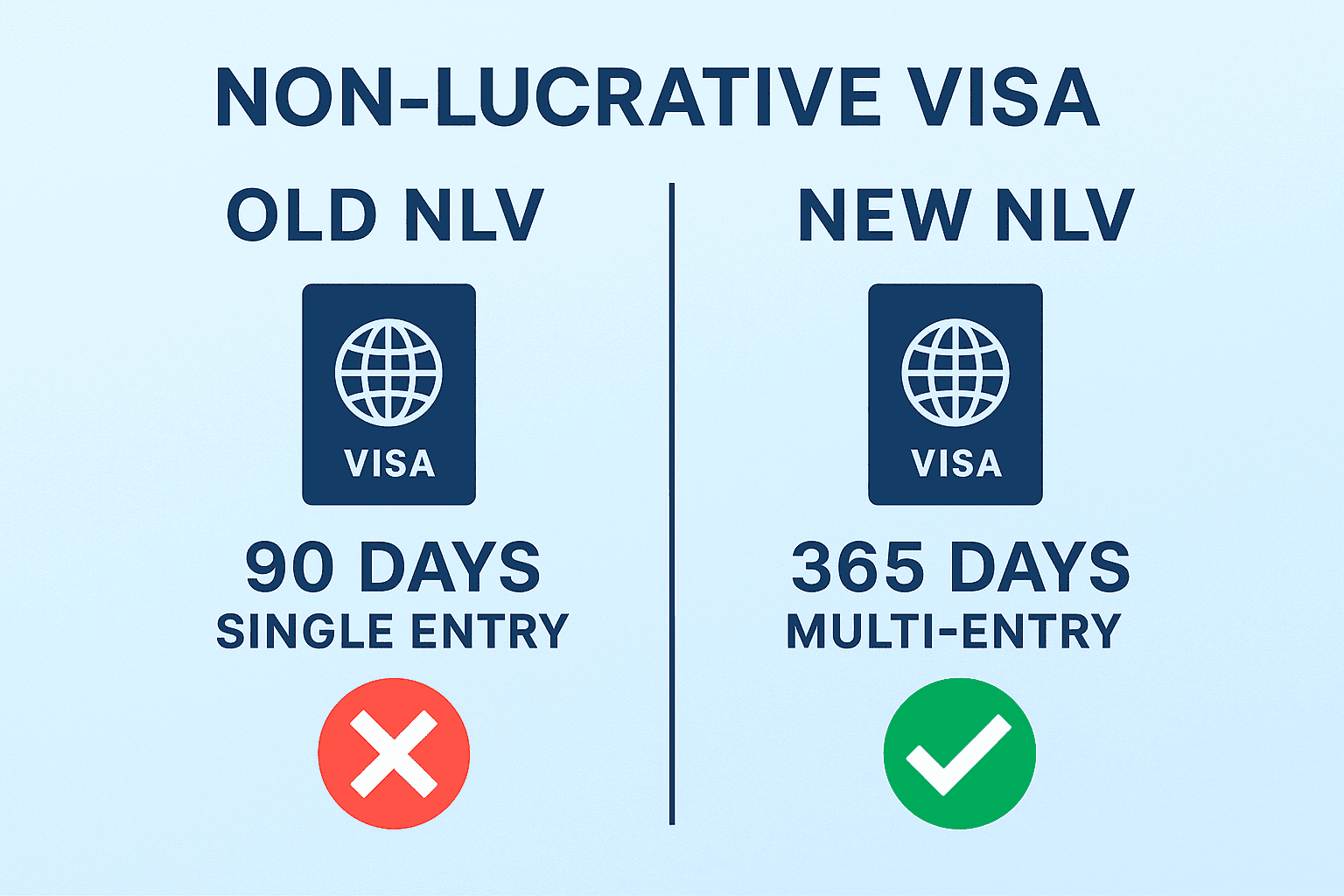
    Previously, once approved by a Spanish consulate abroad, successful applicants received a visa sticker in their passport valid for just 90 days. This meant you had to enter Spain within three months of issuance.

    As of June 2025, the validity has been extended to 365 days, and the visa is now issued as a multi-entry visa. This gives new residents much more freedom when arranging their move.


    Why This Matters

    • No rush to relocate
      With the extended validity period, you’re no longer pressured to move within 90 days. If you’re waiting for a property sale, closing down affairs back home, or simply needing more time to prepare, the 12-month window is a huge relief.

    • Travel flexibility
      Because the NLV is now multi-entry, you can travel in and out of Spain during that first year. This is especially useful if you’re renting while house-hunting, or if you have ongoing family or business commitments back home.

    Relocation experts confirm this is a positive change: “Moving abroad is a major step which often throws up unexpected issues. The extended visa validity gives applicants more breathing room and avoids unnecessary stress,” notes one Spanish immigration advisor.


    Key Deadlines to Keep in Mind

    • Start of residency: Your official residency date begins when you first enter Spain on the visa (the entry stamp in your passport is proof).

    • TIE application: Within one month of arrival, you must apply for your TIE card (Tarjeta de Identidad de Extranjero) at the local police station.

    • Renewal requirements: To renew your NLV after the first year, you must prove you spent at least 183 days in Spain during that period.

    ⚠️ Important: Spending 183+ days in Spain makes you a Spanish tax resident, meaning your worldwide assets and income may be subject to Spanish taxation. The Spanish tax year runs from January 1 to December 31.


    NLV Income Requirements for 2025

    To qualify, applicants must show proof of sufficient passive income or savings:

    • Main applicant: €2,400 per month (€28,800 per year)

    • Each dependent: €600 per month (€7,200 per year)

    Acceptable sources include pensions, savings, rental income, dividends, and investments. Income from employment or freelance work is not permitted under this visa.


    Planning Ahead

    If you’re considering relocating to Spain in 2026 or 2027, now is the time to familiarize yourself with the NLV process and its financial requirements.

    The extended 12-month validity period offers greater flexibility, but careful planning—especially around taxes, property sales, and residency obligations—remains essential for a smooth transition.


    👉 Whether you’re from the U.S., Britain, Canada, Australia, or elsewhere outside the EU, the Non-Lucrative Visa continues to be the most straightforward path to enjoying life in Spain—now with more breathing space than ever before.

    [siteorigin_widget class=”SiteOrigin_Widget_Image_Widget”][/siteorigin_widget]

    You can find much more information on visas in  Our Guide to Buying Property on the Costa del Sol

    [siteorigin_widget class=”WP_Widget_Block”][/siteorigin_widget]
    [siteorigin_widget class=”Ert_Title_Widget”][/siteorigin_widget]

    1. What is the Non-Lucrative Visa (NLV) in Spain?
    The Non-Lucrative Visa is a residency permit for non-EU citizens who want to live in Spain without working. It allows you to stay in Spain long-term, provided you can show sufficient financial means to support yourself and your family.

    2. Can Americans and Canadians apply for the NLV?
    Yes. The NLV is open to all non-EU citizens, including Americans, British, Canadians, Australians, and others. You apply at the Spanish consulate in your home country before relocating.

    3. How much income do I need to qualify for the NLV in 2025?
    For 2025, the minimum income requirement is €2,400 per month (€28,800 per year) for the main applicant, plus €600 per month (€7,200 per year) for each dependent. These funds must come from passive income such as pensions, savings, rental income, or investments.

    4. Can I work in Spain with the Non-Lucrative Visa?
    No. The NLV does not allow employment or freelance work in Spain. However, after holding residency for a certain period, it may be possible to modify your status to a different visa that permits work.

    5. Do I become a tax resident in Spain with the NLV?
    Yes, if you spend more than 183 days in Spain within a calendar year, you are considered a Spanish tax resident. This means your worldwide income and assets may be subject to Spanish taxation.

    6. How long is the Non-Lucrative Visa valid?
    Since June 2025, the NLV is issued as a multi-entry visa valid for 12 months. This gives you more time and flexibility when planning your move to Spain. After the first year, you can renew it for two years at a time.

    [siteorigin_widget class=”WP_Widget_Custom_HTML”][/siteorigin_widget]
  • How to Get a NIE Number in Spain (2026 Step-by-Step)

    How to Get a NIE Number in Spain (2026 Step-by-Step)

    How to Get a NIE Number in Spain in 2026

    A step-by-step guide for expats


    If you’re planning to live, work, study or buy property in Spain, one of the first things you’ll need is a
    NIE number (Número de Identificación de Extranjero).

    This unique foreigner identification number is essential for most legal, financial and administrative processes in Spain — from opening a bank account and signing a property deed to paying taxes or enrolling children in school.

    This updated 2026 guide explains what a NIE is, who needs one, how to apply, what documents are required, typical costs, and practical tips to avoid delays.

    What is a NIE number?

    A NIE is a personal identification number issued to non-Spanish nationals for tax and legal purposes. It is used across all interactions with Spanish authorities and institutions.

    Important: The NIE itself is permanent. Once issued, it is valid for life and does not expire — even if your residency status changes.

    Who needs a NIE in Spain?

    • EU / EEA citizens: Must register as residents and obtain a NIE if staying in Spain for more than 90 days.
    • Non-EU citizens (UK, USA, Canada, etc.): Are automatically assigned a NIE as part of their residency (TIE) application.

    Even non-residents often need a NIE to buy property, open a Spanish bank account or pay taxes.

    How to get a NIE number in Spain (step-by-step)

    1. Book your appointment (cita previa)

    NIE applications must be submitted by appointment through Spain’s official government booking system.

    • Visit the official cita previa portal
    • Select your province
    • Choose the correct procedure:
      • “Certificados UE” — for EU citizens
      • “Asignación de NIE / Tarjeta de Identidad de Extranjero” — for non-EU citizens
    • Enter your personal details and confirm the appointment

    Tip: In popular areas such as Málaga, Marbella or Madrid, appointments can take 4–8 weeks. Applying via a Spanish consulate abroad may take longer.

    2. Prepare the required documents

    While requirements can vary slightly by province, you will typically need:

    • Application form
      – EU citizens: Form EX-18
      – Non-EU citizens (NIE-only request): Form EX-15
    • Proof of purpose (why you need a NIE): property purchase, job offer, business activity, study enrolment, etc.
    • Passport: original plus photocopies
    • Passport photos (usually 1–2, colour)
    • Proof of legal entry or visa (non-EU citizens)
    • Form 790 Código 012 — NIE tax payment receipt

    📌 All forms must be completed in Spanish. Only Spanish-language versions are accepted.

    3. Pay the NIE fee

    The NIE fee is paid using Form 790, Código 012.

    In 2026, the fee is typically around €12, though minor adjustments may occur. Payment can be made at most Spanish banks or ATMs after printing the form.

    4. Attend your appointment

    Attend your appointment at the Oficina de Extranjería or Policía Nacional with all original documents and copies.

    Depending on the office, your NIE may be issued immediately or collected within 5–10 working days.

    Helpful tips to avoid delays

    • Bring photocopies of everything — including your passport
    • Check local requirements in advance, as rules can vary slightly by region
    • Arrive early for your appointment
    • Store your NIE safely — you’ll need it frequently

    Frequently asked questions

    Is a NIE number permanent?
    Yes. Once issued, your NIE is valid for life.

    Can I apply for a NIE before moving to Spain?
    Yes. Applications can be made through a Spanish consulate abroad, though processing times are usually longer.

    Do I need a job or property to get a NIE?
    No, but you must provide a legitimate reason for requesting one.

    How much does a NIE cost in 2026?
    Approximately €12, subject to minor annual adjustments.

    Final thoughts

    Obtaining a NIE is one of the most important first steps when moving to Spain. Once you have it, you can legally:

    • Open Spanish bank accounts
    • Buy or rent property
    • Sign employment or business contracts
    • Pay taxes and register for healthcare or education

    If you’re planning to relocate or buy property, understanding the NIE process early will save you time and stress later on.

  • Do I have to pay tax in Spain on the non-lucrative visa?

    Do I have to pay tax in Spain on the non-lucrative visa?


    As the name suggests, Spain’s non-lucrative visa or NLV doesn’t allow you to work, but that doesn’t necessarily mean you’re not liable to pay taxes here.

    The non-lucrative visa or NLV is a one-year residency visa that allows non-EU citizens to come and live in Spain and is extendable for a further two years.

    The main rule of the NLV is that you’re not allowed to work while in Spain, this means no working for companies within Spain, no remote work for companies outside of Spain and no self-employed work either.

    Because of this, it’s a popular choice for those who want to retire in Spain.

    So, if you’re not earning any money in Spain, does this mean you have to pay tax here or not?

    In short, yes, you will have to pay tax in Spain if you’re here on the NLV. 

    In order to be eligible for the NLV you have to have a substantial amount of savings or receive a certain amount of passive income to be able to support yourself here.

    This passive income could be from receiving a pension, rental payments for a property you own abroad, returns on investments or capital gains from the sale of assets.

    So even though you’re not physically working while living in Spain, you are still earning money in some form, even if this is only a small amount of interest on your savings. All of it is taxable. 

    In order to be eligible for the NLV, you need to prove you have 400 times the amount of the IPREM which for 2025 is €2,400 per month in passive income or savings of €28,800 for the year.

    Spanish law states that if you’re resident in Spain you must pay income tax on your worldwide income and capital gains.

    If you’re here on a one-year visa and stay in Spain over the 183-day threshold then you will be subject to paying tax here. If you don’t spend a minimum of 183 days, you won’t be able to renew your NLV.

    This means that even though you are prohibited from working while on this visa, your passive income is still taxable and you will pay tax on your global income.

    Interest on savings or capital gains are taxed at the following rates:

    • 19 percent for the first €6,000 of taxable income
    • 21 percent for the following €6,000 to €50,000
    • 23 percent for the next €50,000 to €200,000 
    • 27 percent €200,000 to €300,000
    • 28 percent for any amounts over €300,000.

    You will also be taxed on pensions and other passive income such as rent from abroad. This will be taxed at a different rate.

    Income tax is charged at the same rate for general income and pensions and is subject to progressive tax rates ranging from 19 up to 47 percent.

    • Up to €12,450: 19 percent
    • €12,451 – €20,200: 24 percent
    • €20,201 – €35,200: 30 percent
    • €35,201 – €60,000: 37 percent
    • €60,001 – €300,000: 45 percent
    • Over €300,000: 47 percent

    If you’re eligible for the NLV and are earning €20,200 to €35,200 for example, you will be taxed at a rate of 30 percent. The exact amount you will pay, however, will depend on your individual circumstances.

    You will be liable to file the annual Declaración de Renta for the previous year. It’s typically due at the end of June and on it, you will declare all your passive income and capital gains.

    You may also be subject to pay wealth tax, as well as inheritance and gift tax, so it’s important that you contact a gestor or tax expert to find out exactly how much you’ll pay.

    If you’re also subject to paying tax in your home country, Spain has double taxation agreements in place with many countries to ensure you don’t pay tax on the same money twice.