
Category: Taxes & Visas

  • Spain’s Digital Nomad Visa in 2026 | Benahavís Collection

    Spain’s Digital Nomad Visa in 2026 | Benahavís Collection

    Why Everyone Is Talking About Spain’s Digital Nomad Visa in 2026

    A Smarter Route to European Residency, Flexibility and Lifestyle

    Spain digital nomad visa 2026 lifestyle Costa del Sol residency guide remote work Spain

    At some point, the idea of “working from anywhere” stops being theoretical.

    Tax efficiency starts to matter. So does legal certainty. So do school choices, airport connections, healthcare, safety — and the quality of the place where your family actually lives day to day.

    That is why Spain’s Digital Nomad Visa has become one of the most talked-about residency routes in Europe in 2026.

    For internationally mobile professionals, founders and remote business owners, it offers something unusually well balanced: a legitimate legal structure, a highly desirable lifestyle, and the potential for a more efficient tax position — without requiring a significant upfront property investment.

    The timing matters too. With Spain’s Golden Visa route now closed to new applicants, the conversation has shifted. The question is no longer whether Spain belongs on the shortlist — but how to structure the move properly, and where the lifestyle works best in practice.

    For many, that answer leads naturally to the Costa del Sol. Málaga’s international connectivity, the area’s established global community and the quality of life between Marbella, Benahavís and Estepona make southern Spain especially compelling for remote earners who want more than a visa alone.

    They want a life that feels expansive, elegant and secure.

    Relocating to the Costa del Sol

    Benahavís area guide

    International schools on the Costa del Sol

    Moving to the Costa del Sol with a family

    What Spain’s Digital Nomad Visa Actually Is

    Spain’s Digital Nomad Visa is designed for non-EU nationals who want to live in Spain while working remotely for companies or clients based outside the country.

    In practical terms, it is for people whose income is already international and location-independent.

    If you are employed, your work must remain tied to a company abroad. If you are self-employed or operate independently, a limited amount of Spanish-source income may be permitted — but it cannot become the primary activity.

    It is not a general work permit, and it is certainly not a “tax-free visa”, despite how it is sometimes presented online.

    The attraction is more nuanced than that: lawful residence in Spain, access to one of Europe’s most desirable lifestyles, and the possibility of applying a favourable tax regime where structured correctly.

    Why the Visa Has Become So Popular

    The appeal is easy to understand once you look beyond the headlines.

    Families want flexibility. Professionals want freedom of movement. Business owners want a European base without immediately stepping into the full tax burden that standard residency can bring.

    Spain delivers that combination unusually well — blending lifestyle, infrastructure and cultural depth.

    On the Costa del Sol, this becomes tangible. Remote work can sit alongside beach days, golf, international schools and easy access through Málaga airport.

    It is not just workable. It is genuinely enjoyable.

    Who the Digital Nomad Visa Suits Best

    The visa suits professionals whose income is already detached from location — senior employees, founders, consultants, international freelancers and business owners.

    It is particularly appealing to families who prefer to relocate gradually. Renting first, understanding areas and selecting schools carefully is often the more considered approach.

    Others arrive with a clear plan from the outset. In those cases, the visa integrates naturally with a property search in areas that offer privacy, security and long-term lifestyle value.

    New developments in Benahavís

    Luxury villas in Benahavís

    Buying property in Spain guide

    Eligibility in Plain English

    The Digital Nomad Visa is structured rather than casual. Spain expects a credible remote working arrangement, proper documentation and financial stability.

    The strongest applications are those prepared carefully from the outset, with clear corporate documentation, proof of income and a coherent tax strategy.

    How Long the Digital Nomad Visa Lasts

    One of the key advantages is flexibility. Initial permissions can extend into longer residence periods, with renewal pathways that allow families to settle gradually rather than rush decisions.

    This creates something valuable: time. Time to understand areas, test routines and make informed long-term choices.

    The Tax Position: Attractive, but Often Misunderstood

    This is where clarity matters most.

    The visa is not tax-free, but it can align with Spain’s special tax regime for qualifying individuals. Handled correctly, the outcome can be highly efficient. Misunderstood, it can become unnecessarily complex.

    Spain Digital Nomad Visa tax calculator

    Tax guide for moving to Spain

    Can Your Family Come Too?

    Yes — and this is where the visa becomes especially compelling.

    Spain allows qualifying family members to accompany the main applicant, turning a legal route into a genuine relocation strategy.

    At that point, the decision becomes less about the visa itself — and more about where life will work best day to day.

    The Lifestyle Case for the Costa del Sol

    If the visa is the legal mechanism, the Costa del Sol is often the reason the move happens.

    It offers a rare balance: refinement and ease, international outlook and Mediterranean rhythm.

    For families seeking space, privacy and proximity to everything that matters, the Marbella–Benahavís–Estepona triangle continues to stand out.

    Benahavís in particular offers a more residential, elevated lifestyle — close to everything, yet removed enough to feel calm, secure and established.

    Why move to Benahavís

    Should You Buy Property Straight Away?

    Not necessarily. One of the key advantages of this visa is flexibility.

    With no investment requirement, families can take time to understand the area before committing — and in most cases, that leads to better long-term decisions.

    Common Mistakes to Avoid

    Misunderstanding the tax position, rushing the process, or choosing a location based on perception rather than daily reality are the most common pitfalls.

    The strongest outcomes come from planning the move holistically — aligning visa, tax, schooling and property decisions from the outset.

    Final Thought

    Spain’s Digital Nomad Visa offers something rare: flexibility with substance.

    Handled properly, it creates the opportunity for a more considered European base, a more efficient structure and a better everyday lifestyle.

    And when combined with the right location, it becomes more than a visa — it becomes a well-planned next chapter.

    Related Reading

    Important Note

    This article is provided for general information only and is not legal, immigration or tax advice. Professional advice should always be taken before acting.
    Find Your Home in Benahavis

    [siteorigin_widget class=”WP_Widget_Custom_HTML”][/siteorigin_widget]
    [siteorigin_widget class=”WP_Widget_Custom_HTML”][/siteorigin_widget]
  • Tax Guide for Moving to Spain (Andalucía) | Benahavís Collection

    Tax Guide for Moving to Spain (Andalucía) | Benahavís Collection

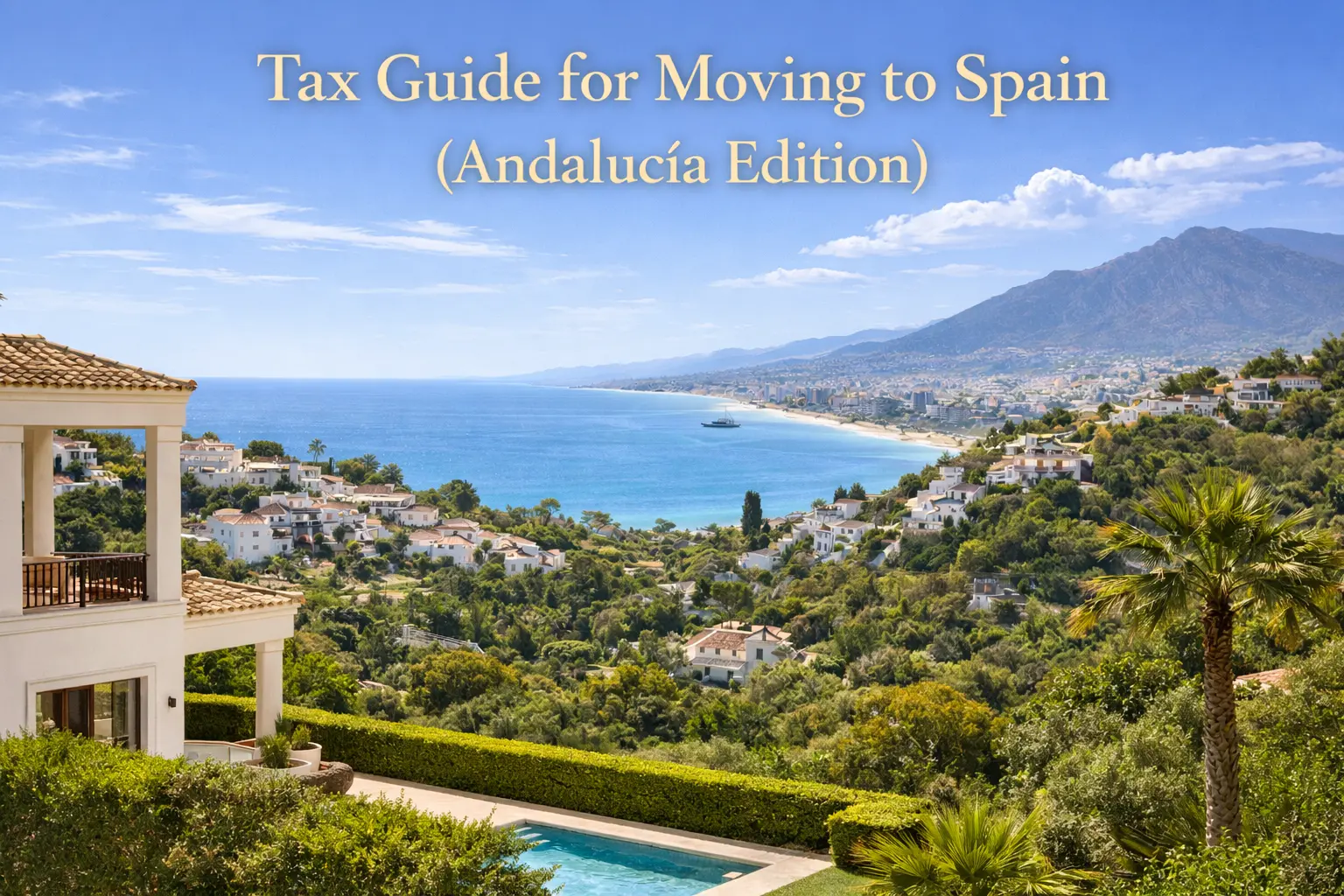
    Tax Guide for Moving to Spain (Andalucía Edition)

    A Refined Look at Property and Personal Tax on the Costa del Sol

    Benahavís property lifestyle Costa del Sol tax guide Spain

    Tax is often the quiet factor behind a relocation decision.

    Not the headline reason — but the one that determines whether a move feels sustainable over time.

    For many internationally mobile families considering Spain, the assumption is simple: lifestyle improves, but taxes rise. The reality, particularly in Andalucía, is more nuanced — and, in some cases, more favourable than expected.

    This guide focuses specifically on the Costa del Sol, with particular reference to Benahavís, where local tax levels remain notably competitive within the region.

    Costa del Sol relocation guide 2026


    Understanding the Spanish Tax Landscape

    Spain operates a layered tax system. There is national taxation, regional variation, and then local municipal taxes — each influencing the overall picture.

    For new residents, the most important distinction is between standard Spanish tax residency and special regimes such as the Digital Nomad / impatriate framework. The latter can significantly alter how income is treated, particularly in the early years of residency.

    However, regardless of structure, property ownership introduces a set of local taxes that are often more predictable — and, importantly, vary depending on where you buy.


    Buying Property in Andalucía

    For resale properties in Andalucía, the primary acquisition tax is the Transfer Tax (ITP), which is currently set at 7%.

    To this, buyers should add legal fees, notary and registry costs, which typically bring total purchase costs to approximately 10% of the purchase price.

    For new-build properties, the structure changes slightly. Instead of ITP, buyers pay VAT (IVA) at 10%, plus stamp duty (AJD), which is generally around 1.2% in Andalucía, alongside legal costs.

    These figures are consistent across the region — but what happens after purchase is where location begins to matter more.

    Buying on the Costa del Sol in 2026 as a foreigner


    Annual Property Taxes in Benahavís

    One of the lesser-known advantages of Benahavís is its relatively low ongoing property taxation compared to neighbouring municipalities.

    The annual council tax (IBI) is typically lower than in Marbella, despite many properties sharing similar values and positioning. This is due to historically lower cadastral values and municipal rates.

    Additionally, the local rubbish collection tax (basura) in Benahavís is notably modest — often in the region of approximately €18 per year for residential properties.

    While these figures may seem minor in isolation, over time they contribute to a noticeably lower cost of ownership, particularly for higher-value homes.

    This is an important distinction: two properties with similar purchase prices on the Costa del Sol can have meaningfully different annual holding costs depending on the municipality.

    In areas such as Marbella, for example, both IBI and local charges are generally higher.


    Income Tax: What Changes When You Move

    For those becoming tax resident in Spain, income tax is typically the most significant consideration.

    Spain applies a progressive income tax system, with combined state and regional rates that can exceed 45% at higher income levels. This is often the figure that creates hesitation among those relocating from low-tax jurisdictions.

    However, this does not always reflect the full picture.

    Under Spain’s special impatriate regime — commonly referred to as the Beckham regime — qualifying individuals may be taxed at a flat rate of 24% on employment income up to €600,000 for a fixed period.

    This framework can significantly alter the effective tax position during the initial years of residency, particularly for internationally mobile professionals and executives.

    It is not automatic, and it must be structured correctly, but it is one of the key reasons Spain has become increasingly attractive for relocation.

    Spain’s Digital Nomad Visa in 2026

    Spain Digital Nomad Visa requirements


    Wealth, Assets and Long-Term Planning

    Spain also applies a wealth tax framework, although Andalucía has effectively neutralised this through a 100% regional relief in most cases.

    In practical terms, this means that for many residents in Andalucía, wealth tax does not currently result in an additional payment — a notable advantage compared to other Spanish regions.

    However, tax planning remains essential. Structures, residency status and asset location all influence the final position.

    Inheritance tax is another area where Andalucía has introduced favourable reductions, particularly for close family members, making intergenerational planning more efficient than in the past.


    A Subtle but Important Advantage

    What becomes clear when looking at the Costa del Sol in detail is that not all locations are equal from a tax perspective.

    Benahavís stands out not because it is radically different — but because it is quietly more efficient.

    Lower municipal taxes, combined with the broader Andalucía framework, create a structure where ongoing ownership costs remain controlled, even for high-value properties.

    This is rarely the headline reason people choose where to live. But over time, it becomes one of the reasons they stay.


    Final Thought

    Relocating to Spain is often viewed through the lens of lifestyle — climate, scenery, pace of life. And rightly so.

    But the financial structure behind that lifestyle matters just as much.

    In Andalucía, and particularly in Benahavís, the balance between lifestyle and taxation is more favourable than many expect. It allows for a way of living that feels elevated, without unnecessary financial friction.

    And for those planning carefully, it creates a foundation that is not only enjoyable — but sustainable.


    Related Reading


    Important Note

    This article is provided for general information only and does not constitute tax or legal advice. Tax treatment depends on individual circumstances, residency status and structuring. Professional advice should always be sought before making decisions.

    [siteorigin_widget class=”WP_Widget_Custom_HTML”][/siteorigin_widget]
  • Beckham Law News 2026: Why Americans Are Moving to Spain

    Beckham Law News 2026: Why Americans Are Moving to Spain

    Why Americans Are Choosing Spain in 2026 — And the Real Story Behind the Beckham Law


    Beckham Law News in 2026 is shaping how Americans approach moving to Spain, blending tax strategy with lifestyle decisions

    Spain has always held a certain allure — climate, culture, and a lifestyle that feels both elevated and grounded. But in 2026, something more strategic is driving relocation decisions among high-net-worth Americans.

    It’s not just about where to live.

    It’s about how to live — and how to structure that life intelligently.

    At the centre of that shift is one of Spain’s most talked-about incentives: the Beckham Law.

    Luxury lifestyle in Marbella and Benahavís for Americans relocating to Spain in 2026

    A Growing American Presence in Spain

    The numbers tell a clear story.

    According to Spain’s National Statistics Institute, the number of US citizens living in Spain has risen sharply in recent years. That growth has helped turn Spain from a lifestyle aspiration into a serious relocation destination for internationally mobile professionals, entrepreneurs, investors, and families.

    However, the raw data only explains part of the trend.

    Behind it sits a more nuanced shift in priorities: stability, safety, quality of life, European mobility, and increasingly, tax efficiency as part of a broader relocation strategy.

    For many buyers and movers, Spain — and particularly areas such as Marbella and Benahavís — offers a rare combination of sophistication, lifestyle value, and long-term positioning.

    The Beckham Law — Still One of Europe’s Most Attractive Regimes

    Originally introduced in 2004 and popularised by David Beckham during his move to Real Madrid, the Beckham Law remains one of Spain’s most widely discussed fiscal incentives for new residents.

    In simple terms, the regime can allow qualifying individuals to pay a flat rate of tax on Spanish employment income rather than entering Spain’s normal progressive resident tax scale. For internationally mobile professionals, that can create a material difference in early-year planning.

    For many high earners, the appeal is obvious. Spain offers lifestyle, connectivity, and prestige, while the tax regime can offer a more efficient starting point than standard residency rules.

    Remote executive working from a luxury villa in Spain under the Beckham Law

    2026 Reality: It’s No Longer Just About Tax

    While the Beckham Law remains a powerful draw, it is no longer the only reason Americans are looking seriously at Spain.

    In practice, the tax regime now sits within a wider equation that includes remote work flexibility, a lower cost base than many major US cities, access to international education, private healthcare, security, and a more balanced pace of life.

    In other words, the Beckham Law is often the enabler, not the decision-maker.

    The actual move is usually driven by something deeper: a desire to live better, with greater freedom, in a place that still feels globally connected.

    Beckham Law News

    Beckham Law News has become one of the most closely watched parts of Spain’s relocation landscape in 2026.

    On one side, Spanish tax advisers and law firms have reported a notable increase in enquiries from American nationals, particularly among remote executives, entrepreneurs, investors, and internationally minded families. On the other, the regime has attracted intense headlines, criticism, and legal commentary that have made some potential movers pause.

    What matters is separating noise from substance.

    Despite negative press in some international publications, the underlying demand story remains strong. Interest has not disappeared. If anything, it has become more serious, more informed, and more professionally advised.

    The real shift in Beckham Law News is not that the regime is disappearing. It is that applicants now need to approach it with greater precision.

    Why the Headlines Have Turned Sharper

    Part of the recent controversy has come from criticism aimed at the way the regime is administered and interpreted in complex international cases. Some advisers have gone so far as to describe the system in highly negative terms, while Spain’s tax authorities have rejected those accusations forcefully.

    For high-net-worth Americans, the bigger point is this: complexity does not necessarily mean danger, but it does mean the structure must be handled properly.

    US trusts, retirement products, and legacy planning arrangements do not always sit neatly inside the Spanish tax framework. A structure that works well in the United States may need careful review before a move to Spain.

    That is where many of the so-called “grey areas” arise — not from the existence of the Beckham Law itself, but from the interaction between different legal and tax systems.

    Private tax planning meeting in Spain discussing Beckham Law news in 2026

    What Has Actually Changed?

    The most important development is not a dramatic rewrite of the regime, but a rise in scrutiny and sophistication.

    Applicants, particularly from the United States, are increasingly asking more detailed questions about qualification, tax exposure, remote work structures, shareholdings, retirement products, investment income, and wealth planning. Advisers, in turn, are having to work more carefully across jurisdictions.

    That is the real 2026 story.

    The Beckham Law still attracts international talent. It still offers meaningful advantages in the right circumstances. But it now sits inside a more mature, better understood, and more thoroughly reviewed relocation process.

    The Startups Law, Remote Work, and the New Buyer Profile

    Another reason the regime remains so relevant is its connection to Spain’s broader effort to attract international talent. Reforms linked to the Startups Law helped modernise Spain’s appeal to founders, remote workers, and globally mobile professionals.

    That has widened the conversation considerably. Today, Americans looking at Spain are not only retirees or second-home buyers. They are active earners, business builders, operators, creatives, and executives who want to remain internationally engaged while shifting their base to somewhere more liveable.

    However, one detail remains essential: qualification rules are specific. The Beckham Law is not a blanket solution for everyone moving to Spain, and structure matters enormously. That is especially true for digital nomads, entrepreneurs, and anyone balancing US obligations with European residency.

    Why Marbella and Benahavís Sit at the Heart of the Trend

    For Americans making a serious move, geography matters as much as tax.

    That is why the Marbella–Benahavís corridor continues to feature so prominently in high-value relocation conversations. It offers privacy, security, exceptional homes, international schools, golf, wellness, dining, and fast access to Málaga Airport. Just as importantly, it offers a setting that feels both discreet and world-class.

    In Benahavís, the appeal is especially clear. Buyers can access hillside villas, gated communities, sea-view apartments, and refined residential enclaves that feel separate from the noise, yet remain close to everything that matters.

    For many relocating Americans, property here is not simply a lifestyle purchase. It is part of a wider life design decision.

    Luxury property in Benahavís for Americans relocating to Spain

    The Reality Behind the Regime

    The Beckham Law is neither a shortcut nor a trap.

    It is a structured regime with clear potential benefits and equally clear requirements. For those who qualify and who prepare correctly, it can create meaningful tax efficiency during the early years of Spanish residence. For those who arrive with unsuitable structures or incomplete advice, the process can become far more complicated than expected.

    That is why the best outcomes tend to come not from reacting quickly, but from planning thoroughly.

    A More Strategic Type of Buyer

    There is a noticeable shift in the kind of buyer and mover arriving in Benahavís today.

    They are not simply chasing sunshine. They are thinking about residency, family lifestyle, school options, time, health, mobility, tax exposure, and the long-term quality of their day-to-day lives.

    They tend to be globally aware, financially sophisticated, and highly selective. They are not making emotional decisions in isolation. They are building an ecosystem around the move.

    In that context, the Beckham Law matters — but only as one part of a much larger picture.

    Final Thought: Why the Interest Keeps Rising

    Despite the tension in the headlines, the direction of travel remains remarkably clear. More Americans are considering Spain. More are exploring what the Beckham Law could mean for them. And more are looking beyond the obvious coastal clichés toward places that offer privacy, elegance, and real long-term value.

    That is why Benahavís, Marbella, and the wider Costa del Sol continue to stand out.

    For the right buyer, Spain offers something increasingly rare: a life that feels richer, calmer, and more intentional — without stepping away from opportunity.

    And in 2026, that combination has become one of the most compelling luxury relocation stories in Europe.

    FAQs: Beckham Law Spain 2026

    • What is the Beckham Law in Spain?
      A special tax regime allowing qualifying foreign residents to pay a flat tax rate on Spanish income instead of progressive worldwide taxation.
    • Is the Beckham Law still available in 2026?
      Yes, and demand is increasing, particularly among US nationals relocating to Spain for lifestyle and tax planning reasons.
    • Do digital nomads qualify for the Beckham Law?
      Some do, but eligibility depends on employment structure. Self-employed individuals often need alternative tax planning strategies.
    • Why are Americans moving to Marbella and Benahavís?
      These areas combine privacy, luxury real estate, international schools, and strong connectivity, making them ideal for high-net-worth relocation.
    • Is the Beckham Law risky?
      Not when structured correctly. However, US tax structures require careful alignment with Spanish regulations.

    Related Articles and Resources

     David Beckham Law News

    Looking for a home outside Benahavís?
    Holiday Homes Spain
    covers the whole Costa del Sol.

    [siteorigin_widget class=”WP_Widget_Custom_HTML”][/siteorigin_widget]
  • Health Insurance for Spain Non-Lucrative Visa

    Health Insurance for Spain Non-Lucrative Visa

    Health insurance for non lucrative visa Spain is one of the most important requirements to get right when applying for residency.

    What Kind of Health Insurance Qualifies for Spain’s Non-Lucrative Visa?


    If you are considering a move to Spain under the Non-Lucrative Visa, health insurance is one of the requirements that deserves close attention from the outset. It is not simply a formality tucked away in the paperwork. In many cases, the policy you choose can shape the success of the application itself. For anyone still comparing residency routes, our guide to Spain visa options is a useful place to begin.

    A retired couple apply for health insurance for the non-lucrative visa in Spain

    Health insurance is a core requirement for Spain’s Non-Lucrative Visa application.

    The Non-Lucrative Visa, often described as Spain’s retirement visa, remains one of the main residence routes for non-EU nationals who want to spend meaningful time in Spain without taking up employment here. It is especially relevant for retirees, second-home owners and lifestyle buyers planning a longer-term move to Benahavís, Marbella and the wider Costa del Sol.

    Why health insurance matters for the Non-Lucrative Visa

    Spain’s public healthcare system is excellent, but access is tied to the social security system. Because the Non-Lucrative Visa does not permit you to work in Spain, or remotely for an overseas employer under the normal NLV rules, the authorities want reassurance that you will not become dependent on public healthcare after arrival.

    That is why private health insurance is not an afterthought. It sits alongside proof of financial means, background checks and the other core requirements of the application. If you are preparing the wider residency process at the same time, you may also find our guide to residency and NIE essentials helpful.

    Not every policy will be accepted

    This is where many applicants encounter confusion. A general international policy, or travel insurance with some healthcare cover attached, may sound reassuring on paper, but it is usually not enough for Spain’s Non-Lucrative Visa.

    The policy must be comprehensive private health insurance issued by an insurer authorised to operate in Spain. It must provide real medical cover rather than temporary travel protection, and it should offer a level of access comparable to Spain’s public healthcare system. A similar principle also applies to Spain’s Digital Nomad Visa, although in some cases health cover may be evidenced differently where there is an applicable social security arrangement in place.

    What the policy needs to include

    For the Non-Lucrative Visa, the cover should normally run for a full year, matching the length of the initial visa. It should apply to all beneficiaries included in the application and be written without the gaps that are common in many standard private policies.

    In practical terms, this means no co-payments, no deductibles, no serious limits on essential treatment and, ideally, no waiting periods for core services. When reviewing Spanish policies, two expressions are especially important: sin copagos and sin carencias. These indicate that the policy is structured without co-payments and without waiting periods, both of which are central to what Spanish consulates typically expect.

    The cover should extend across primary care, specialist consultations, hospital treatment, surgery, diagnostic testing and out-of-hospital care. In short, it needs to feel like proper healthcare, not emergency assistance dressed up as a medical policy.

    Spain non-lucrative visa health insurance documents on table with coastal backdrop

    A common source of confusion for applicants

    One reason this requirement causes so much uncertainty is that insurers often offer several tiers of cover. Some are designed for residents and visa applicants. Others are lighter products with co-payments, exclusions or waiting periods built in. They may sound similar in conversation, but they are not treated equally for immigration purposes.

    That is why it is wise to tell the insurer from the start that you are applying for Spain’s Non-Lucrative Visa. Most established providers understand the process and can point you toward the plans most commonly used for residency applications. Among the best-known names are Sanitas, Adeslas, Asisa, ASSSA and DKV. Each offers different levels of cover, so it is the policy wording, not simply the brand name, that matters most.

    Pre-existing conditions and older applicants

    For older applicants, or those with a more complex medical history, the process can become more nuanced. Insurers will usually ask for details of current health issues, previous diagnoses, operations and medication. In some cases, a doctor will review the file or request a call before deciding what terms can be offered.

    Some applicants are accepted smoothly. Others may be offered a policy with exclusions for certain conditions or areas of treatment. Whether that is acceptable for visa purposes can depend on the individual case and on how the application is assessed. For that reason, arranging cover early is often the more comfortable approach.

    What private health insurance typically costs

    Premiums vary according to age, health profile and insurer, but many applicants find the cost relatively manageable by international standards. Younger applicants may find policies at the lower end of the range, while those of retirement age will typically pay more for full cover.

    As a broad guide, monthly premiums often sit somewhere between around €50 and €160, with older applicants generally toward the upper end of that range. It is also common for consulates to ask for proof that the first year has been paid in full, rather than simply arranged by monthly instalments. That helps demonstrate the insurance will remain active for the whole initial visa period.

    For buyers planning a longer relocation rather than only the visa process, it is often sensible to think about healthcare alongside the practicalities of the move itself, from residency paperwork to legal costs and ownership planning. Our articles on the buying process in Spain and purchase costs in Andalucía can help place those decisions in a broader context.

    Why this detail deserves proper attention

    For many people planning a move to Spain, health insurance feels like a technical requirement hidden inside a much bigger lifestyle decision. Yet it is one of the points where precision matters most. A policy that appears perfectly reasonable at first glance may still fall short of what the authorities expect.

    Choosing the right cover from the outset can make the application process far more straightforward. More importantly, it gives you confidence as you prepare for a new chapter in Spain, whether that means retirement in the sun, more time with family, or a slower and more rewarding way of living on the Costa del Sol.

    At Benahavís Collection, we always recommend confirming the latest visa and insurance requirements with your consulate, immigration adviser or legal representative before submitting an application, as interpretation can vary slightly depending on the route and the applicant’s circumstances.

    Health insurance for non lucrative visa Spain

    [siteorigin_widget class=”WP_Widget_Custom_HTML”][/siteorigin_widget]
  • How Much Does It Cost to Build a Villa on the Costa del Sol?

    How Much Does It Cost to Build a Villa on the Costa del Sol?

    How Much Does It Cost to Build a Villa on the Costa del Sol?


    Modern villa construction on the Costa del Sol in the Benahavís hills

    If you’re looking at building plots in areas like La Zagaleta, Marbella Club Golf Resort, Monte Mayor or Real de La Quinta, you’ll quickly discover a simple truth: the plot is only the starting point.

    The build cost itself can be surprisingly variable — not because builders are vague, but because “a villa” can mean anything from a straightforward Mediterranean home to a highly engineered, glass-heavy, basement-rich modern statement with lifts, wellness areas and complex retaining walls.

    This guide breaks down the real-world numbers buyers need: a realistic cost-per-m² range, the “hidden” soft costs (architects, licences, engineers), and a practical way to budget so you don’t get caught by unpleasant surprises mid-project.

    1) The headline number: build cost per m²

    As a broad benchmark for coastal Spain, reputable market commentary commonly places construction cost ranges around €1,500–€3,000 per m², depending on quality, location and complexity. That’s a useful starting point, but it’s only the start.

    On the Costa del Sol (and especially in the Benahavís/Marbella prime belt), many “dream villa” builds sit toward the upper end because of: hillside sites, sea-view orientation, large basements, high-spec glazing, bespoke stonework, smart-home systems, and landscaping that’s designed like a boutique hotel.

    Architectural studios focused on Marbella luxury often quote luxury builds in the €1,400–€2,500+/m² range depending on specification and complexity.

    A practical buyer-friendly way to think about it:

    • Good quality villa: often starts around €2,000/m²+ (and can rise quickly with specification).
    • Contemporary prime/luxury villa: commonly budgets at €2,500–€3,500/m²+
    • Architectural “statement” villa: €4,000/m²+ is not unusual once complexity and premium finishes stack up

    Important detail: people often quote cost per m² using “built area”, but your lifestyle features (pool, terraces, landscaping, retaining walls, access roads) can add very significant budget outside that simple number.

    2) The costs buyers forget: “soft costs” and professional fees

    In Spain, building a villa is a regulated process. You don’t just hire a contractor; you assemble a professional team and work through licensing. Your soft costs will vary, but it’s common for them to land in the 10–20%+ range of build cost depending on what’s included.

    Typical items include:

    • Architect (proyecto + design leadership)
    • Architect Técnico / Quantity Surveyor (dirección de ejecución) — a formal role in Spanish builds
    • Geotechnical study (critical on hillside plots)
    • Topographical survey (site boundaries, levels, access)
    • Structural engineer (often integrated via the architect)
    • Health & Safety coordination (required)
    • OCT / quality control + decennial insurance (typically required for certain builds/sales scenarios)

    You’ll also see administrative “visado” (professional validation/filing) costs via local professional colleges as part of the process.

    3) Licences, taxes and municipal charges

    Every municipality has its own process and fee structure, but in general you should expect a combination of: urban planning/works licence fees and the municipal construction tax called ICIO.

    For context, Marbella’s own information pages explain that urban licence fees and ICIO are handled through municipal tax management procedures (and you’ll receive a payment document as part of the process).

    As a rule of thumb, many buyers budget municipal costs as a percentage of the official construction budget (often referred to as PEM). A commonly cited example for Marbella is ICIO at 4% of PEM plus an additional urban services/processing fee that can be around the low single digits. (Always confirm with the relevant town hall for your plot.)

    If you’re building in Benahavís municipality, you’ll also follow the town hall’s “obra mayor” (major works) licence requirements and documentation process.

    4) VAT: don’t guess — it depends on the type of work

    VAT treatment trips people up. The Spanish Tax Agency explains that, as a general rule, works are taxed at the standard rate, with a reduced rate applying in specific scenarios — including certain construction/rehabilitation works on buildings intended mainly for housing.

    In practice, your VAT position depends on the structure of the project, who contracts whom, and the precise classification of the works. This is one of the areas where a good architect/gestor and an independent lawyer save real money, because “small misunderstandings” here become expensive.

    5) The real budget structure: a simple way to avoid surprises

    When buyers run into trouble, it’s often because they budget only the “build” and forget the rest. A more reliable framework is:

    • A) Construction (the building itself) — your €/m² number
    • B) Site & external works — excavation, retaining walls, access roads, drainage, gardens
    • C) Professional team — architect, técnico, surveys, studies
    • D) Licensing & municipal taxes — licence fees + ICIO
    • E) Fit-out & lifestyle extras — kitchens, wardrobes, lighting, home automation, spa/gym, cinema
    • F) Furniture & styling — optional, but common in this market
    • G) Contingency — the most underestimated line

    If you want one strong rule: keep a 10–15% contingency for a straightforward build and consider 15–20%+ for complex hillside or basement-heavy designs.

    On steep plots, the unknowns are usually ground conditions, retaining requirements and service routing — not the tiles.

    6) Timeline: how long does it actually take?

    Buyers often assume “one year.” In reality, many villa builds take longer because the timeline includes two phases: pre-construction (design + licensing) and construction (build + completion paperwork).

    A sensible expectation for a custom villa is often:

    • Design + permitting: several months (sometimes longer, depending on municipality and complexity)
    • Construction: commonly 12–18 months for a substantial villa; complex projects can extend beyond that

    The best way to protect timeline is to do the “boring” work early: full surveys, clear scope, realistic specification, and a contract structure that matches the build style (fixed price vs managed build).

    7) Buying a finished villa vs building: when does building make sense?

    Building makes the most sense when you care deeply about the end result — layout, orientation, privacy, sustainability, smart-home, wellness features — and you’re prepared to manage time and decision-making.

    Buying an existing villa often wins on speed and certainty. Building wins on personalisation — and sometimes on value, if you secure an exceptional plot and execute the project well.
    In prime areas where plots are scarce, a well-designed new build can stand out strongly in the resale market.

    8) A quick “starter budget” example

    Let’s keep this simple and realistic. Imagine a 400 m² contemporary villa (plus terraces/pool/landscaping) on a hillside plot:

    If construction is budgeted in a prime range (say €2,500–€3,500/m²), the building cost alone is roughly €1.0M–€1.4M before you add: external works, professional fees, municipal charges, interior fit-out upgrades, and contingency.

    That’s why two “similar size” villas can end up with very different total project budgets — the plot and the specification drive the outcome.

    9) Our practical advice (the short version)

    • Do a proper feasibility review before you fall in love with a plot.
    • Budget external works early — especially on hillside sites.
    • Get clarity on licensing steps with the correct municipality (Marbella vs Benahavís vs Estepona matters).
    • Don’t treat VAT and municipal charges as “minor lines”. Confirm them properly.
    • Protect yourself with scope clarity, staged payments, and a realistic contingency.

    If you’re considering a building plot in La Zagaleta, Marbella Club Golf Resort, Monte Mayor or Real de La Quinta, tell us what you want to build (style, size, features, timeline) and we’ll help you sanity-check the numbers and the feasibility before you commit.

    Alternatively, you can view some of the residential plots we currently have for sale here →

    [siteorigin_widget class=”WP_Widget_Custom_HTML”][/siteorigin_widget]
  • Visa, Residency & Citizenship Changes in Spain 2026

    Visa, Residency & Citizenship Changes in Spain 2026

    Spain visa changes 2026

    Visa, Residency and Citizenship Changes in Spain in 2026


    Spain remains one of Europe’s most appealing destinations for relocation — whether you’re seeking a better lifestyle, a base in the EU, or a long-term property plan on the Costa del Sol.

    Heading into 2026, several updates to visas, residency documents and citizenship processes are coming into focus. Some are administrative, others affect budgets and timelines — and a few may influence how you enter Spain for the first time.

    This guide focuses on what’s most relevant for US, Canadian and British citizens considering a move to Spain, especially those planning to live in or around Benahavís, Marbella and the wider Costa del Sol.

    Costa del Sol panoramic lifestyle view near Benahavís

    Non-Lucrative Visa (NLV): financial requirements likely to remain stable

    For many British, American and Canadian citizens planning early retirement or a lifestyle-led move, the Non-Lucrative Visa (NLV) continues to be one of the most common routes to Spanish residency. The encouraging news for 2026 is that the financial threshold is expected to remain unchanged.

    The NLV requirement is linked to Spain’s IPREM index. At present, applicants must show savings or passive income equivalent to 400% of IPREM for the main applicant — commonly cited as €28,800 per year — with additional amounts for dependants. Spain’s General State Budget, which influences IPREM updates, has faced repeated delays, so the IPREM figure is widely expected to remain frozen into 2026.

    If the NLV is on your shortlist, it’s still worth planning early — not because the thresholds are changing, but because consular timelines, document gathering and appointment availability can be the real bottleneck.

    Related reading: Visa options for moving to Spain

    Digital Nomad Visa (DNV): income threshold likely to increase

    Spain’s Digital Nomad Visa has become a popular route for remote workers and location-independent professionals, particularly from the US and Canada. Unlike the NLV, the DNV income threshold isn’t linked to IPREM — it’s connected to Spain’s minimum wage (SMI).

    The Spanish government has indicated that the minimum wage may rise again early in 2026. If a proposed increase to €1,446.66 gross per month is approved, and applicants must show 200% of that figure, the threshold would move to roughly €2,893 per month, up from about €2,763.

    The increase is not dramatic, but it matters if you’re close to the margin — especially for freelancers, contractors or founders whose income fluctuates. If you’re planning to apply, build in a buffer and keep your documentation tidy: clear contracts, consistent invoices and bank statements can make the process far smoother.

    For some remote workers, tax planning is just as important as visa eligibility. If that’s part of your decision-making, see our guide to Beckham Law News in Spain in 2026, which looks at how high-earning professionals and internationally mobile Americans are approaching Spain this year.

    Related reading: Visa options for moving to Spain

    Remote workers and digital nomads considering a move to Spain

    Citizenship: a surge of new Spaniards via the “Grandchildren’s Law”

    One of the biggest under-the-radar shifts going into 2026 is the impact of Spain’s so-called “Grandchildren’s Law”.

    This pathway allows children and grandchildren of Spaniards who lost or renounced nationality, often due to political exile, to reclaim Spanish citizenship.

    Although the application deadline ended in October 2025, many successful applicants are expected to complete processing and relocate in 2026. This doesn’t directly apply to most US, Canadian or British citizens, but it can still affect you indirectly: increased volume puts pressure on administrative systems, potentially influencing wait times for appointments, civil registries and immigration processing in high-demand provinces.

    British citizens: more permanent TIE renewals in 2026

    For UK nationals living in Spain under the Withdrawal Agreement, 2026 will be another busy year for upgrading residency documents. Those who were issued temporary WA TIE cards in 2021 will become eligible to switch to permanent WA TIE cards during 2026.

    The most common challenge remains the cita previa appointment, especially in locations with high foreign populations. In practice, the “rule change” isn’t the issue — it’s access to appointments and getting everything lined up correctly.

    It’s also worth noting that a significant number of British residents still rely on the old green EU certificates. Both British and Spanish authorities have repeatedly advised switching to a biometric TIE to avoid friction with banks, notaries and public offices.

    Related reading: Legal & Residency resources

    More foreign residents in Spain — and more applications

    Spain’s appeal to international residents shows no signs of slowing.

    Recent migration data indicates that the number of foreign residents with permits grew in 2025, and applications for work and residency permits rose sharply following immigration reforms.

    The bigger picture is simple: Spain has an ageing population and a low birth rate, so inward migration supports the workforce and the pension system. That reality continues to influence policy, even while immigration becomes a more polarising topic across Europe.

    ETIAS: the visa-waiver system expected towards the end of 2026

    The long-discussed ETIAS travel authorisation is now expected to be introduced towards the end of 2026. ETIAS will apply to visa-free visitors from countries including the UK, US and Canada.

    In practical terms, travellers will complete an online form before visiting Spain or other Schengen countries and pay a fee, commonly cited at €20. Once approved, ETIAS is expected to be valid for three years, or until your passport expires, covering multiple short visits.

    While ETIAS is aimed at tourists, it matters for future residents too. Many people “test” Spain first with a short stay before deciding on a longer move, and some visa routes are sensitive to entry and exit timing.

    If you’re planning a 2026 move, keep ETIAS on your radar — especially for late-year travel.

    Spain residency, planning and financial preparation for a move in 2026

    Spanish citizenship exams: a small cost increase

    If you’re planning to apply for Spanish citizenship after long-term legal residency, commonly 10 years for most nationalities, you’ll likely need to pass two exams: the CCSE cultural and constitutional knowledge test and the DELE A2 language exam where applicable.

    In 2026, the DELE A2 registration fee is expected to rise slightly, from €134 to €138. It’s a small increase, but it reflects a wider pattern: administrative costs rarely go down, so it’s wise to budget conservatively for the full citizenship process.

    Could Spain adopt tougher migration measures?

    Across the EU there has been a visible shift towards tougher migration policies, including proposals for external “return hubs” and stricter enforcement for failed asylum claims. Spain has taken a more pragmatic stance so far, largely because the economy benefits from a steady inflow of workers.

    However, migration is increasingly political across Europe, and Spain is not immune to that pressure. If the domestic political landscape changes, policy tone could shift too. For most readers considering legal routes like the NLV or DNV, the key takeaway is to plan early and keep your documentation robust — those two habits solve more problems than trying to predict political headlines.


    Planning a move to Spain in 2026?

    Visa rules are only one part of the relocation puzzle. Property selection, purchase costs, tax planning and lifestyle considerations also play a major role — particularly for overseas buyers.

    If you’re relocating to the Costa del Sol, it’s helpful to understand the full sequence: research, budgeting, viewing trips, the offer process, and legal completion.

    For higher earners and internationally mobile professionals, tax structure may also be part of the discussion. Our guide to Beckham Law News 2026 explains why the regime is attracting renewed attention from Americans moving to Spain.

    You may also find these guides helpful:

    Benahavís village square at dusk on the Costa del Sol

    Looking for a home outside Benahavís?
    Holiday Homes Spain
    covers the whole Costa del Sol.

    [siteorigin_widget class=”WP_Widget_Custom_HTML”][/siteorigin_widget]
  • Spain Digital Nomad Visa vs Other Countries (2026)

    Spain Digital Nomad Visa vs Other Countries (2026)

    Spain’s Digital Nomad Visa vs Other Countries


    Spain is not the only country offering a digital nomad visa, but it has quickly become one of the most talked-about options in Europe. For many applicants, the decision is not simply about eligibility — it is about lifestyle, long-term security, tax clarity and ease of relocation.

    In this guide, we compare Spain’s Digital Nomad Visa with other leading European programmes to help you understand where it stands — and whether it is the right fit for your plans in 2026 and beyond.

    Related reads:

    Spain vs Portugal

    Portugal has long been one of the most popular destinations for digital nomads, particularly due to its lifestyle appeal and established expat communities. However, recent changes have shifted the balance slightly.

    Portugal’s digital nomad pathways typically require higher minimum income levels and, importantly, the removal of the well-known Non-Habitual Resident (NHR) tax regime has reduced its tax advantage for new applicants.

    Spain, by comparison, offers a clearer framework under its Digital Nomad Visa. The application process is generally more structured, with defined income thresholds and a faster turnaround when handled correctly. Moreover, Spain’s tax regime for eligible applicants can provide a competitive flat-rate structure, offering greater predictability.

    In lifestyle terms, both countries perform strongly. However, Spain’s broader infrastructure — particularly in regions like the Costa del Sol — often appeals to those seeking international schools, healthcare access, and year-round connectivity.

    Spain vs Greece & Italy

    Greece and Italy both offer digital nomad visas, but they tend to involve more administrative complexity. Application processes can be slower, and requirements are sometimes interpreted differently depending on the region or consulate.

    While both countries offer exceptional lifestyle appeal — from Mediterranean coastlines to cultural heritage — they can be less predictable in terms of immigration timelines and long-term planning.

    Spain benefits from a more modernised and centralised approach. Its Digital Nomad Visa was introduced as part of a broader strategy to attract international professionals, which means supporting services — legal, tax, relocation — are already well established.

    For applicants prioritising clarity and efficiency, Spain often emerges as the more straightforward choice.

    Spain vs Other European Options (Estonia, Croatia, Malta)

    Countries such as Estonia, Croatia and Malta were early adopters of digital nomad visas and remain attractive for short-term stays. Estonia, in particular, is known for its digital-first infrastructure, while Croatia offers a relaxed lifestyle with relatively simple entry requirements.

    However, these programmes are often designed for temporary residency rather than long-term settlement. Renewal pathways can be limited, and integration into the local system — including tax residency — is not always as seamless.

    Spain stands out for those looking beyond a short stay. Its visa allows for longer-term planning, potential residency progression, and a clearer route to establishing a base in Europe.

    Lifestyle Comparison: Why Spain Stands Out

    Beyond visa mechanics, lifestyle plays a defining role in choosing a destination. Spain consistently ranks highly due to its climate, healthcare system, connectivity and overall quality of life.

    Areas such as Marbella and Benahavís offer a particularly compelling balance — combining international infrastructure with a relaxed Mediterranean lifestyle. This is especially relevant for families or professionals planning to relocate for several years rather than a short-term stay.

    Additionally, Spain’s accessibility — with major international airports and strong transport links — makes it easier to maintain global business connections.

    Who Spain’s Digital Nomad Visa suits best

    • Remote employees working for established international companies
    • Freelancers with consistent, recurring income streams
    • Entrepreneurs seeking a European base with long-term potential
    • Families looking for stability, schooling and healthcare access
    • Applicants planning to stay for multiple years rather than short-term travel

    In particular, Spain appeals to those who want a structured and predictable relocation pathway, rather than a temporary or experimental move.

    Key takeaway: Spain’s Digital Nomad Visa offers one of Europe’s most balanced propositions — combining lifestyle, legal clarity and long-term planning potential. While other countries may suit short stays or niche profiles, Spain consistently stands out for professionals seeking a stable base in Europe.

    Digital Nomad Visa Comparison Table

    The table below offers a practical comparison of some of Europe’s best-known digital nomad and remote worker routes. Rules, thresholds and processing can change, so applicants should always confirm the latest position with the relevant consulate or official authority before applying.

    Country Route Income Guide Initial Stay Who It Suits Main Watch-Out
    Spain Digital Nomad Visa / International Teleworking Often presented as one of Europe’s more accessible professional thresholds 1 year visa, with longer in-country residence options Remote employees, freelancers and applicants planning a longer European base Documentation must be well prepared; Spanish-source work is limited
    Portugal D8 Digital Nomad Visa Generally higher income threshold than Spain Can support temporary stay or residency route depending on application Applicants who prioritise Lisbon, Porto or Portugal’s established expat scene Tax and residency planning needs careful review following recent rule changes
    Greece Digital Nomad Visa €3,500 net per month for the main applicant Up to 1 year, with residence permit route for longer stays Remote workers focused on Mediterranean lifestyle and a lower-cost base You cannot work for a Greek employer during the visa period
    Italy Digital Nomad / Remote Worker Visa Around €28,000 annual income guide 1 year, renewable Highly skilled remote professionals wanting an Italy base Italy’s route is more selective and specifically geared to highly specialised workers
    Estonia Digital Nomad Visa €4,500 gross per month Up to 1 year Tech-focused nomads who value digital infrastructure and clarity Climate and lifestyle may be less appealing for applicants prioritising year-round warmth
    Croatia Temporary Stay of Digital Nomads Proof of sufficient means required under Croatia’s official formula Up to 18 months Applicants wanting a relatively straightforward lifestyle-based temporary stay It is a temporary-stay route rather than the strongest long-term residency platform

    In simple terms, Spain stands out for balance. Portugal remains attractive but often asks more financially. Greece offers a clear Mediterranean alternative. Italy is appealing but more selective. Estonia is excellent for digital systems, while Croatia suits applicants looking for a simpler temporary lifestyle move.

    [siteorigin_widget class=”WP_Widget_Custom_HTML”][/siteorigin_widget]
  • Is Spain’s Digital Nomad Visa Income Gross or Net?

    Is Spain’s Digital Nomad Visa Income Gross or Net?

    Is Spain’s Digital Nomad Visa Income Requirement Gross or Net?


    One of the most common questions from Digital Nomad Visa applicants is whether Spain’s income requirement refers to
    gross income or net (after-tax) income. The distinction matters — and misunderstandings can delay approvals.


    Related reads:

    What Spanish authorities look at

    In practice, Spain’s immigration authorities assess gross income. The key question is whether your
    earnings — before personal tax — meet or exceed the required threshold.

    This approach aligns with how income is defined in contracts, invoices and payslips, which are the primary documents
    used during DNV assessment.

    Employees vs self-employed applicants

    • Remote employees: employment contract + payslips showing gross salary
    • Freelancers/self-employed: invoices, client contracts and bank statements

    For freelancers, authorities often look for consistency across documents rather than a single high-income month.

    Common mistakes to avoid

    • Using net income after personal tax deductions
    • Failing to convert foreign currency into euros clearly
    • Submitting irregular or incomplete invoices
    • Relying on future income projections instead of proven earnings
    Key takeaway: Spain’s Digital Nomad Visa income requirement is assessed using gross income.
    Clear, consistent documentation matters more than headline figures.
  • Where Are Spain’s Digital Nomad Visa Holders From?

    Where Are Spain’s Digital Nomad Visa Holders From?

    Where Are Spain’s Digital Nomad Visa Holders From?


    Since its introduction in 2023, Spain’s Digital Nomad Visa (DNV) has attracted thousands of remote professionals.
    While the programme is open to non-EU nationals worldwide, certain nationalities consistently dominate application numbers.


    Related reads:

    Top nationalities applying for Spain’s DNV

    Based on official releases, press briefings and regional immigration data, the majority of Digital Nomad Visa holders
    typically come from:

    • United States — tech, consulting and remote corporate roles
    • United Kingdom — post-Brexit demand for EU residency options
    • Canada — freelancers and remote employees seeking lifestyle mobility
    • Argentina & Latin America — Spanish language advantage and family ties
    • Australia & New Zealand — long-term remote professionals

    Why these countries dominate

    Several factors explain why applicants from these regions are particularly common:

    • Strong remote-work cultures and high digital employment penetration
    • Favourable time-zone overlap with Europe
    • Higher average salaries that comfortably meet DNV income thresholds
    • Existing cultural, linguistic or historical ties to Spain

    Does nationality affect approval chances?

    In principle, nationality does not affect eligibility. Applications are assessed on documentation, income stability and compliance with visa criteria — not passport ranking.

    However, applicants from countries with clear banking systems, standardised employment contracts and easily verifiable income sources may find the process smoother.

    Key takeaway: Spain’s Digital Nomad Visa attracts a global audience, but applicants from the U.S., UK, Canada and Latin America currently make up a large share due to income levels, remote work norms and lifestyle appeal.
  • Spain Digital Nomad Visa Income Requirement 2026 Explained

    Spain Digital Nomad Visa Income Requirement 2026 Explained

    [siteorigin_widget class=”WP_Widget_Custom_HTML”][/siteorigin_widget]

    If you’re planning your move this year, Spain DNV income 2026 is one of the first numbers to understand — because the Digital Nomad Visa threshold is linked to Spain’s minimum wage (SMI). In plain terms, when SMI increases, the income requirement usually moves with it. That’s why we built the calculator on this page: it lets you model realistic 2026 scenarios, add a partner or children, and include a buffer if you’re paid in USD, CAD or GBP.

    For a broader overview of visas and next steps, see our Visa options guide and our Moving to Spain in 2026 article. If your plan includes buying a home on the Costa del Sol, our Purchase costs in Andalucía guide is a helpful companion.

    We keep the figures updated, but always verify the latest official SMI before you submit. The BOE is the definitive source for legal updates, and the European Central Bank is useful for reference exchange rates.

    Use the calculator above to estimate the monthly income you’ll likely need for your application.

    [siteorigin_widget class=”WP_Widget_Custom_HTML”][/siteorigin_widget]