Category: Home Buying Tips

  • 95% Mortgages in Spain for Under-35s in 2026

    95% Mortgages in Spain for Under-35s in 2026

    Young couple buying property in Spain with mortgage approval Costa del Sol

    95% Mortgages in Spain for Under-35s: What Buyers Need to Know in 2026

    For many buyers on the Costa del Sol, the challenge has never been the monthly mortgage payment — it’s the deposit. Saving 20–30% upfront, on top of taxes and purchase costs, has kept homeownership just out of reach for a large number of younger residents.

    Now, that’s starting to change.

    Across Spain — and increasingly here in Andalucía — banks are offering 95% loan-to-value (LTV) mortgages aimed at buyers under 35. Often referred to as “youth mortgages” (hipoteca joven), these products are designed to reduce the upfront barrier and help younger residents step onto the property ladder sooner.

    However, as with most things in the Spanish property market, the detail matters. Eligibility depends not just on age, but on residency status, income structure, and in some cases, regional support schemes.

    What Is a 95% Mortgage in Spain?

    A 95% mortgage allows a buyer to finance up to 95% of the property’s value, meaning only a 5% deposit is required. This is a notable shift from the traditional Spanish lending model, where banks typically offer 70–80% to residents and 60–70% to non-residents.

    That said, it’s important to look beyond the headline. Even with 95% financing, buyers still need to cover taxes and associated costs.

    In reality, most buyers should still budget around 10–12% of the purchase price in available funds to complete comfortably.

    Why These Mortgages Are Now Available

    This shift reflects both market pressures and policy changes.

    Property prices — particularly in areas such as Marbella, Estepona, and Benahavís — have risen steadily, while saving for a deposit has become increasingly difficult. At the same time, regional governments, including Andalucía, have introduced guarantee schemes that help reduce the risk for banks when lending above 80%.

    For lenders, it’s also a long-term strategy. Younger buyers represent stable, long-duration clients — and offering higher LTV products is a way to bring them into the market earlier.

    Which Banks Offer 95% Mortgages?

    Several major Spanish banks now offer youth-focused mortgage products, although terms vary depending on the applicant profile and region.

    Santander (Hipoteca Joven) offers up to 95% financing for eligible buyers under 35, typically with terms of up to 30 years and lending based on the lower of purchase price or valuation.

    BBVA (Hipoteca Joven) is often one of the more competitive options. In some cases, BBVA covers notary, registry, and administrative costs, which can reduce the upfront cash requirement — although this depends on the specific application.

    Other lenders, including CaixaBank and regional banks, also participate — particularly where government-backed guarantee schemes are in place.

    Who Actually Qualifies?

    This is where clarity is essential.

    These mortgages are not limited to Spanish nationals — but they are primarily designed for residents in Spain buying a primary residence.

    Typical criteria include:

    – Under 35 (sometimes under 36 depending on the bank)
    – Legal residency in Spain (NIE + residency status)
    – Stable, provable income within Spain
    – Purchase of a primary residence
    – Often first-time buyers (or not owning another property)

    By contrast, non-resident buyers — including overseas investors — are generally limited to 60–70% financing.

    Can Foreign Buyers Get a 95% Mortgage in Spain?

    This is one of the most important questions — especially on the Costa del Sol, where many buyers are international.

    The short answer is: yes, but only if you are a resident in Spain.

    Banks do not require Spanish citizenship. However, they do require that you are legally resident and financially integrated into the Spanish system. In practical terms, that means:

    – Holding a valid residency permit (including EU residency or qualifying visas)
    – Having a Spanish NIE number
    – Earning income that can be verified and taxed in Spain
    – Demonstrating financial stability through Spanish bank statements and tax returns

    For residents living on the Costa del Sol — whether Spanish or international — this opens up real opportunities. However, for buyers based abroad, 95% mortgages are not currently an option.

    What About Digital Nomad Visa Holders?

    Digital nomad visa holders sit somewhere in between.

    As legal residents, they can qualify in principle. However, approval depends heavily on how their income is structured.

    Banks are generally more comfortable when income is:

    – Paid in euros
    – Supported by Spanish tax declarations
    – Stable and contractually consistent

    If income is earned from overseas clients or employers, some lenders may apply stricter criteria or reduce the loan-to-value offered.

    That said, this is evolving — and certain banks are becoming more flexible as remote work becomes more established.

    What Costs Do Buyers Still Need to Cover?

    Even with a 95% mortgage, there are still upfront costs to plan for.

    These typically include:

    – The remaining 5% deposit
    – Property transfer tax (ITP) on resales (7% in Andalucía)
    – VAT (IVA) on new builds (10%) plus stamp duty (AJD)
    – Notary, registry, and legal fees
    – Property valuation (tasación)

    As a guide, buyers should still expect to contribute around 10–12% of the purchase price in total.

    Why This Matters for Buyers on the Costa del Sol

    In areas such as Benahavís, Marbella, and Estepona, where prices have risen steadily, reducing the deposit requirement from 30% to 5% can make a meaningful difference.

    For younger residents already living and working locally, this can accelerate the move from renting to ownership by several years — particularly at entry-level and mid-market price points.

    It also reflects a broader shift in the market, with more international residents choosing to settle long-term rather than remain purely lifestyle buyers.

    Final Thoughts

    95% mortgages in Spain are not universal — and they are not available to everyone. However, for the right buyer profile, they represent one of the most important shifts in the Spanish property market in recent years.

    If you are under 35, resident on the Costa del Sol, and considering buying your first home, this is an opportunity worth exploring carefully.

    As always, the key is understanding the detail — and structuring your purchase correctly from the outset.

    Related Guides & Next Steps

    If you’re considering buying property in Spain — especially as a resident on the Costa del Sol — these guides will help you understand the full picture before making a decision:

    95% Mortgages in Spain for Under-35s in 2026

    Looking outside of Benahavís?
    holiday-homes-spain.com
    website covers the whole Costa del Sol.
    [siteorigin_widget class=”WP_Widget_Custom_HTML”][/siteorigin_widget]
  • Why Property in Spain Just Got Cheaper for North Americans

    Why Property in Spain Just Got Cheaper for North Americans

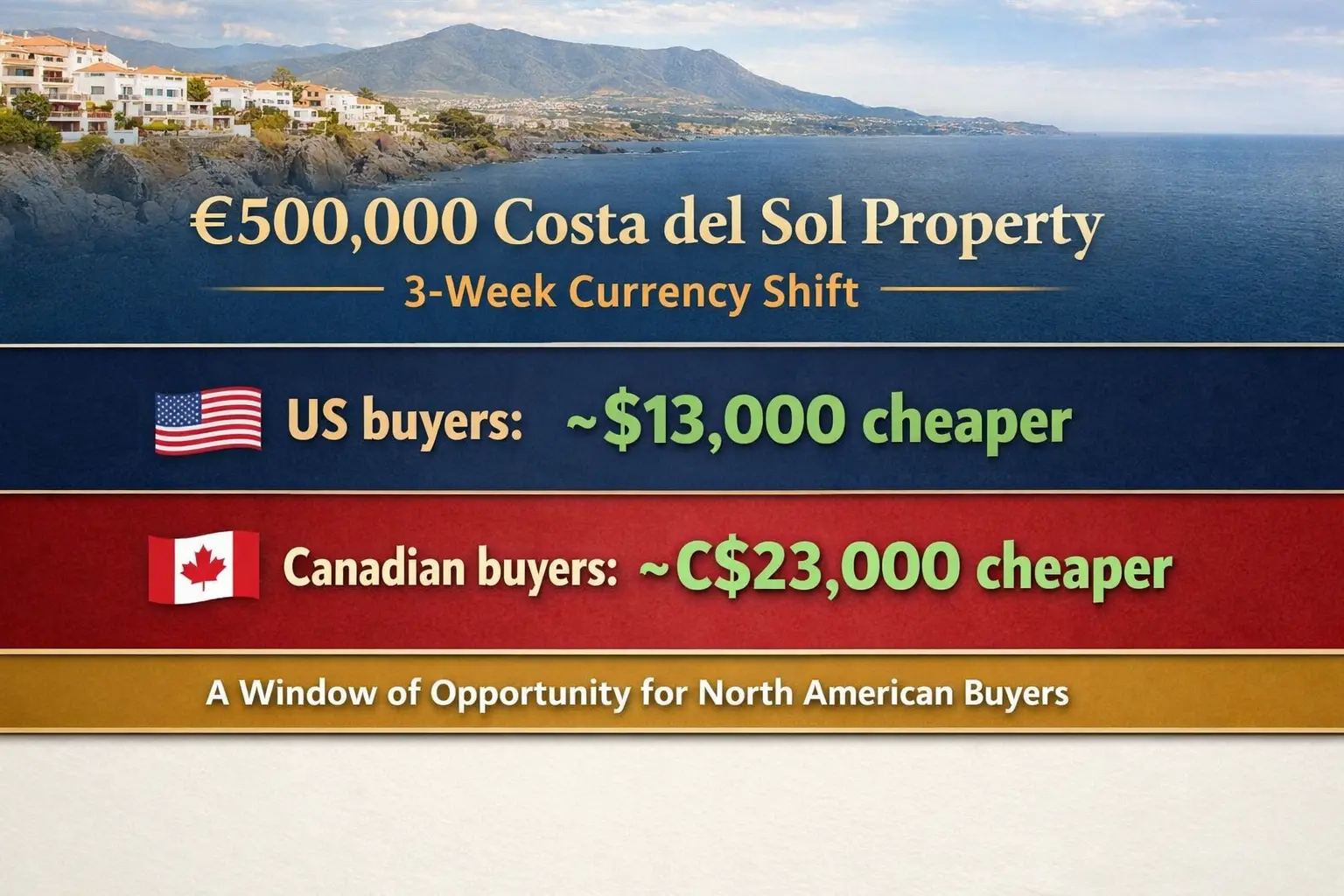
    Why a €500,000 Property in Spain Just Got Cheaper for North Americans


    Currency advantage for US and Canadian buyers purchasing property in Spain

    If you are buying property in Spain from North America, exchange rates can quietly make a meaningful difference to the final price you pay. Over the past three weeks, recent geopolitical tensions have strengthened both the US dollar and the Canadian dollar, creating a more favourable window for buyers looking at homes on the Costa del Sol.

    For anyone considering a move, a holiday home or a lifestyle investment, this shift is worth paying attention to. On a €500,000 property, the difference is no longer minor. It is large enough to influence timing, budget and purchasing power.

    What has changed?

    In periods of uncertainty, investors often move towards assets and currencies seen as more defensive. That has helped support the US dollar in recent weeks. At the same time, higher oil prices have also supported the Canadian dollar, which tends to benefit when energy markets rise.

    The result is simple: the euro now costs fewer US dollars and fewer Canadian dollars than it did just a few weeks ago.

    What does that mean in real terms?

    Using recent exchange rate movements, here is how a €500,000 property in Spain compares:

    For US buyers
    Around three weeks ago, a €500,000 property would have cost approximately $589,200. At current levels, the same property is closer to $573,800.

    That is roughly $15,400 less purely due to currency movements.

    For Canadian buyers
    Around three weeks ago, a €500,000 property would have cost approximately C$807,000. At current levels, the same property is closer to C$784,000.

    That is roughly C$23,000 less purely due to currency movements. ECB rates 16.03.2026

    Of course, exchange rates move every day and there is no guarantee this window will stay open. However, for North American buyers who were already considering a purchase, it is a timely reminder that currency can materially affect the total cost of buying overseas.

    Why this matters for Costa del Sol buyers

    The Costa del Sol continues to attract buyers from the United States and Canada for a combination of reasons: climate, lifestyle, accessibility, strong international communities and comparatively attractive property values when set against many major North American cities.

    When exchange rates move in your favour, that value proposition becomes even more compelling. A stronger home currency can improve your budget, widen your choice of homes or simply reduce the effective cost of the purchase.

    Can North Americans buy property in Spain?

    Yes. North Americans can buy property in Spain with no restrictions. Spain allows foreign buyers, including Canadian and US citizens, to purchase real estate in exactly the same way as Spanish residents.

    The process typically involves obtaining a Spanish tax identification number (NIE), opening a Spanish bank account and completing the purchase through a notary. Many international buyers work with a local lawyer who handles the legal checks and paperwork.

    For buyers considering property on the Costa del Sol, the process is straightforward and well established. North Americans regularly purchase holiday homes, investment properties and full-time residences across Marbella, Benahavís and the surrounding areas.

    Looking beyond the exchange rate

    Currency is only one part of the bigger picture, but it works best when viewed alongside running costs, lifestyle and overall buying expenses in Spain.

    If you would like to explore how Spain compares more broadly, these guides may be helpful:

    Costa del Sol cost of living vs New York, London and Toronto

    A useful moment to revisit the market

    If you are a US or Canadian buyer who had been considering a purchase in Spain, this may be a good moment to take another look. A currency move on its own should never be the only reason to buy, but when it aligns with long-term plans and the right property, it can create a genuinely useful advantage.

    Whether you are searching for a permanent move, a second home or an investment with lifestyle appeal, a stronger dollar can improve what is possible right now.

    Further reading for North American buyers

    If you are exploring the idea of buying property on the Costa del Sol, these guides provide a useful overview of the practical and lifestyle considerations involved in moving or investing in Spain.

    Request more information →

    [siteorigin_widget class=”WP_Widget_Custom_HTML”][/siteorigin_widget]
  • La Zagaleta Micro-Location: Gates, Sun, Views & Living

    La Zagaleta Micro-Location: Gates, Sun, Views & Living

    La Zagaleta Micro-Location Explained: Gates, Elevation & Day-to-Day Living

    La Zagaleta estate in Benahavís with hillside villas and protected landscape

    One of the most useful things to understand about La Zagaleta is that it’s not a “single experience”. The estate is vast and varied, and micro-location plays a bigger role here than in most other areas of Benahavís.

    Two villas can both be “La Zagaleta” and still live very differently: different gate routes, different winter sun, different wind exposure, and very different day-to-day drive times. This guide explains what micro-location means in practice — and how to use it to choose the right home, not just the right listing.

    What “micro-location” really means in La Zagaleta

    In many Costa del Sol neighbourhoods, buyers can judge location mainly by postcode, proximity to the beach, or walking distance to amenities. In La Zagaleta, the estate itself is the destination — so the meaningful differences are often inside the gates.

    Micro-location is the combination of access route, elevation, orientation, privacy and day-to-day convenience. These factors influence not only how a home feels to live in, but also how it performs long-term when it comes to desirability and resale.

    Gate access and the “daily direction” question

    Owners naturally fall into a rhythm based on where they go most often — school runs, supermarkets, restaurants, beaches, golf outside the estate, or quick trips to Marbella and Puerto Banús. That rhythm is heavily shaped by gate access and where a villa sits within the internal road network.

    The practical takeaway is simple: before you fall in love with a house, decide which direction you need to optimise. A home that looks perfect on paper can feel “far” if it adds time to your daily route, while another villa deeper in the estate might feel effortless if it aligns with how you actually live.

    Elevation, views and what they cost in real life

    Elevation is one of La Zagaleta’s great advantages. Higher positions often unlock broader view corridors and a stronger sense of privacy. However, elevation also comes with trade-offs — and it’s worth being honest about them early.

    For example, higher-up homes can be more exposed to wind, and some positions feel cooler in winter evenings. None of this is a dealbreaker, but it does influence how terraces are used, where outdoor seating works best, and whether you’ll naturally gravitate to certain parts of the home at different times of year.

    This is why we always recommend viewing with context: not just “Is the view beautiful?”, but “Will you use this terrace in February?” and “Does the plot feel calm on a windy day?”

    Orientation and winter sun (the comfort factor many buyers miss)

    In a private estate where you spend significant time at home, sunlight becomes part of comfort. Orientation affects morning light, afternoon warmth, and how usable outdoor living areas feel across the seasons.

    A villa with a similar build size and finish can feel dramatically more inviting if its key terraces and living spaces catch the right winter sun. Equally, some buyers prefer cooler, shaded plots in summer — especially if they spend more time here in peak months. The “best” orientation depends on your lifestyle calendar.

    Privacy: plot shape, neighbours and “felt distance”

    La Zagaleta is known for privacy, but privacy isn’t uniform. Plot shape, vegetation maturity, building position and neighbouring sightlines all affect how secluded a home feels.

    Sometimes the most private villa isn’t the one with the biggest plot — it’s the one that sits correctly on the land, with the right setbacks, natural screening and terrace placement. This is also where older properties can outperform newer ones: mature landscaping can be priceless.

    How micro-location influences pricing and long-term demand

    Micro-location is one of the main reasons La Zagaleta pricing can vary sharply even between homes that look comparable in photos. Buyers tend to pay premiums for positions that combine: strong views, practical access routes, usable outdoor living, and a feeling of privacy that holds up when you’re actually on the terrace.

    If you’re comparing options, it helps to think in layers: finish and design are important, but the underlying micro-location is what you can’t change later. Renovations can improve layout and efficiency. You can’t move the gate route, the orientation, or the view corridor.

    A simple way to shortlist (without over-analysing)

    Micro-location can sound technical, but the decision can be kept simple. Start with your “daily direction”, then test each villa against comfort and convenience. If a home passes those two tests, the rest becomes much easier.

    If you want a quick checklist, focus on these three questions:

    • Does the access route suit my real routine (school, beach, dining, services)?
    • Do the main terraces and living areas work across the seasons I’ll be here?
    • Does the privacy feel genuine when you’re outside, not just inside?

    Answer those honestly, and you’ll avoid most of the common regrets buyers experience when they choose based on photos alone.

    Related guides for La Zagaleta buyers

    If you’re building a shortlist, these pages sit together as a single “La Zagaleta decision pack”:

    Ready to view with context? You can explore current villas for sale in La Zagaleta here, or request a curated shortlist tailored to your routine, preferred views and privacy level.

    [siteorigin_widget class=”WP_Widget_Custom_HTML”][/siteorigin_widget]
  • Buying Property in La Zagaleta: What Buyers Should Know

    Buying Property in La Zagaleta: What Buyers Should Know

    Buying Property in La Zagaleta: What’s Different and What to Know Before You Buy

    La Zagaleta estate in Benahavís showing hillside luxury villas and landscape

    La Zagaleta is a private estate, not just a gated urbanisation

    La Zagaleta functions as a large, privately managed estate rather than a conventional residential development. Access is controlled at the gates, internal roads are private, and the estate operates under its own community governance with strict rules designed to protect privacy, security and long-term character.

    For buyers, this means that ownership comes with additional layers of regulation and coordination. These aren’t obstacles — but they are differences that should be understood early, particularly if you’re comparing La Zagaleta with areas such as El Madroñal or La Quinta. For an overview of the estate and current listings, see our La Zagaleta area guide.

    Estate rules, approvals and why they matter

    La Zagaleta places strong emphasis on preserving the estate’s low density and visual consistency. As a result, certain activities that might be straightforward elsewhere require formal approval here.

    This can include:

    • New construction or significant renovation projects
    • Changes to exterior appearance or boundary treatments
    • Access modifications, driveways or plot reconfiguration

    The practical implication is simple: properties with approved designs, completed builds, or compliant renovations often carry a premium — not just for the finish, but for the certainty they offer.

    Turnkey villas vs renovation opportunities

    Buyers in La Zagaleta generally fall into two broad camps. Some prioritise turnkey, modern homes where everything is resolved before completion. Others see value in older villas on exceptional plots, planning to upgrade layout, efficiency and design over time.

    Both approaches can work — but renovation timelines, approval processes and build access should be factored into your decision. In La Zagaleta, “how easily a project can be executed” is often just as important as the purchase price itself.

    Memberships and how they relate to ownership

    Purchasing a home in La Zagaleta does not automatically include club membership. Golf and social memberships are optional and subject to separate application and fees.

    This distinction matters during due diligence. Some buyers assume membership is bundled with ownership, while others deliberately choose properties without any intention of joining. Understanding how memberships work — and what transfers or doesn’t — avoids surprises later. (We cover this in detail in our guide to La Zagaleta community fees and memberships.)

    Micro-location: why two La Zagaleta homes can live very differently

    One of the most important — and least obvious — aspects of buying in La Zagaleta is micro-location. The estate is vast, and factors such as elevation, orientation and gate access have a real impact on daily life.

    Two villas may share a similar price point yet differ meaningfully in winter sun, wind exposure, privacy levels or daily drive times. These nuances don’t always show up in listings but become immediately apparent once you start living there. For a practical breakdown, see La Zagaleta micro-location explained.

    Off-market property and why it matters in La Zagaleta

    La Zagaleta has one of the strongest off-market cultures on the Costa del Sol. Many owners prefer discretion, and some of the best-positioned homes never appear on public portals.

    For serious buyers, this means that relying solely on public listings can give an incomplete picture of what’s actually available. Access to off-market opportunities is often relationship-driven and time-sensitive.

    Common buyer mistakes (and how to avoid them)

    The most common missteps we see aren’t about price — they’re about assumptions. Buyers sometimes underestimate drive-time differences, overlook renovation constraints, or focus on headline specifications rather than how the home actually lives day to day.

    Taking time to understand the estate, viewing with context, and planning beyond the purchase itself usually leads to a much more satisfying long-term outcome.

    Is La Zagaleta right for you?

    La Zagaleta suits buyers who value privacy, space and long-term consistency over convenience and walkability. It works particularly well for those who spend meaningful time in residence and want a true estate environment rather than a resort setting.

    If you’re weighing La Zagaleta against other gated communities, our comparison guide La Zagaleta vs El Madroñal vs El Herrojo Alto can help clarify which environment fits your priorities best.

    You can explore current villas for sale in La Zagaleta here, or request a curated shortlist (including off-market options) tailored to how you plan to live. For broader buying guidance, see our Resources & Buyer Guides.

    [siteorigin_widget class=”WP_Widget_Custom_HTML”][/siteorigin_widget]
  • Buying on the Costa del Sol in 2026: 11 Key Steps

    Buying on the Costa del Sol in 2026: 11 Key Steps

    [siteorigin_widget class=”WP_Widget_Custom_HTML”][/siteorigin_widget]

    11 Key Steps to Buy a Home on the Costa del Sol in 2026 (As a Foreigner)


    Buying property on the Costa del Sol as a foreigner in 2026 is straightforward when you follow the right order. In Andalucía (Marbella, Benahavís, Estepona and the wider Málaga coast), the journey is typically: agree your budget, appoint an independent lawyer, organise NIE + banking, protect your exchange rate, complete due diligence, then sign at the notary.

    The process is broadly similar for EU and non-EU buyers. The main differences tend to be mortgage criteria and residency planning. Notably, Spain’s property-linked “Golden Visa” route was abolished (applications closed in April 2025), so non-EU buyers now usually compare options like the Digital Nomad Visa or the Non-Lucrative Visa depending on lifestyle and income structure.


    View of the sea and mountains from a villa with a pool - the Benahavis Lifestyle


    Step 1) Clarify your plan: lifestyle, location and timeline


    Before paperwork begins, get clear on how you’ll use the home. A winter-sun base near golf has different priorities to a full-time relocation with schools, or an investment-led purchase with rental goals.

    On the Costa del Sol, your shortlist usually tightens quickly once you decide what matters most: walkability vs views, beach access vs hillside privacy, village charm vs resort convenience, and how close you want to be to Málaga Airport.

    Step 2) Set a true budget (price + purchase costs + setup)


    One of the most common surprises for overseas buyers is that Spanish listing prices don’t include transaction taxes and fees. As a practical guide in Andalucía, allow roughly ~10% on top for a resale (ITP + typical fees) and ~12–13% for a new build (IVA + AJD + fees), then refine once your lawyer confirms the exact case.

    If you want a clear breakdown with examples, see:  Purchase Costs in Andalucía (2026).


    Keys to a new home on a Costa del Sol beach

    Step 3) Appoint an independent property lawyer early


    Start with an independent Spanish property lawyer who acts for you (not the agent or the seller). They’ll verify ownership and charges, review contracts, coordinate the notary, and confirm the real costs and timeline.

    Many foreign buyers also grant a Power of Attorney so their lawyer can handle admin (banking, tax forms, registry filings) if travel dates are tight. It’s common on the Costa del Sol because buyers often purchase while living abroad.

    Step 4) If you need finance, get mortgage guidance before you reserve


    If you’re using a Spanish mortgage, speak to a bank or mortgage broker early so you understand realistic loan-to-value and documentation requirements. As a broad rule, resident buyers can often borrow up to around 80% of the property value, while non-residents are typically closer to 60–70% (subject to profile, property type, and bank policy).

    For a Costa del Sol-specific walkthrough, see:  Financing & Mortgages (Benahavís & Costa del Sol).

    Step 5) Apply for your NIE (and line up residency planning if relevant)


    Every foreign buyer needs a NIE (Número de Identidad de Extranjero). It’s the ID number used on property deeds, taxes, and most banking paperwork. Processing times vary, so treat this as an early task.

    If you’re also planning to spend extended time in Spain as a non-EU buyer, map out your visa route alongside your purchase planning (the “Golden Visa” is no longer available). Our starting points:

    Step 6) Open a Spanish bank account and prepare “source of funds” evidence


    A Spanish bank account makes completion smoother: purchase funds, taxes, notary/registry fees, utilities, and community fees are usually paid locally. Some banks allow remote onboarding (video identification), while others require an in-person visit or Power of Attorney.

    Also expect robust anti-money laundering checks. In practice, that means being ready to show where funds come from (salary, dividends, sale of another property, savings history), plus translated documents if requested.

    Step 7) Protect your budget with a smart currency strategy


    If you’re paying in EUR from GBP, USD or another currency, exchange movements can materially change the final cost—especially between reservation, deposit (arras), and completion. Many buyers use specialist FX providers, rate alerts, or forward contracts to reduce uncertainty.

    The key is simple: plan transfers around contract dates, and avoid leaving large conversions to the last minute.


    People discussing currency exhange and mortages

    Step 8) Run legal and technical checks (Costa del Sol essentials)


    Before you commit to a deposit, your lawyer should request a nota simple from the Land Registry to confirm ownership, boundaries/description, and any registered debts or charges. Beyond that, Costa del Sol purchases often benefit from a few extra checks:

    • Planning and occupancy: confirm the property’s planning status and, where applicable, the Licence of First Occupation (often referenced in Andalucía as LPO/LFO depending on context).
    • Community debts: ask for confirmation that community fees are up to date (very relevant in apartment and gated urbanisations).
    • IBI and local charges: verify recent IBI receipts and any local waste charge arrangements.
    • Energy certificate (EPC): request the current certificate (required for sale listings).
    • Technical condition: for older villas or properties with renovations, consider an independent surveyor/architect inspection.

    If you’re early-stage and want a structured set of viewing questions, this helps:  Viewing Etiquette & Offer Strategy.

    Step 9) Agree the offer, then reserve properly (reservation contract)


    Once you agree price and terms, the seller may request a reservation contract and a small payment to take the home off the market for a defined period. This is where foreign buyers should slow down slightly and ensure the document is crystal clear about:

    • the agreed purchase price and included items (furniture, parking, storage)
    • the deadline for signing the main deposit contract
    • what happens if finance or legal checks uncover an issue
    • the refund terms (when it’s refundable and when it isn’t)

    Step 10) Sign the deposit contract (arras) and progress mortgage + valuation


    The next milestone is typically the arras contract. A common structure is “arras penitenciales”, where the buyer can forfeit the deposit if they withdraw, while the seller must return double if they pull out (your lawyer will confirm the exact wording and type being used). The deposit is often around 10% of the price, but it can vary depending on negotiation and timelines.

    If you’re taking a mortgage, the bank will request a full document pack and will instruct an official valuation (tasación). If the valuation comes in below the purchase price, you may need a larger cash contribution or renegotiate.

    Step 11) Notary signing (escritura), payment, taxes and registration


    Completion happens at the notary, where you sign the public deed of purchase (escritura) and, if applicable, the mortgage deed. Funds are typically settled by bank transfer and/or banker’s draft in line with the agreed completion mechanics.

    If you are signing a mortgage, Spanish mortgage rules require banks to provide pre-contract information in advance and a minimum “reflection” period before signing, with a prior notary visit to confirm understanding and compliance.

    After signing, taxes and fees are paid and the deed is submitted to the Land Registry so ownership is registered in your name. Your lawyer will also help switch utilities, arrange direct debits for community fees, and ensure any ongoing obligations (for example, non-resident tax filings where relevant) are set up correctly.


    A quick note on new builds and off-plan purchases


    Buying off-plan is common on the Costa del Sol, but the checks shift slightly. Your lawyer should verify the developer’s legal structure, planning permissions, stage-payment schedule, and, crucially, your protection for any advance payments. Spain’s buyer-protection rules require developers to secure guarantees (typically via bank guarantee or insurance) for amounts paid in advance under the regulated framework for off-plan purchases.

    You’ll also want clarity on delivery dates, specification, snagging, and what happens if timelines move.


    New development on the Costa del Sol at sunrise


    Useful next reads (Costa del Sol buyers)


    Purchase Costs in Andalucía (2026)
    Financing & Mortgages (Costa del Sol)
    Viewing Etiquette & Offer Strategy
    Glossary of Spanish property & legal terms
    Spain Visa Options 2026
    Property portals vs local specialists (what buyers should know)

    Properties for sale across the Costa del Sol (not just Benahavis)

  • Property Portals vs Local Specialists: What Buyers Should Know

    Property Portals vs Local Specialists: What Buyers Should Know

    Property portals versus local property specialists in Spain

    Property Portals vs Local Specialists: What Buyers Should Know


    Property portals are usually where a Spanish home search begins. They’re easy to browse, highly visual, and they quickly give you a feel for what different areas cost.

    That said, portals aren’t designed to be a “truth layer”. They’re designed to show volume. So the key is knowing what they’re brilliant for — and what they can’t reliably tell you once you’re ready to take action.

    If you understand the difference early, you’ll save time, avoid the classic frustrations, and make much better decisions when you start booking viewings.

    What portals are genuinely useful for

    Used well, portals are a great way to get your bearings. Think of them as a market overview tool: they help you form a sense of price bands, what different styles look like, and which neighbourhoods keep coming up in your searches.

    In the early stage, you’re not trying to find “the one” — you’re trying to narrow your focus. Portals help you do that quickly, especially if you keep your filters fairly broad and pay attention to patterns rather than individual listings.

    Best way to use a portal: collect ideas, spot patterns, and shortlist areas — then verify the specific listings once you’re ready to view.

    Where portals start to fall short

    The problems usually appear when buyers move from browsing to enquiry. Suddenly, you’re not looking for inspiration — you’re trying to build a real viewing list. That’s when accuracy matters, and portals can be inconsistent.

    For example, a property might still be online even though it sold weeks ago. Or the same home appears multiple times under different agencies — sometimes with different prices, different photos, or a description that doesn’t quite match reality.

    And occasionally, a listing looks almost suspiciously good for the price. Sometimes that’s a genuine opportunity. More often, there’s a catch — or it’s simply not available in the way the advert suggests.

    “If it looks too good to be true…”

    One of the most frustrating experiences for buyers is getting excited about a property, enquiring, and then hearing something like: “It has just gone under offer this week.”

    Sometimes that’s true. However, in many cases, the listing was never realistically available — it existed to generate enquiries. Once contact is made, the conversation shifts to “similar alternatives”, which may be very different from what caught your eye in the first place.

    A simple rule of thumb: If a listing is significantly better priced than everything comparable around it, there’s usually a reason — and it’s rarely a hidden bargain.

    Airplane landing in Malaga with tourists and people on viewing trips in Spain

    Once flights and viewing days are involved, accuracy matters far more than volume.

    Why accuracy matters once you’re planning viewings

    As soon as flights, accommodation and viewing days are involved, the cost of “getting it wrong” goes up. A portal can show you hundreds of options, but what you really need at that stage is a short list you can trust.

    It’s also worth remembering that portal prices rarely reflect the true cost of buying. In Andalucía, purchase taxes and buying fees sit outside the headline price — so your real budget should include that from the beginning. If you haven’t seen the breakdown yet, start here: purchase costs in Andalucía.

    We update our listings daily, and every property on our site clearly shows the date it was added, so you can see what’s genuinely current.

    Where a local specialist changes the experience

    A good local specialist doesn’t replace portals. Instead, they add the missing layer portals can’t provide: context, verification and judgement.

    That starts with a simple but important step: confirming whether a property is genuinely available and viewable. From there, the real value is helping you understand what the advert can’t tell you — how the community feels on the ground, whether the layout works for how you’ll live, and what your ongoing costs are likely to be.

    Running costs are a classic blind spot on portals. Community fees, local taxes, and maintenance can vary hugely between developments, and they matter just as much as the purchase price. If you’d like a simple explanation, this guide helps: community fees & running costs explained.

    One point of contact — full market access

    We collaborate with all other agencies and developers active in Benahavís. So if you see something on a portal, we can usually arrange a viewing — but we won’t simply pass your details on and hope for the best.

    Instead, we verify listings first, remove duplicates and dead ends, and then help you use your time properly when you’re in Spain. If you’re planning a trip, this guide explains how to structure it so you don’t waste days driving back and forth: how to make the most of a Spanish property viewing trip.

    In practice, this usually means:

    fewer wasted enquiries • fewer “already sold” moments • a tighter viewing plan • and much clearer decisions

    Final thoughts

    Portals are a useful starting point — but they’re not the full story. The best results come from combining online research with local verification and honest guidance, especially once you’re spending money and time on a viewing trip.

    If you’re still at the planning stage, this practical overview can also help: buyer’s checklist for purchasing in Spain.

    Keys to new home on the Costa del Sol, Spain


    [siteorigin_widget class=”WP_Widget_Custom_HTML”][/siteorigin_widget]
  • Spanish Property Viewing Trip: How to Make the Most of It

    Spanish Property Viewing Trip: How to Make the Most of It

    Property viewing trip in Spain

    How to Make the Most of a Spanish Property Viewing Trip


    A viewing trip is one of the most valuable steps when buying in Spain. Online listings help you start the search, but they can’t show you how a neighbourhood feels, how the light moves through a home, or what the area is like at different times of day.

    A well-planned trip lets you compare properly, adjust expectations, and make decisions based on real experience rather than photos alone. Below is a simple, low-stress way to prepare — and get the maximum clarity from your time on the ground.

    In short: the goal isn’t to see as many homes as possible. It’s to understand locations, spot patterns in what you like (and don’t), and gain the confidence to move forward — whether now or on a future visit.

    Before you fly: define your priorities and keep the plan calm

    The most successful trips start well before you arrive. You don’t need perfect clarity — but you do need a basic “north star” so you can compare properties fairly.

    Start with use-case. A holiday home, a full-time residence, and a long-term investment all pull you in different directions. Schools, winter sunshine, beach access, walkability, rental rules and year-round services matter in very different ways depending on how you’ll live.

    Then set a realistic budget. Remember that Spanish prices are listed before purchase costs. As a rule of thumb, many buyers allow roughly 10–13% on top of the price for taxes and fees (property type dependent). If you want the clear breakdown, start here: Purchase costs in Andalucía.

    A calm schedule beats a packed one: decision fatigue is real. If you overload the day, everything starts to blur and the trip becomes stressful instead of useful.

    A simple approach is to group viewings by location and keep each day light enough to leave time for driving, coffee stops, and seeing the area without pressure. If you’re mortgage planning at the same time, it’s also worth sanity-checking affordability before you book flights: Financing & mortgages in Spain.

    During viewings: what to look for (and what to ask)

    It’s easy to focus on finishes and décor. However, long-term satisfaction usually comes down to practical details — the kind you only notice in person.

    Pay attention to orientation and light. Sun, heat and shade vary dramatically by aspect — especially in winter vs summer. Also look at outdoor space as a “real living area”: privacy, wind, noise, and how usable the terrace or garden feels in practice.

    Check condition with a calm eye. Minor cracks are common, but damp, insulation issues, poor ventilation, or rushed construction deserve attention. Don’t be shy about asking what has been updated and when.

    Then zoom out to the community and surroundings. Shared areas and maintenance standards can make or break the experience. If you want a clearer picture of what community fees usually cover, this explainer helps: Community fees: costs & services breakdown.


    Questions worth asking early (so you don’t waste time on the wrong options):

    • Legal status: Is it registered correctly and free of debts or planning issues?
    • Running costs: Community fees, IBI, basura/waste, utilities — and any known upcoming works.
    • Rental rules: If relevant, is holiday letting permitted and under what conditions?

    Your lawyer will confirm everything formally, but understanding these points during viewings helps you filter out unsuitable properties early. For a broader overview of taxes and ongoing obligations, see: Taxes when buying & owning in Spain. If you’re curious how the process typically works with agents here, this explainer can also help: How estate agents work on the Costa del Sol.

    Record your impressions (so properties don’t blur together)

    After several viewings, homes can start to blend into one. A quick system makes the trip far more valuable when you’re back at home.

    • Take photos or short videos (where permitted).
    • Write a few notes immediately after each viewing — what you loved, what concerned you, and what felt “off”.
    • Separate emotion from practicality: both matter, but they’re different signals.

    After the trip: turn the visit into clarity

    Once home, review your notes calmly. Many successful purchases don’t happen on the first trip — instead, the first trip sharpens your understanding of what you truly want.

    If a property stands out, request further details or plan a second viewing. If nothing feels right, that’s still progress — clarity is invaluable.

    If you want a practical structure for the days after you return (documents, timelines, and offer approach), this page is useful: Viewing etiquette & offer strategy.

    Final thoughts

    A Spanish property viewing trip is about more than houses. It’s about understanding neighbourhoods, lifestyle, and long-term comfort. With thoughtful preparation and an open mind, even a short visit can move you significantly closer to finding the right home.

    If your focus is Benahavís, a viewing trip can be especially efficient with the right local coordination. We collaborate with all other agencies and developers active in the municipality, which means we can arrange viewings for any property currently available for sale in Benahavís — not just our own listings.

    Rather than juggling multiple agents, we design a tailored viewing itinerary around your priorities, grouping properties by area and timing to maximise your time on the ground.

    We accompany all viewings, provide local context, and help you compare options calmly and objectively. When a purchase completes, we receive an introducer’s fee from the vendor or listing agent. There is no cost to you for arranging or attending viewings, and no obligation to proceed.

    In short: one point of contact, full access to the Benahavís market, and a viewing trip designed around your time — not multiple sales agendas.

    Related resources

    You can also browse the wider hub here: Buyer’s Guide.

    [siteorigin_widget class=”WP_Widget_Custom_HTML”][/siteorigin_widget]
  • Mortgages in Spain 2026: Rates, Euribor & Buyer Tips

    Mortgages in Spain 2026: Rates, Euribor & Buyer Tips

    Mortgages in Spain 2026 outlook

    What Changes Are in Store for Mortgages in Spain in 2026?


    If you’re planning to buy a home in Spain in 2026 — or you already have a mortgage (hipoteca) — it helps to understand where interest rates, lending criteria and bank approvals are heading.

    Mortgages don’t move in isolation. They respond to wider European rate trends, housing demand, and how comfortable (or cautious) banks feel about risk. The good news is that 2026 looks less “wild” than the sharp swings many buyers have experienced recently.

    In short: Euribor-driven borrowing costs are expected to be more stable than the sharp shifts seen in recent years. However, it’s unlikely Spain returns to ultra-low mortgage pricing in 2026. For most buyers, fixed and mixed-rate deals will still feel like the default choice.

    Current context: prices, Euribor and monthly payments

    Spain’s housing market continued to see upward pressure on prices through late 2025, while Euribor — the reference index used by many Spanish banks — stayed well above the lows seen earlier in the decade.

    Euribor (most commonly the 12-month Euribor for residential lending) is the benchmark used to price many variable mortgages. When Euribor rises, monthly payments on variable-rate mortgages increase.

    Why it matters: variable-rate mortgages can become more expensive quickly when the index moves. That’s why many buyers have shifted to fixed or mixed products — predictable payments reduce stress (especially in the first years of ownership).

    Mortgage trends to watch in 2026

    Euribor
    Fixed vs variable
    Approvals
    Demand

    Several themes are likely to shape mortgages in Spain in 2026.

    First, Euribor may stabilise. Most forecasts point to a steadier range than 2025, rather than a return to near-zero levels. That means fewer nasty surprises for variable borrowers, but it doesn’t automatically mean “cheap money” is back.

    Second, fixed and mixed-rate products should stay popular. Buyers continue prioritising payment certainty — especially when relocating, buying a second home, or managing income across currencies.

    Finally, banks may become a touch more selective. Higher prices often mean larger loans, and that increases rejection risk for borderline affordability cases.

    Mortgage demand: signings have been rising

    Despite higher borrowing costs, demand has remained resilient. In practice, many buyers still prefer a mortgage over renting — particularly in areas where rents have increased and supply remains tight.

    A sustained demand/supply imbalance can keep purchase activity elevated, even if lending conditions remain more selective.

    Which mortgage types are likely to dominate in 2026?

    In 2026, fixed-rate and mixed-rate mortgages are expected to remain the default choice for many buyers because they reduce payment uncertainty.

    • Fixed-rate: predictable payments for the full term.
    • Mixed-rate (hybrid): a fixed period (often 5–10 years) followed by a variable rate.
    • Variable-rate: may only regain share if Euribor drops meaningfully — not the base-case expectation for 2026.

    Mortgage approvals: expect more scrutiny

    As property values rise, borrowers often need larger loans. That can lead banks to apply stricter affordability checks — especially where income is variable or existing debt is already high.

    What helps: stable income, low consumer debt, a strong deposit, and clean documentation (income proof, bank statements, and tax filings where relevant).

    What to consider when taking out a mortgage in 2026

    If you want one simple principle, it’s this: structure your mortgage so it still feels comfortable on a “normal month”, not just a good month.

    • Keep payments manageable: as a rule of thumb, many buyers aim to keep payments at ~30% (or less) of household income.
    • Compare offers properly: pricing and conditions vary significantly between banks and brokers.
    • Budget for the true total: include taxes, fees and mortgage setup costs — not just the monthly payment.
    • Stress-test your plan: if you choose mixed or variable, plan for higher payments once the fixed period ends.

    Also factor in associated purchase costs such as:

    • Property transfer tax (ITP) or VAT (IVA), depending on the property
    • Notary and land registry fees
    • Valuation fees
    • Home insurance (often required by lenders)

    Quick view: mortgage outlook for 2026

    Aspect Outlook
    Euribor More stable than recent spikes; unlikely to return to historic lows quickly.
    Mortgage costs Generally steady, though bank pricing may rise if competition cools.
    Lending selectivity Banks may tighten approvals for high debt-to-income borrowers.
    Most popular types Fixed-rate; mixed-rate (5–10 years fixed) increasingly attractive.
    Demand Moderate growth likely where rents stay high and supply remains tight.

    Final takeaway

    Spain’s mortgage landscape in 2026 looks set to be more stable than during the sharp shifts of recent years — but it’s not a return to the ultra-low interest environment buyers enjoyed in earlier cycles.

    Best approach: prioritise payment certainty (fixed or a well-structured mixed), prepare documentation early, and budget for all purchase costs — not just the monthly payment.

    FAQs

    Will Euribor fall in 2026?
    Forecasts vary, but the most common expectation is that Euribor will be more stable than during recent spikes. A return to ultra-low levels is not the base case outlook for 2026.

    Which mortgage type is likely to be best in Spain in 2026: fixed, mixed or variable?
    Many buyers prefer fixed or mixed mortgages for payment certainty. A mixed mortgage can suit buyers who want stability for the first 5–10 years and flexibility later. Variable rates may only become more attractive if Euribor falls meaningfully.

    How can I improve my chances of mortgage approval in Spain?
    Keep debt low, document income clearly, maintain stable bank statements, and aim to keep the mortgage payment around 30% (or less) of household income. A larger deposit also improves affordability metrics and lender confidence.

    Related resources

    Helpful next steps if you’re planning financing for a purchase in Spain:

    [siteorigin_widget class=”WP_Widget_Custom_HTML”][/siteorigin_widget]
  • Living on a Golf Course in Benahavís | Guide

    Living on a Golf Course in Benahavís | Guide

    Living on a Golf Course in Benahavís

    Frontline golf homes overlooking the fairway in Benahavís

    For many buyers, living on a golf course in Benahavís is the ultimate Costa del Sol lifestyle. You swap traffic noise for golf buggies in the distance, trade city views for fairways and mountain backdrops, and keep the clubhouse, practice area and walking routes just a few minutes from your front door.

    Benahavís stands out because it combines serious golf with a relaxed, year-round residential feel. Courses such as La Quinta, Los Arqueros, El Higueral and Marbella Club Golf Resort sit in low-density valleys and hills, with modern communities wrapped around the fairways. Many homes enjoy sea views as well as green views.

    This guide looks at what day-to-day life is really like on a golf course in Benahavís, the difference between frontline and “on-course” homes, and the practical points to weigh up before you buy. It also links out to our dedicated Golf in and around Benahavís guide and the main collections of golf course homes and frontline golf properties.

    What It’s Like to Live on a Golf Course in Benahavís

    Daily life on a golf course in Benahavís is calmer than many buyers expect. Early mornings tend to be peaceful, with greenkeepers out first and the first tee times starting quietly. As the day warms up, you notice golfers on buggies in the distance rather than crowds, especially on low-density courses.

    Most golf communities in Benahavís are gated and landscaped, with shared pools, gardens and often a gym or spa. You can walk or drive a short distance to the clubhouse for coffee, lunch, a practice session or dinner on the terrace. In the evenings, the fairways fall quiet again and many homes enjoy sunset views across the course towards the sea.

    It’s a setting that suits year-round residents as much as second-home owners: you feel close to nature but are only a short drive from beaches, schools and town centres like San Pedro de Alcántara, Puerto Banús or Marbella.

    Frontline Golf vs Homes Inside Golf Communities

    Not every golf property is the same. In Benahavís it helps to distinguish between frontline golf homes and homes that simply sit within a golf course urbanisation.

    • Frontline golf: the property directly overlooks a hole, fairway or green with minimal visual
      barriers. Views are often spectacular and resale demand is strong, but you should consider privacy, stray
      balls and the orientation of terraces.
    • Golf course homes: properties located inside a golf community or on the perimeter roads of
      the course. They still benefit from the setting, security and facilities, but may have more partial or
      elevated views rather than “grass at your doorstep”.

    If you are exploring both options, our Golf Course Homes collection gives a broad view of communities built around fairways, while the curated Frontline Golf Homes collection focuses only on properties positioned right on the course.

    Who Living on a Golf Course in Benahavís Works Best For

    Living on a golf course in Benahavís is not just for low-handicap players. It also appeals to buyers who simply enjoy wide open views, mature landscaping and a quieter atmosphere than many coastal strips.

    • Year-round residents: people who want a primary home with fresh air, space to work from
      home, and easy access to clubs, gyms and walking routes.
    • Second-home owners: buyers seeking a lock-and-leave apartment or townhouse in a secure,
      well-maintained community with a reliable management structure.
    • Families: parents who like the safety of gated communities, on-site facilities and the option
      to combine golf with nearby schools such as Atalaya International College or CEIP Daidín.
    • Investors: buyers interested in rental demand from golfers and winter sun seekers, particularly
      in well-known venues like La Quinta and Los Arqueros.

    The right match depends on how often you play, how much time you spend in Spain and whether you see the property as a pure lifestyle purchase or as part of a broader investment plan.

    Practical Things to Check Before You Buy

    Before committing to any golf course home in Benahavís, it is helpful to walk through a simple checklist with your agent and lawyer. A few small details can make a big difference to how the property feels once you move in.

    • Orientation & views: when does the sun hit your terrace, and are you looking onto tees, fairways or a quieter green?
    • Community fees: what do the annual charges include and how do they compare with similar golf developments in Benahavís?
    • Club membership: does ownership include any playing rights or discounts, or is membership separate and optional?
    • Noise & privacy: how close are paths, tees and buggy tracks to your outdoor areas, and are there any screens or planting in place?
    • Rental rules: if you plan to rent, are there any community or municipal limits on short-term lettings or touristic licences?

    A good viewing schedule will include visits at different times of day so you can feel how the course and community operate in real conditions, not just at a single quiet moment.

    Popular Golf Course Neighbourhoods in Benahavís

    Several areas in and around Benahavís have become reference points for golf course living. Each offers a slightly different balance of views, facilities and price points.

    • La Quinta: a 27-hole course with established communities and new developments, close to Nueva Andalucía and San Pedro. A favourite for year-round residents and second-home owners.
    • Los Arqueros: hillside golf course with a mix of apartments, townhouses and villas, popular with residents who want easy access to Ronda road and the coast.
    • El Higueral & Capanes corridor: scenic nine-hole course with communities such as Capanes del Golf offering lush gardens, indoor pools and a tranquil feel.
    • Marbella Club Golf Resort: low-density, luxury homes on large plots with wide open views and a strong country-club atmosphere.
    • Villa Padierna / Los Flamingos: resort-style environment with hotel, spa and three courses, appealing to those who want full facilities and quick coastal access.

    If you are just starting your search, it can help to compare a couple of these areas in the same day to decide which version of golf course living in Benahavís really fits your lifestyle.

    Benahavís vs Marbella’s “Golf Valley”

    Many buyers compare living on a golf course in Benahavís with properties in Marbella’s Golf Valley (Nueva Andalucía). Both areas offer multiple courses, strong international communities and good access to schools and amenities.

    Broadly speaking, Benahavís tends to feel a little more spacious and rural, with lower-density plots and a slightly quieter atmosphere once you return home. Golf Valley, by contrast, is more compact and closer to Puerto Banús nightlife and central Marbella.

    Neither is “better” – but if you value open views, hiking routes and the village feel of Benahavís, living on a golf course here can be an ideal middle ground between countryside and coast.

    Planning to Live on a Golf Course in Benahavís?

    Darren & Angelina — your Personal Property Concierge — will help you compare frontline golf villas with homes in wider golf communities, explain fees and club structures, and match you with neighbourhoods that fit your lifestyle, budget and school needs.

    Share your requirements and we’ll curate a shortlist of golf course homes in Benahavís and arrange private viewings around your travel plans.
    Get in touch →

    [siteorigin_widget class=”WP_Widget_Custom_HTML”][/siteorigin_widget]
  • Why the Costa del Sol beats London, New York & Toronto

    Why the Costa del Sol beats London, New York & Toronto

    Cost of Living:

    Costa del Sol vs London, New York and Toronto in 2026

    Costa del Sol coastline at golden hour – cost of living Costa del Sol vs London New York Toronto

    “Living on the Costa del Sol in 2026 costs significantly less than life in London, New York or Toronto — while offering 300 days of sunshine and a calmer, more outdoor lifestyle.”

    More people than ever are asking a simple question:

    “Is there somewhere I can live better — not just cheaper?”

    For many, the answer is yes: the Costa del Sol. Sunshine, lower everyday costs, Mediterranean food culture and strong international communities make the region one of Europe’s most appealing places to relocate.

    This guide compares the cost of living on the Costa del Sol vs London, New York and Toronto using realistic 2026 figures, so you can see how far your money really goes.

    Living Costs on the Costa del Sol (2026)

    The Costa del Sol remains one of Europe’s best-value regions for day-to-day living, especially when you compare it with major English-speaking cities. Mild winters help keep utility bills down, fresh produce is affordable, and household insurance is typically a fraction of what residents pay in the UK, US or Canada.

    Fresh produce in Malaga market – cost of living Costa del Sol vs London New York Toronto
    Fresh produce at Málaga’s local markets keeps weekly food costs under control.

    Typical monthly spending for a couple (Costa del Sol)

    For two adults living a comfortable, non-extravagant lifestyle in Málaga and surroundings, a realistic monthly budget looks like this:

    • Groceries & eating out: €700–850
    • Utilities & telecoms (electricity, water, internet, mobiles): €200–260
    • Local transport: €35–50
    • Insurance (home + car combined): €650–1,050/year (≈ €55–88/month)

    Typical total monthly spend (excluding rent or mortgage): €1,000–1,200

    For most people moving from London, New York or Toronto, that alone is a big adjustment: bills become more predictable and manageable, and a larger share of your income goes on lifestyle rather than fixed costs.

    Jump to your city

    See the full cost of living breakdown, lifestyle notes and real examples:

    London ->
    New York ->
    Toronto ->

    London: Cost of Living Breakdown (2026)

    London remains one of the world’s most expensive cities. Energy prices, transport and insurance are all significantly higher than in southern Spain, and many households feel that most of their income disappears on basics before they even think about going out.

    Monthly costs for a couple in London (excluding rent)

    • Food & dining: £760–950/month
    • Utilities & telecoms: £320–450/month
    • Public transport (Zone 1–3 style pass): £170+/month
    • Insurance (home + car): £900–1,600/year (≈ £75–133/month)

    Typical total monthly spend (excluding rent or mortgage): £1,450–1,800 (≈ €1,700–2,100)

    Property snapshot: London vs Costa del Sol

    • London 2-bed flat: £575,000–750,000
    • London 3-bed townhouse: £1.05–1.30m
    • Costa del Sol 3-bed townhouse: €575,000–725,000

    For many London homeowners, selling a family house can fund an outright purchase on the Costa del Sol with money left over, turning a mortgage payment into additional income.

    Real example: selling in London → moving to Spain

    Imagine a London couple selling a £1.2m semi-detached home. After agent and legal fees, they might walk away with roughly £1.16–1.17m.

    On the Costa del Sol, they buy a modern townhouse in a gated community for around €700,000, plus approximately €70,000 in purchase costs. Their total outlay is roughly €770,000.

    That leaves a substantial amount of released equity which, invested modestly at 3–4% per year, can help offset monthly costs and provide a meaningful lifestyle cushion.

    Monthly non-housing costs:

    • London: £1,450–1,800
    • Costa del Sol: €1,000–1,200 (often noticeably lower even with a similar lifestyle)

    Summary: in this scenario, the couple lives mortgage-free, reduces monthly spending and can often cover a meaningful part of their new lifestyle from investment income alone.

    New York City: Cost of Living Breakdown (2026)

    New York offers incredible energy and opportunity, but everyday costs add up fast — especially groceries, eating out and insurance. For many New Yorkers, moving to Spain feels like taking the pressure off without giving up big-city connections.

    Monthly costs for a couple in NYC (excluding rent)

    • Food & dining: $1,250–1,650/month
    • Utilities & telecoms: $360–500/month
    • Public transport (MetroCard / OMNY): $132+/month
    • Insurance (home + car): $2,800–4,500/year (≈ $235–375/month)

    Typical total monthly spend (excluding rent or mortgage): $2,100–2,800 (≈ €1,950–2,600)

    Property snapshot: New York vs Costa del Sol

    • 2-bed condo (Manhattan): $1.9–2.6m
    • Costa del Sol 2-bed apartment: €300,000–420,000
    • Costa del Sol detached villa: €750,000–1.15m

    Real example: selling in NYC → moving to Spain

    A New York couple sells a two-bedroom Manhattan condo for around $2.0m and nets roughly $1.85m after closing costs. They purchase a high-quality Costa del Sol townhouse for around €770,000 all-in (roughly $830,000–860,000, depending on exchange rate).

    Capital released: often close to (or above) $1.0m. Invested at 3–4% annually, that can generate meaningful income — frequently enough to offset a large share of living costs in Spain, before considering pensions or other income.

    Monthly non-housing costs:

    • New York City: $2,100–2,800
    • Costa del Sol: €1,000–1,200 (≈ $1,080–1,320, exchange-rate dependent)

    Summary: many New Yorkers find they can reduce fixed expenses dramatically, turn home equity into income, and swap crowded commutes for a Mediterranean lifestyle with sunshine and outdoor living.

    Toronto: Cost of Living Breakdown (2026)

    Toronto’s cost of living has risen sharply over the past decade. Groceries, utilities, mobile phone plans and insurance are among the highest in the world — and homeowners also face substantial property tax and water bills.

    Monthly costs for a couple in Toronto (excluding mortgage)

    The figures below reflect a typical two-adult household with two cars and a detached or semi-detached home:

    • Food & dining: C$1,700–2,300/month
    • Utilities & telecoms (heat, electricity, internet, mobiles): C$700–900/month
    • Insurance (home + 2 cars): C$720–900/month (based on ~C$8,600–10,800/year)
    • Public transport (TTC): C$160–175/month (more if paying for parking and tolls when driving into the city)

    Core monthly spend (excluding property tax & water): C$3,280–4,275

    Property tax, water and other municipal charges

    On top of that, most Toronto homeowners pay significant municipal charges:

    • Property tax: typically C$4,800–7,200/year (≈ C$400–600/month)
    • Water & sewage: typically C$1,300–2,000/year (≈ C$110–170/month)

    When you include property tax and water, the true non-mortgage monthly cost for many Toronto households rises to around:

    C$3,850–5,050 per month (≈ €2,600–3,400, exchange-rate dependent)

    Property snapshot: Toronto vs Costa del Sol

    • Toronto 2-bed condo: C$850,000+
    • Toronto 3-bed townhouse: C$1.25m+
    • Toronto detached house: C$1.6–2.2m+ (area-dependent)
    • Costa del Sol 3-bed townhouse / semi-detached: €575,000–725,000

    Real example: selling in Toronto → moving to Spain

    A Toronto family sells a 3-bedroom detached home in a desirable neighbourhood for around C$1.55m and nets roughly C$1.49m after fees. They purchase a Costa del Sol townhouse in a modern community with pool and gardens for about €770,000 all-in.

    Their everyday costs also change dramatically. Instead of spending C$3,850–5,050 each month on food, utilities, telecoms, insurance, transport, property tax and water, they now spend around:

    €1,000–1,200 per month in Spain (often roughly C$1,500–2,000, exchange-rate dependent).

    Summary: for many Toronto households, moving to the Costa del Sol meaningfully reduces monthly outgoings, while swapping long winters for a climate where outdoor life is possible most of the year.

    People walking along a Costa del Sol beach in winter sunshine – cost of living Costa del Sol vs London New York Toronto
    Year-round outdoor living: beaches, golf courses, hiking routes and coastal walks.

    Why So Many People Choose the Costa del Sol

    The financial savings are important, but for most people the real attraction is how different everyday life feels. Instead of planning your week around bills, weather and commuting, you start planning it around daylight, terraces and time outside.

    • Around 300 days of sunshine per year
    • Outdoor cafés, coastal walks, golf and hiking as part of normal life
    • Excellent public healthcare and affordable private options
    • Safe, international communities with English widely spoken
    • Easy flights back to the UK, Europe, Canada and the US

    Many people who move from London, New York or Toronto say the biggest change is not just lower costs, but a lighter, calmer daily rhythm: fewer long commutes, more time outside, and the feeling that they are finally getting value from the money they spend.

    How much do I need per month on the Costa del Sol?

    Everyone’s lifestyle is different, but these ballpark figures are a useful starting point:

    • Comfortable couple (excluding housing): most two-adult households live well on around €1,000–1,200 per month for food, utilities, telecoms, local transport and insurance.
    • Comfortable couple (including rent or mortgage): adding a mid-range long-term rental or modest mortgage, many couples find that a total budget of around €2,100–2,800 per month provides a very comfortable lifestyle in much of the Costa del Sol.
    • Single professional or remote worker: a single person can often cover non-housing costs on €750–950 per month, with total budgets from around €1,600–2,050 including rent (depending on location and housing choice).

    These are guide figures only, but the pattern is clear: for many people relocating from London, New York or Toronto, the Costa del Sol offers a noticeably lower monthly outlay for a similar – or better – standard of living.

    Snapshot: Monthly Cost Comparison (Two Adults, Excl. Housing)

    This snapshot brings everything together. It shows realistic 2026 monthly costs for two adults, excluding rent or mortgage payments.

    Costa del Sol: €1,000–1,200 per month
    (guide for two adults living comfortably)
    London: £1,450–1,800 per month
    (≈ €1,700–2,100)
    New York City: $2,100–2,800 per month
    (≈ €1,950–2,600)
    Toronto (incl. property tax & water): C$3,850–5,050 per month
    (≈ €2,600–3,400)

    Key Takeaways for 2026

    • Costa del Sol living costs are typically 35–55% lower than in London, New York or Toronto for similar lifestyles (excluding housing).
    • Food, utilities and insurance are dramatically cheaper in southern Spain, and bills are more predictable.
    • Property prices often offer significantly better value than in major English-speaking cities, especially for two- and three-bedroom homes.
    • Many movers can sell once, buy outright in Spain and release equity to invest or use as a lifestyle cushion.
    • Beyond the numbers, most people report a better quality of life — more time outside, less financial pressure and a calmer daily rhythm.

    Related Guides & Resources

    Planning a move to the Costa del Sol?

    Download our guide to moving to Spain, which includes sections on visas, healthcare, education and retirement. These resources will also help:

    Final Summary: Why the Costa del Sol Wins on Cost of Living in 2026

    When you combine lower living costs, better-value property, predictable household expenses, sunshine, outdoor living and a calmer pace of life, the Costa del Sol becomes one of the most compelling relocation and retirement choices for 2026.

    For many people leaving London, New York or Toronto, the reality is simple:
    life on the Costa del Sol is not only cheaper — it is richer, healthier and more enjoyable.

    “In 2026, the Costa del Sol offers a richer lifestyle — for less.”
    moodarse.com/