Tag: Tax

  • The Non-Lucrative Visa (NLV): More Flexibility for Non-EU Citizens Moving to Spain

    The Non-Lucrative Visa (NLV): More Flexibility for Non-EU Citizens Moving to Spain

    [siteorigin_widget class=”WP_Widget_Block”][/siteorigin_widget]
    [siteorigin_widget class=”Ert_Title_Widget”][/siteorigin_widget]

    The Non-Lucrative Visa (NLV) remains the most popular pathway for non-EU citizens—such as Americans, British, Canadians, Australians, and others—looking to settle in Spain.

    Designed for individuals who do not intend to work during their initial stay, the NLV allows applicants to gain Spanish residency while bypassing the standard 90-day tourist rule that restricts stays in the Schengen Area.

    In recent years, the application process has evolved, with consulates around the world increasingly using third-party agencies (such as BLS International in some regions) to manage submissions. But a major update introduced in mid-2025 now gives applicants far greater flexibility when planning their relocation.


    What’s Changed?

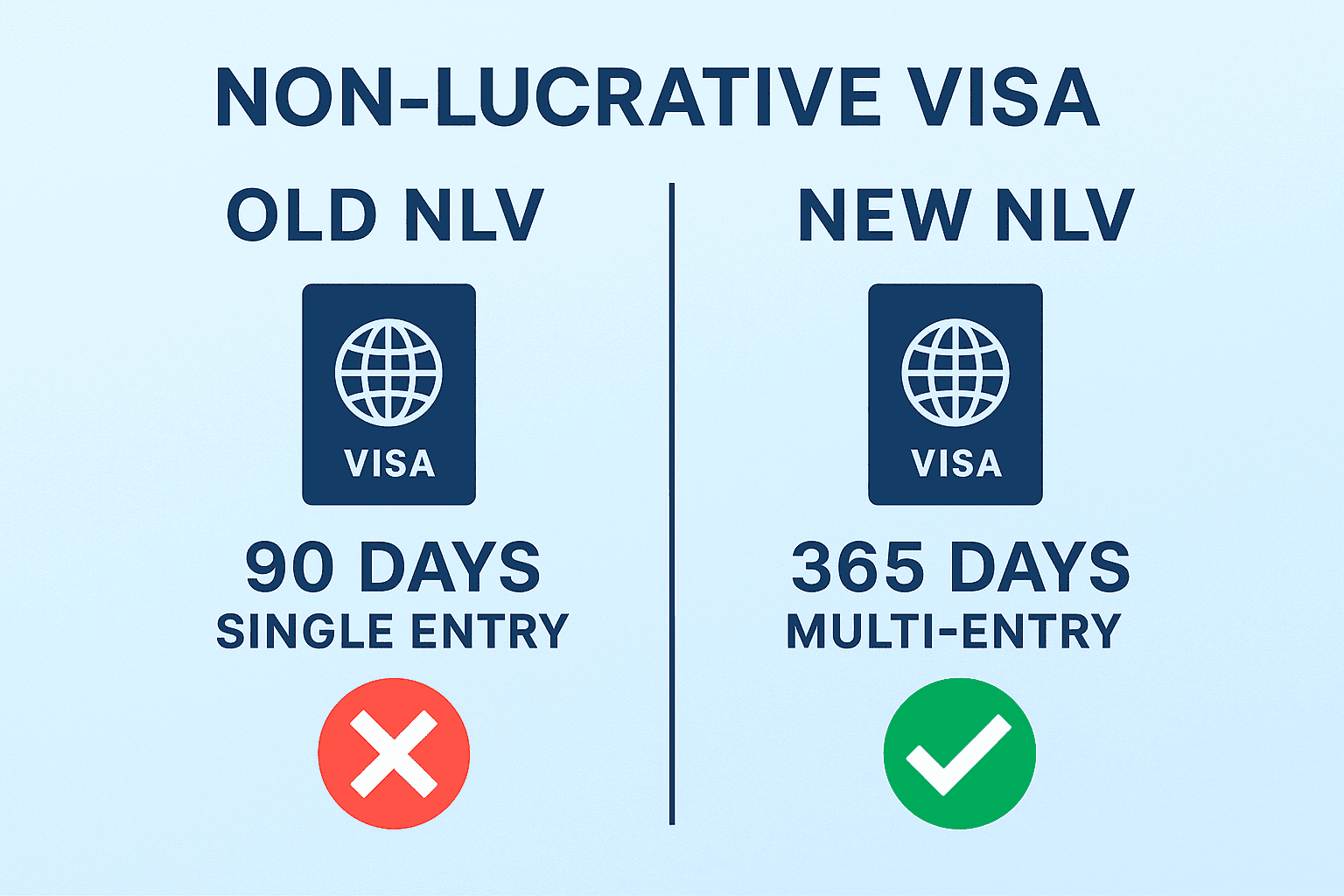
    Previously, once approved by a Spanish consulate abroad, successful applicants received a visa sticker in their passport valid for just 90 days. This meant you had to enter Spain within three months of issuance.

    As of June 2025, the validity has been extended to 365 days, and the visa is now issued as a multi-entry visa. This gives new residents much more freedom when arranging their move.


    Why This Matters

    • No rush to relocate
      With the extended validity period, you’re no longer pressured to move within 90 days. If you’re waiting for a property sale, closing down affairs back home, or simply needing more time to prepare, the 12-month window is a huge relief.

    • Travel flexibility
      Because the NLV is now multi-entry, you can travel in and out of Spain during that first year. This is especially useful if you’re renting while house-hunting, or if you have ongoing family or business commitments back home.

    Relocation experts confirm this is a positive change: “Moving abroad is a major step which often throws up unexpected issues. The extended visa validity gives applicants more breathing room and avoids unnecessary stress,” notes one Spanish immigration advisor.


    Key Deadlines to Keep in Mind

    • Start of residency: Your official residency date begins when you first enter Spain on the visa (the entry stamp in your passport is proof).

    • TIE application: Within one month of arrival, you must apply for your TIE card (Tarjeta de Identidad de Extranjero) at the local police station.

    • Renewal requirements: To renew your NLV after the first year, you must prove you spent at least 183 days in Spain during that period.

    ⚠️ Important: Spending 183+ days in Spain makes you a Spanish tax resident, meaning your worldwide assets and income may be subject to Spanish taxation. The Spanish tax year runs from January 1 to December 31.


    NLV Income Requirements for 2025

    To qualify, applicants must show proof of sufficient passive income or savings:

    • Main applicant: €2,400 per month (€28,800 per year)

    • Each dependent: €600 per month (€7,200 per year)

    Acceptable sources include pensions, savings, rental income, dividends, and investments. Income from employment or freelance work is not permitted under this visa.


    Planning Ahead

    If you’re considering relocating to Spain in 2026 or 2027, now is the time to familiarize yourself with the NLV process and its financial requirements.

    The extended 12-month validity period offers greater flexibility, but careful planning—especially around taxes, property sales, and residency obligations—remains essential for a smooth transition.


    👉 Whether you’re from the U.S., Britain, Canada, Australia, or elsewhere outside the EU, the Non-Lucrative Visa continues to be the most straightforward path to enjoying life in Spain—now with more breathing space than ever before.

    [siteorigin_widget class=”SiteOrigin_Widget_Image_Widget”][/siteorigin_widget]

    You can find much more information on visas in  Our Guide to Buying Property on the Costa del Sol

    [siteorigin_widget class=”WP_Widget_Block”][/siteorigin_widget]
    [siteorigin_widget class=”Ert_Title_Widget”][/siteorigin_widget]

    1. What is the Non-Lucrative Visa (NLV) in Spain?
    The Non-Lucrative Visa is a residency permit for non-EU citizens who want to live in Spain without working. It allows you to stay in Spain long-term, provided you can show sufficient financial means to support yourself and your family.

    2. Can Americans and Canadians apply for the NLV?
    Yes. The NLV is open to all non-EU citizens, including Americans, British, Canadians, Australians, and others. You apply at the Spanish consulate in your home country before relocating.

    3. How much income do I need to qualify for the NLV in 2025?
    For 2025, the minimum income requirement is €2,400 per month (€28,800 per year) for the main applicant, plus €600 per month (€7,200 per year) for each dependent. These funds must come from passive income such as pensions, savings, rental income, or investments.

    4. Can I work in Spain with the Non-Lucrative Visa?
    No. The NLV does not allow employment or freelance work in Spain. However, after holding residency for a certain period, it may be possible to modify your status to a different visa that permits work.

    5. Do I become a tax resident in Spain with the NLV?
    Yes, if you spend more than 183 days in Spain within a calendar year, you are considered a Spanish tax resident. This means your worldwide income and assets may be subject to Spanish taxation.

    6. How long is the Non-Lucrative Visa valid?
    Since June 2025, the NLV is issued as a multi-entry visa valid for 12 months. This gives you more time and flexibility when planning your move to Spain. After the first year, you can renew it for two years at a time.


    [siteorigin_widget class=”WP_Widget_Custom_HTML”][/siteorigin_widget]
  • The most common mistakes when selling a house in Spain

    The most common mistakes when selling a house in Spain

    According to data from idealista, the average price of existing homes in Spain rose by 12.8% year-on-year in May, hitting a historic peak of €2,391 per square metre. Despite the spike, many buyers remain active in the market—partly driven by recent interest rate reductions from the European Central Bank, which have lowered borrowing costs to around 2%.

    This optimism is reflected in a modest uptick in home sales: April saw 53,589 transactions, a 0.4% increase compared to the previous year, based on preliminary data from the College of Registrars. As demand surges, properties are often snapped up within days. Yet for those selling, speed can backfire—leading to costly missteps and diminished profits.


    💼 Preparing Your Home for Sale: Essential Documents

    Before listing your property, ensure you’ve gathered the required paperwork:

    • Energy Efficiency Certificate: Mandatory since June 2023. Issued following a site visit by a qualified technician; cost ranges from €60 to €130.
    • Nota Simple: Verifies there are no encumbrances on the home; available online for €9.20.
    • Occupation Licence: Certifies the property is safe and habitable. Fees range from €60 to €160.
    • Mortgage Cancellation: If the property is mortgaged, it must be paid off prior to sale. Expect fees between €400 and €500.


    💸 Understanding Your Tax Obligations

    Sellers may be liable for the following taxes depending on circumstances:

    Capital Gains Tax (IRPF)
    Levied on profits from the sale:

    Up to €6,000 – 19%
    €6,001–€50,000 – 21% 
    €50,001–€200,000 – 23%
    €200,001–€300,000 – 27%
    Over €300,000 – 28% 

    Exemptions apply if:

    • Profits are fully reinvested into a permanent residence.
    • Seller is over 65 and the home is their primary residence.
    • Seller is a dependent individual.

    Municipal Capital Gains Tax (Plusvalía)
    Charged by local councils based on the property’s value increase since purchase. Rates vary by municipality.


    🚫 Avoiding Common Seller Mistakes

    Selling property is often a once-in-a-decade event. It’s easy to overlook updated regulations or miscalculate expenses. Expert advice is key.


    🔍 Frequently Overlooked Costs:

    • Annual Property Tax (IBI): If you’re the registered owner on January 1st, you’re responsible for that year’s tax—unless you’ve negotiated otherwise with the buyer.
    • Notary Fees: Cancelling a mortgage involves signing a deed with a notary, which may cost up to €500.
    • Agency Fees: Commission fees depend on the agreement with the real estate agent and may be paid by the buyer or seller.


    📑 Checklist of Supporting Documents

    To ensure a smooth sale, have these documents ready:

    • Energy Certificate
    • Nota Simple
    • Homeowners’ association payment certificate (if applicable)
    • Association bylaws, service contracts, floorplans, original property documents
    • Certificate of IBI payments
    • Utility bills (water, electricity, gas)


  • Do I have to pay tax in Spain on the non-lucrative visa?

    Do I have to pay tax in Spain on the non-lucrative visa?


    As the name suggests, Spain’s non-lucrative visa or NLV doesn’t allow you to work, but that doesn’t necessarily mean you’re not liable to pay taxes here.

    The non-lucrative visa or NLV is a one-year residency visa that allows non-EU citizens to come and live in Spain and is extendable for a further two years.

    The main rule of the NLV is that you’re not allowed to work while in Spain, this means no working for companies within Spain, no remote work for companies outside of Spain and no self-employed work either.

    Because of this, it’s a popular choice for those who want to retire in Spain.

    So, if you’re not earning any money in Spain, does this mean you have to pay tax here or not?

    In short, yes, you will have to pay tax in Spain if you’re here on the NLV. 

    In order to be eligible for the NLV you have to have a substantial amount of savings or receive a certain amount of passive income to be able to support yourself here.

    This passive income could be from receiving a pension, rental payments for a property you own abroad, returns on investments or capital gains from the sale of assets.

    So even though you’re not physically working while living in Spain, you are still earning money in some form, even if this is only a small amount of interest on your savings. All of it is taxable. 

    In order to be eligible for the NLV, you need to prove you have 400 times the amount of the IPREM which for 2025 is €2,400 per month in passive income or savings of €28,800 for the year.

    Spanish law states that if you’re resident in Spain you must pay income tax on your worldwide income and capital gains.

    If you’re here on a one-year visa and stay in Spain over the 183-day threshold then you will be subject to paying tax here. If you don’t spend a minimum of 183 days, you won’t be able to renew your NLV.

    This means that even though you are prohibited from working while on this visa, your passive income is still taxable and you will pay tax on your global income.

    Interest on savings or capital gains are taxed at the following rates:

    • 19 percent for the first €6,000 of taxable income
    • 21 percent for the following €6,000 to €50,000
    • 23 percent for the next €50,000 to €200,000 
    • 27 percent €200,000 to €300,000
    • 28 percent for any amounts over €300,000.

    You will also be taxed on pensions and other passive income such as rent from abroad. This will be taxed at a different rate.

    Income tax is charged at the same rate for general income and pensions and is subject to progressive tax rates ranging from 19 up to 47 percent.

    • Up to €12,450: 19 percent
    • €12,451 – €20,200: 24 percent
    • €20,201 – €35,200: 30 percent
    • €35,201 – €60,000: 37 percent
    • €60,001 – €300,000: 45 percent
    • Over €300,000: 47 percent

    If you’re eligible for the NLV and are earning €20,200 to €35,200 for example, you will be taxed at a rate of 30 percent. The exact amount you will pay, however, will depend on your individual circumstances.

    You will be liable to file the annual Declaración de Renta for the previous year. It’s typically due at the end of June and on it, you will declare all your passive income and capital gains.

    You may also be subject to pay wealth tax, as well as inheritance and gift tax, so it’s important that you contact a gestor or tax expert to find out exactly how much you’ll pay.

    If you’re also subject to paying tax in your home country, Spain has double taxation agreements in place with many countries to ensure you don’t pay tax on the same money twice.