Living in La Zagaleta: Community Fees, Memberships & Lifestyle Costs (2026)

La Zagaleta is widely regarded as one of Europe’s most exclusive residential estates. Set in the hills above Marbella in Benahavís, it combines vast private plots, strict security, and a members-only lifestyle that prioritises discretion and space.
For buyers considering a move here, the key question is often not just the purchase price — but the ongoing cost of ownership. This guide explains the running costs most owners budget for: estate community fees, club memberships (golf vs social), and the additional “real-life” costs that come with owning a large villa in a low-density private estate.
Important: some figures below are published as guidance across reputable local market sources, but La Zagaleta does not publicly list a full fee schedule online. Treat these as 2026 budgeting ranges, then confirm the exact costs during due diligence.
Community fees in La Zagaleta (estate running costs)
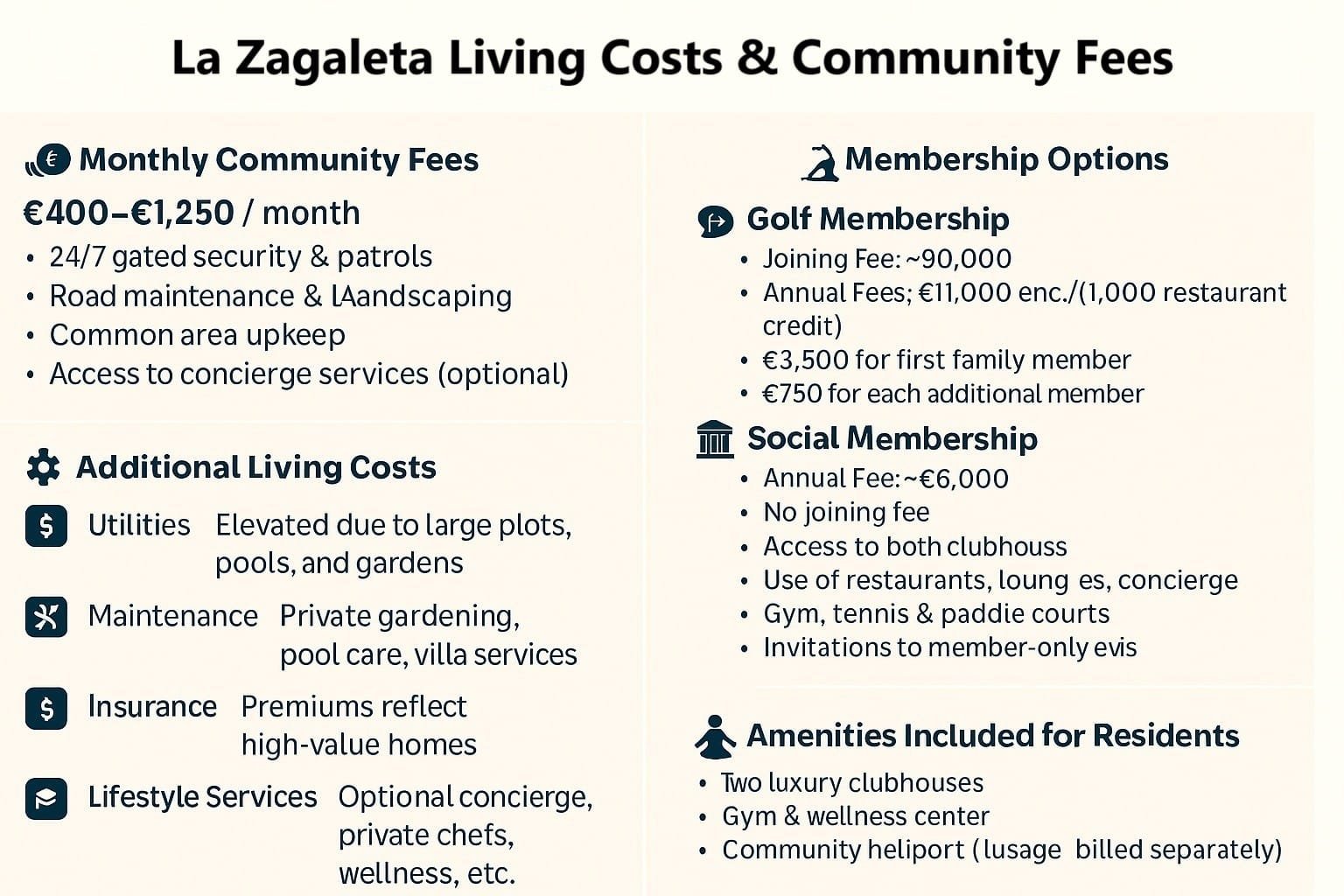
Community fees in La Zagaleta are among the highest on the Costa del Sol — and that’s largely because the estate is huge. You’re contributing to round-the-clock gate security, private roads, protected landscape management and the general running of a controlled-access environment.
As a practical 2026 budgeting guide, many owners allow roughly €8,000 to €15,000+ per year, with the exact amount varying by plot size, location and how the community cost structure is applied to your specific property.
In simple terms, these fees are typically supporting:
- 24-hour gated security and controlled access points
- Maintenance of private roads, lighting and estate infrastructure
- Landscaping and stewardship of communal/protected natural zones
- Estate management and administration (including coordination services)
What they don’t usually include: golf or social club membership, private villa maintenance, or property-specific services such as pool care, gardening, security systems, or staff.
La Zagaleta memberships in 2026: golf vs social
Ownership in La Zagaleta gives residents the option to join the private club. Membership isn’t compulsory — plenty of owners choose La Zagaleta primarily for the estate setting and security — but the club is central to the lifestyle for many families. The two most common options are golf membership and social membership.
Golf membership (budgeting guidance for 2026)
Golf membership is the “full access” option: it’s commonly described as providing access to La Zagaleta’s two private golf courses and the broader club environment. Most published guidance references a significant one-off joining fee plus annual dues.
Typical reported costs (guide only):
- Joining fee: commonly reported in the region of €90,000–€100,000
- Annual fee (title owner): often reported around €11,000 per year (some sources note restaurant credit may apply)
- Additional family members: often reported as an extra annual fee per person (commonly quoted around €3,500 for the first additional member, then lower for further members)
What you’re effectively paying for is privacy and availability: limited tee times, a quieter playing environment, and a club rhythm that feels more “members-only country club” than “commercial golf resort”.
Note: different membership categories can exist (for example, owner vs limited non-resident options), and terms can change — so treat the figures above as a budgeting anchor and confirm the live schedule directly with the club.
Social membership (budgeting guidance for 2026)
Social membership is designed for owners who want the club atmosphere — dining, social life and facilities — without golf course access. It’s a popular option for families who use the estate as a retreat but still want a sense of community when they’re in residence.
Typical reported costs (guide only):
- Joining fee: often reported as none (confirm for your membership category)
- Annual fee: commonly reported around €6,000 per year
As always, membership pricing and inclusions can change; confirm the current terms directly with the club as part of due diligence.
What residents actually use: amenities & services
Beyond golf, La Zagaleta operates as a private estate with club-style infrastructure. Some facilities are tied to membership, while others are pay-as-you-use. The key point is that life here is intentionally low-footfall — the facilities are built for residents, not day visitors.
Clubhouses & dining
Owners often describe the clubhouses as the social heart of the estate: dining, terraces, meeting spaces and quiet “third spaces” that make the estate feel complete, especially for longer stays.
Wellness, tennis & day-to-day activity
Depending on membership level and service model at the time, residents may have access to gym facilities and racket sports, with coaching and treatments typically billed separately. The overall feel is private and curated, rather than “busy gym schedule”.
Helipad access and the “private helipad” question
La Zagaleta is widely associated with helicopter access. The estate has a community helipad, while private helipads within individual villas are generally described as restricted in practice due to community rules and noise considerations — something to check carefully if it’s important to you.
Equestrian facilities
The estate also offers equestrian facilities and riding trails through protected countryside — one of the reasons La Zagaleta feels more like a private country estate than a typical gated community.
Other costs to budget for in 2026 (often overlooked)
The biggest misunderstanding we see is assuming “community fees + membership” equals the full running cost. With large villas and big plots, the real-world ownership budget is usually driven by the property itself: staffing, maintenance, gardens, utilities and preventative upkeep.
Here are the main categories owners typically plan for:
- Local property taxes: IBI (annual council tax) plus basura (refuse collection) — both vary by cadastral values and local rates
- Utilities: electricity, water, internet, alarm monitoring (large homes can vary significantly by usage)
- Garden & pool: a major line item for big plots, especially if you’re maintaining a “show home” standard
- Home insurance: rebuild cost and contents, plus optional liability / staff cover
- Staffing: housekeeping, gardeners, security, property management — depending on how often you’re in residence
- Planned maintenance: resurfacing terraces, repainting, HVAC servicing, pool plant, waterproofing, and ongoing upgrades to keep the home “turnkey”
If you’d like, we can help you model a realistic annual budget based on the specific villa you’re considering (plot size, build size, orientation, gardens and technical systems), not a generic headline figure.
What you’re really paying for
The cost of living in La Zagaleta reflects its position as a low-density, ultra-secure estate with extensive land, strict planning controls and long-term value protection. For many owners, the fees are justified by privacy, consistency, and the absence of overdevelopment — while the “true” running costs are mostly tied to maintaining a large home to the standard the estate is known for.
FAQs
Are La Zagaleta memberships compulsory?
No. Many owners choose to join, but membership is optional.
Is the golf membership really a €90k–€100k joining fee?
Multiple published local sources commonly reference a joining fee in that region plus annual dues (often cited around €11k for the title owner). Confirm the exact schedule directly with the club during due diligence.
Do community fees include golf or club access?
Typically no — estate community fees and club memberships are separate line items.
Can a villa have a private helipad?
Some villas may show helipad features, but usage is commonly described as restricted in practice due to community rules and noise considerations. Treat this as a “confirm early” topic if it matters to you.
What’s the most underestimated cost?
Villa upkeep on a large plot: gardens, pool plant, technical systems, preventative maintenance, and (if needed) staffing or professional property management.
Related reading
You can explore current villas for sale in La Zagaleta here.
Considering alternatives? See our comparison guide:
La Zagaleta vs El Madroñal vs El Herrojo.