Tag: Australian

  • How Estate Agents Work on the Costa del Sol

    How Estate Agents Work on the Costa del Sol

    [siteorigin_widget class=”Ert_Title_Widget”][/siteorigin_widget]

    The Costa del Sol is one of Europe’s most international property markets. Buyers arrive from across the globe—Britain, Scandinavia, Belgium, France, the Netherlands, the Middle East, the United States, Canada, and beyond. With such a diverse client base, the real estate sector here has developed a unique way of working: collaboration between agencies.

    Unlike some countries where agencies guard their listings closely, the Costa del Sol real estate market thrives on cooperation. This benefits not only buyers and sellers but also the agents themselves, creating an ecosystem where everyone can succeed.

    A Multi-National Buyer Landscape

    One of the defining features of the Costa del Sol property market is its global reach. International buyers often prefer to work with an agency that speaks their mother tongue, understands their cultural expectations, and can guide them through the Spanish legal and financial framework.

    For example:

    • A Swedish family might feel more comfortable with a Scandinavian-run agency.

    • A British retiree may seek advice from a UK-origin agent familiar with pension transfers and non-lucrative visas.

    • A Belgian investor might prefer to speak in French or Flemish when discussing taxation.

    This is where the collaborative system shines—because no single agency can cater to every nationality with the same depth of cultural understanding.

    [siteorigin_widget class=”SiteOrigin_Widget_Image_Widget”][/siteorigin_widget]

    How Agency Collaboration Works

    On the Costa del Sol, most agencies operate within a shared listing network. Properties listed by one agency are often available to others, allowing them to present the same homes to their own clients.

    Here’s how it works in practice:

    1. Exclusive Listing – A seller signs a contract with one agency to market their property. That agency becomes the “listing agent.”

    2. Shared Access – Other agencies are granted access to the property details, photos, and pricing through central databases or personal collaboration agreements.

    3. Buyer Representation – A second agency may introduce the property to their client, negotiate on their behalf, and accompany them through the purchase.

    4. Commission Split – When a deal is completed, the commission is shared between the listing agent and the buyer’s agent, typically on a 50/50 basis.

    This system ensures that a buyer from, say, Norway can work with a trusted Norwegian-speaking agent, but still gain access to the full range of properties across Marbella, Benahavís, Estepona, and beyond.

    [siteorigin_widget class=”SiteOrigin_Widget_Image_Widget”][/siteorigin_widget]

    Why Collaboration Benefits Buyers

    For international buyers, this collaborative model is highly advantageous:

    • Access to the Entire Market – You don’t have to jump between dozens of agencies. Your trusted agent can show you virtually any property available on the Costa del Sol.

    • Language & Trust – You work with someone who speaks your language, understands your culture, and is on your side—while still tapping into the wider market.

    • Streamlined Process – Instead of negotiating separately with multiple sellers’ agents, your buyer’s agent handles everything, from scheduling viewings to coordinating with lawyers.

    • Read our top 3 tips to buying a property here ->

    Why Collaboration Benefits Sellers

    Sellers also reap the rewards:

    • Wider Reach – Their property is marketed not just by one agency, but by many—reaching international buyers across multiple countries.

    • Professional Representation – The listing agent ensures consistent information, quality photography, and controlled pricing, while partner agents bring qualified buyers to the table.

    • Faster Sales – With so many agents collaborating, the chances of finding the right buyer—whether from Madrid, London, Stockholm, or Toronto—are significantly higher. Learn more about how we work for our vendors here ->

    Final Thoughts

    The Costa del Sol real estate market is unlike most others in Europe. It thrives on collaboration, not competition.

    This cooperative system makes buying property in southern Spain far more transparent and efficient for international buyers, while giving sellers unparalleled exposure to a global audience. Most importantly, it allows buyers to work with an agency they feel most comfortable with—often one that speaks their mother tongue—while still enjoying full access to the region’s finest properties.

    If you’re considering buying on the Costa del Sol, we work within this collaborative framework every day—partnering with trusted agencies, developers, and specialists to make sure our clients have the widest possible choice and the most reliable guidance. We also have a comprehensive guide to Buying A Property in Spain which you can download here ->
  • The Non-Lucrative Visa (NLV): More Flexibility for Non-EU Citizens Moving to Spain

    The Non-Lucrative Visa (NLV): More Flexibility for Non-EU Citizens Moving to Spain

    [siteorigin_widget class=”WP_Widget_Block”][/siteorigin_widget]
    [siteorigin_widget class=”Ert_Title_Widget”][/siteorigin_widget]

    The Non-Lucrative Visa (NLV) remains the most popular pathway for non-EU citizens—such as Americans, British, Canadians, Australians, and others—looking to settle in Spain.

    Designed for individuals who do not intend to work during their initial stay, the NLV allows applicants to gain Spanish residency while bypassing the standard 90-day tourist rule that restricts stays in the Schengen Area.

    In recent years, the application process has evolved, with consulates around the world increasingly using third-party agencies (such as BLS International in some regions) to manage submissions. But a major update introduced in mid-2025 now gives applicants far greater flexibility when planning their relocation.


    What’s Changed?

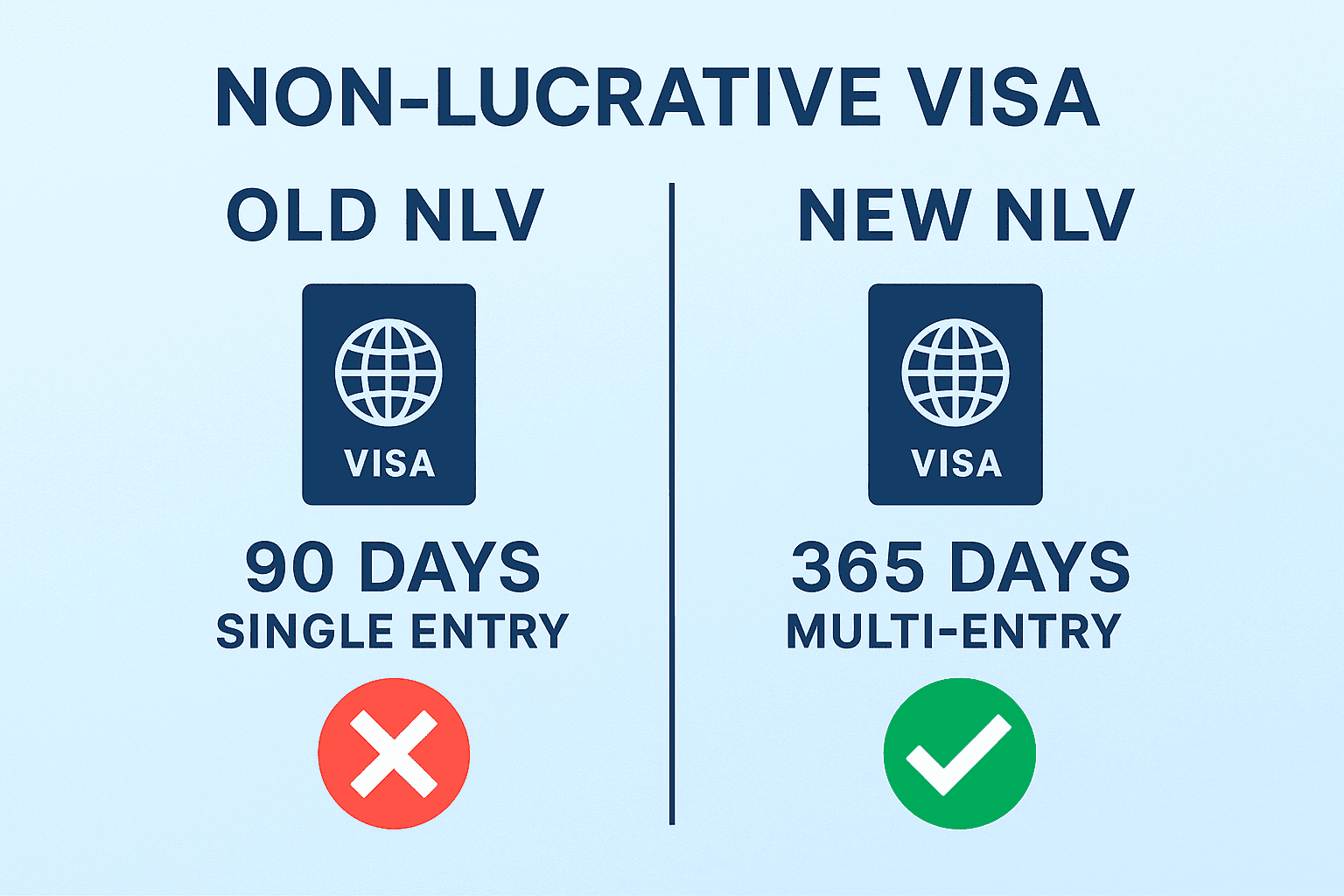
    Previously, once approved by a Spanish consulate abroad, successful applicants received a visa sticker in their passport valid for just 90 days. This meant you had to enter Spain within three months of issuance.

    As of June 2025, the validity has been extended to 365 days, and the visa is now issued as a multi-entry visa. This gives new residents much more freedom when arranging their move.


    Why This Matters

    • No rush to relocate
      With the extended validity period, you’re no longer pressured to move within 90 days. If you’re waiting for a property sale, closing down affairs back home, or simply needing more time to prepare, the 12-month window is a huge relief.

    • Travel flexibility
      Because the NLV is now multi-entry, you can travel in and out of Spain during that first year. This is especially useful if you’re renting while house-hunting, or if you have ongoing family or business commitments back home.

    Relocation experts confirm this is a positive change: “Moving abroad is a major step which often throws up unexpected issues. The extended visa validity gives applicants more breathing room and avoids unnecessary stress,” notes one Spanish immigration advisor.


    Key Deadlines to Keep in Mind

    • Start of residency: Your official residency date begins when you first enter Spain on the visa (the entry stamp in your passport is proof).

    • TIE application: Within one month of arrival, you must apply for your TIE card (Tarjeta de Identidad de Extranjero) at the local police station.

    • Renewal requirements: To renew your NLV after the first year, you must prove you spent at least 183 days in Spain during that period.

    ⚠️ Important: Spending 183+ days in Spain makes you a Spanish tax resident, meaning your worldwide assets and income may be subject to Spanish taxation. The Spanish tax year runs from January 1 to December 31.


    NLV Income Requirements for 2025

    To qualify, applicants must show proof of sufficient passive income or savings:

    • Main applicant: €2,400 per month (€28,800 per year)

    • Each dependent: €600 per month (€7,200 per year)

    Acceptable sources include pensions, savings, rental income, dividends, and investments. Income from employment or freelance work is not permitted under this visa.


    Planning Ahead

    If you’re considering relocating to Spain in 2026 or 2027, now is the time to familiarize yourself with the NLV process and its financial requirements.

    The extended 12-month validity period offers greater flexibility, but careful planning—especially around taxes, property sales, and residency obligations—remains essential for a smooth transition.


    👉 Whether you’re from the U.S., Britain, Canada, Australia, or elsewhere outside the EU, the Non-Lucrative Visa continues to be the most straightforward path to enjoying life in Spain—now with more breathing space than ever before.

    [siteorigin_widget class=”SiteOrigin_Widget_Image_Widget”][/siteorigin_widget]

    You can find much more information on visas in  Our Guide to Buying Property on the Costa del Sol

    [siteorigin_widget class=”WP_Widget_Block”][/siteorigin_widget]
    [siteorigin_widget class=”Ert_Title_Widget”][/siteorigin_widget]

    1. What is the Non-Lucrative Visa (NLV) in Spain?
    The Non-Lucrative Visa is a residency permit for non-EU citizens who want to live in Spain without working. It allows you to stay in Spain long-term, provided you can show sufficient financial means to support yourself and your family.

    2. Can Americans and Canadians apply for the NLV?
    Yes. The NLV is open to all non-EU citizens, including Americans, British, Canadians, Australians, and others. You apply at the Spanish consulate in your home country before relocating.

    3. How much income do I need to qualify for the NLV in 2025?
    For 2025, the minimum income requirement is €2,400 per month (€28,800 per year) for the main applicant, plus €600 per month (€7,200 per year) for each dependent. These funds must come from passive income such as pensions, savings, rental income, or investments.

    4. Can I work in Spain with the Non-Lucrative Visa?
    No. The NLV does not allow employment or freelance work in Spain. However, after holding residency for a certain period, it may be possible to modify your status to a different visa that permits work.

    5. Do I become a tax resident in Spain with the NLV?
    Yes, if you spend more than 183 days in Spain within a calendar year, you are considered a Spanish tax resident. This means your worldwide income and assets may be subject to Spanish taxation.

    6. How long is the Non-Lucrative Visa valid?
    Since June 2025, the NLV is issued as a multi-entry visa valid for 12 months. This gives you more time and flexibility when planning your move to Spain. After the first year, you can renew it for two years at a time.

    [siteorigin_widget class=”WP_Widget_Custom_HTML”][/siteorigin_widget]
  • How to Get a NIE Number in Spain (2026 Step-by-Step)

    How to Get a NIE Number in Spain (2026 Step-by-Step)

    How to Get a NIE Number in Spain in 2026

    A step-by-step guide for expats


    If you’re planning to live, work, study or buy property in Spain, one of the first things you’ll need is a
    NIE number (Número de Identificación de Extranjero).

    This unique foreigner identification number is essential for most legal, financial and administrative processes in Spain — from opening a bank account and signing a property deed to paying taxes or enrolling children in school.

    This updated 2026 guide explains what a NIE is, who needs one, how to apply, what documents are required, typical costs, and practical tips to avoid delays.

    What is a NIE number?

    A NIE is a personal identification number issued to non-Spanish nationals for tax and legal purposes. It is used across all interactions with Spanish authorities and institutions.

    Important: The NIE itself is permanent. Once issued, it is valid for life and does not expire — even if your residency status changes.

    Who needs a NIE in Spain?

    • EU / EEA citizens: Must register as residents and obtain a NIE if staying in Spain for more than 90 days.
    • Non-EU citizens (UK, USA, Canada, etc.): Are automatically assigned a NIE as part of their residency (TIE) application.

    Even non-residents often need a NIE to buy property, open a Spanish bank account or pay taxes.

    How to get a NIE number in Spain (step-by-step)

    1. Book your appointment (cita previa)

    NIE applications must be submitted by appointment through Spain’s official government booking system.

    • Visit the official cita previa portal
    • Select your province
    • Choose the correct procedure:
      • “Certificados UE” — for EU citizens
      • “Asignación de NIE / Tarjeta de Identidad de Extranjero” — for non-EU citizens
    • Enter your personal details and confirm the appointment

    Tip: In popular areas such as Málaga, Marbella or Madrid, appointments can take 4–8 weeks. Applying via a Spanish consulate abroad may take longer.

    2. Prepare the required documents

    While requirements can vary slightly by province, you will typically need:

    • Application form
      – EU citizens: Form EX-18
      – Non-EU citizens (NIE-only request): Form EX-15
    • Proof of purpose (why you need a NIE): property purchase, job offer, business activity, study enrolment, etc.
    • Passport: original plus photocopies
    • Passport photos (usually 1–2, colour)
    • Proof of legal entry or visa (non-EU citizens)
    • Form 790 Código 012 — NIE tax payment receipt

    📌 All forms must be completed in Spanish. Only Spanish-language versions are accepted.

    3. Pay the NIE fee

    The NIE fee is paid using Form 790, Código 012.

    In 2026, the fee is typically around €12, though minor adjustments may occur. Payment can be made at most Spanish banks or ATMs after printing the form.

    4. Attend your appointment

    Attend your appointment at the Oficina de Extranjería or Policía Nacional with all original documents and copies.

    Depending on the office, your NIE may be issued immediately or collected within 5–10 working days.

    Helpful tips to avoid delays

    • Bring photocopies of everything — including your passport
    • Check local requirements in advance, as rules can vary slightly by region
    • Arrive early for your appointment
    • Store your NIE safely — you’ll need it frequently

    Frequently asked questions

    Is a NIE number permanent?
    Yes. Once issued, your NIE is valid for life.

    Can I apply for a NIE before moving to Spain?
    Yes. Applications can be made through a Spanish consulate abroad, though processing times are usually longer.

    Do I need a job or property to get a NIE?
    No, but you must provide a legitimate reason for requesting one.

    How much does a NIE cost in 2026?
    Approximately €12, subject to minor annual adjustments.

    Final thoughts

    Obtaining a NIE is one of the most important first steps when moving to Spain. Once you have it, you can legally:

    • Open Spanish bank accounts
    • Buy or rent property
    • Sign employment or business contracts
    • Pay taxes and register for healthcare or education

    If you’re planning to relocate or buy property, understanding the NIE process early will save you time and stress later on.