Category: Market Analysis

  • Can Owners Request a New Vote on Short-Term Rentals in Andalusia?

    Can Owners Request a New Vote on Short-Term Rentals in Andalusia?

    Can Owners Request a New Vote on Short-Term Rentals in Andalusia?

    Understanding Your Rights After a Community “No”


    In places such as Benahavís, the debate over short-term rentals rarely feels abstract. It sits at the point where lifestyle, investment, privacy and community harmony all meet. Since the latest legal changes took effect, many owners have been asking a more precise question: if a community has already voted against tourist rentals, can that issue be brought back for another vote?

    The answer is yes, but the route matters. Spanish horizontal property law does not treat one unsuccessful vote as the end of the story. A community can revisit the issue at a later meeting. However, the way that reconsideration reaches the agenda, and the way any new decision is approved, must follow the proper legal process.

    The starting point: an owner can ask for the issue to return to the agenda

    Under the Ley de Propiedad Horizontal, any owner may ask for a matter of community interest to be studied and voted on by the owners’ meeting. That request should be made in writing, clearly identifying the issue to be discussed, and it should be sent to the president. The law states that the president will include it on the agenda of the next meeting.

    That distinction matters. An owner is not simply reopening the issue informally in conversation or WhatsApp chat. The correct route is a written agenda request. In practical terms, that means the owner should frame the point carefully, make the wording clear, and submit it before notice of the next annual meeting is circulated.

    A new vote is possible, but an extraordinary meeting is different

    Where some owners get caught out is in assuming that the right to request a topic is the same as the right to force an immediate extraordinary meeting. It is not. If the aim is to wait for the next AGM, the legal position is comparatively straightforward: submit the written request in time and ask for the matter to be placed on the agenda.

    If the aim is to accelerate the issue and bring it forward sooner, the threshold is higher. An extraordinary meeting may be called by the president, but it may also be requested by at least one quarter of the owners, or by owners representing at least 25% of the participation quotas. In other words, one owner alone may be able to place the issue before the next ordinary meeting, but usually cannot compel an immediate extraordinary meeting without broader support.

    A previous “no” does not permanently close the door

    A prior refusal does not create a permanent legal lock. Communities are allowed to reconsider issues when circumstances change, when a proposal is better structured, or when owners wish to revisit the implications of an earlier decision. In a place like Benahavís, that is particularly relevant because opinion often shifts once owners move from a vague debate about “holiday lets” to a more detailed discussion about management standards, insurance, quiet-hours, guest controls and community safeguards.

    That is why the quality of the second proposal often matters more than the fact that there was a first refusal. A poorly explained request may attract instinctive opposition. A measured proposal, by contrast, can reframe the question away from disruption and toward governance, control and enforceable standards.

    Why the 2025 reform changed the conversation

    The national reform that entered into force on 3 April 2025 altered the landscape in a meaningful way. For owners who want to start tourist-rental activity after that date, prior express community approval is now central. The relevant community decision sits within the 3/5 majority framework applied to approvals, restrictions, conditions and prohibitions for that activity.

    That makes the community vote much more significant than it once was. In many cases, the question is no longer simply whether the community objects in principle. It is whether the owner can obtain the express approval now required for a new tourist-rental use. At the same time, owners who were already lawfully exercising that activity before the reform came into force may fall within a different transitional position, which is why timing and documentation are now so important.

    Andalusia adds another layer, not a substitute

    Andalusia’s own regulatory framework also tightened recently, and that has added to the confusion. In practice, however, the regional regime does not replace community approval issues. It sits alongside them. A property may still need to satisfy the Andalusian tourist-rental rules, local planning constraints and building-specific community rules at the same time. In short, owners should avoid treating the regional registration process as though it overrides what the community can decide under horizontal property law.

    For Benahavís owners, that is where a more strategic approach becomes important. The legal mechanics matter, but so does presentation. Communities are far more likely to engage seriously with a proposal that feels neighbour-conscious, professionally managed and limited by clear conditions.

    How to ask for a fresh vote intelligently

    The most effective requests are usually the calmest ones. Rather than simply asking the community to reverse itself, it is often better to invite reconsideration of the issue in light of a responsible operating framework. That can include professional management, emergency contact details, insurance, noise-control rules, guest registration procedures, occupancy limits and clear consequences for breaches.

    That approach does two things at once. First, it makes the agenda request feel constructive rather than confrontational. Second, it gives undecided owners something practical to assess. In communities where the first vote was driven by uncertainty, that can make a material difference.

    The practical conclusion

    Yes, an owner can request that short-term rentals be put back before the community for a new vote. The law gives owners a route to ask for that issue to be included on the agenda of the next meeting. What an owner cannot usually do alone is force an immediate extraordinary meeting without the support required by law.

    That means the real opportunity lies in timing, wording and preparation. In today’s legal climate, especially in Andalusia, communities are no longer just debating principle. They are deciding how much control they want, what standards they expect, and whether a carefully regulated model is preferable to a blanket refusal. For owners who still want the issue reconsidered, the most persuasive move is rarely a louder argument. It is a better one.

    Download the supporting documents

    If you are preparing to raise the issue in your own community, you can make the process feel more professional from the outset. We recommend sending a formal written request, attaching a neighbour-conscious proposal, and circulating a measured briefing to other owners before the meeting.

    We have created draft documents which you can use in your community:

    If you would like editable word versions of these documents, please feel free to ask.

    If you are looking to sell your property in benahavis, we have marketing strategies for both properties with and without rental licences, highlighting the benefits of both. We would love to discuss marketing your home.

    Related Reading

    This article is provided for general information only and does not constitute legal advice. Community statutes, prior resolutions, registry position, municipal rules and the exact timing of any tourism registration can all affect the outcome in a specific case.

    Looking for a home outside Benahavís?
    Holiday Homes Spain
    covers the whole Costa del Sol.

    [siteorigin_widget class=”WP_Widget_Custom_HTML”][/siteorigin_widget]
  • Bringing Pets to Spain: Travel & Relocation Guide

    Bringing Pets to Spain: Travel & Relocation Guide

    Bringing Your Pets to Spain: A Complete Guide for Visitors and Future Residents

    Woman and her pet enjoying a sunset by the beach on the Costa del Sol

    Spain is one of Europe’s most welcoming destinations for pet owners. The outdoor lifestyle, mild climate and abundance of natural space make it an excellent place for dogs and cats to thrive. Whether you are planning a holiday on the Costa del Sol or considering a permanent move to southern Spain, travelling with your pets is entirely possible with the right preparation.

    For many people relocating to the Marbella and Benahavís area, pets are part of the family. Fortunately, Spain has clear and well-established regulations for bringing animals into the country, and the Costa del Sol offers excellent veterinary care, outdoor space and a pet-friendly culture.

    This guide explains how the process works — from entry requirements and paperwork to travel logistics and what everyday life looks like for pets once you arrive.


    Understanding Spain’s Pet Travel Rules

    Veterinarian scanning a cat's microchip with handheld scanner

    Spain follows the European Union’s standard regulations for the movement of companion animals. These rules exist primarily to protect public health and ensure that animals entering the country meet strict vaccination and identification requirements.

    The simplified travel system applies to dogs, cats and ferrets. Other animals such as birds, reptiles or rodents are subject to separate import procedures and may require additional documentation.

    In general, pets entering Spain must travel with their owner or with a person authorised by the owner, and most journeys are limited to a maximum of five animals unless they are travelling for recognised competitions or exhibitions. The essential requirements centre around three things: identification, vaccination and proper health certification.

    Once these conditions are met, bringing a pet to Spain is usually straightforward.


    Visiting Spain with Your Pet

    Golden retriever sitting at a terrace café on the Costa del Sol with sea views and palm trees

    Many visitors to the Costa del Sol choose to travel with their pets, especially those staying for longer holidays or spending time in private villas and apartments. Spain’s relaxed lifestyle makes it easy to include your dog or cat in everyday activities, from outdoor dining to countryside walks.

    However, before travelling, it is essential that your pet meets Spain’s entry requirements.

    Microchip Identification

    The first requirement is proper identification. Pets entering Spain must have an ISO-compliant microchip that meets international standards (ISO 11784 or 11785). The microchip must be implanted before the rabies vaccination is administered, as the vaccination record is linked to the chip number.

    Tattoos are only accepted if they were applied before 3 July 2011 and are clearly readable.

    Rabies Vaccination

    Rabies control is central to the EU’s pet travel rules. All pets must have a valid rabies vaccination administered after microchipping. The animal must be at least 12 weeks old at the time of vaccination.

    If the vaccination is being given for the first time, travellers must wait at least 21 days before entering Spain. Booster vaccinations given before the previous one expires usually do not require this waiting period.

    Pet Passport or Animal Health Certificate

    Documentation depends on where you are travelling from.

    Travellers coming from EU countries can use the standard EU Pet Passport issued by a veterinarian. Visitors arriving from outside the EU must instead obtain an EU Animal Health Certificate issued by an official veterinarian in their home country within ten days of travel.

    This certificate confirms that the pet meets the EU’s identification and vaccination rules.

    Rabies Antibody Blood Test

    Depending on the country of origin, pets may also require a rabies antibody titration test. This blood test confirms that the vaccination has produced adequate immunity.

    The test must be carried out at an approved laboratory, and a waiting period typically applies before travel. Many travellers moving from outside the EU plan this step several months in advance.


    Flying to Spain with Pets

    Dog in pet carrier on airplane to Spain

    Air travel is the most common way to bring pets to Spain. Most airlines allow small animals to travel in the cabin if they remain inside an approved carrier, while larger animals usually travel in a climate-controlled cargo area.

    Each airline has its own policies regarding weight limits, crate dimensions and booking procedures, so it is important to check the details before planning your journey.

    Some owners prefer to use specialised pet relocation companies, particularly for long-distance moves. These services handle the paperwork, transport logistics and veterinary documentation required for international travel.

    If you are arriving from outside the EU, you must also enter through an airport authorised to process animal imports.


    Arriving in Spain with Your Pet

    Once you arrive in Spain, you will normally pass through a brief veterinary inspection point where officials may check your pet’s microchip and documentation. Provided all requirements are met, the process is usually quick.

    After arrival, most visitors are pleasantly surprised by how welcoming Spain is for animals. Dogs are commonly seen on restaurant terraces, in parks and on hiking trails. The Costa del Sol in particular has a strong outdoor culture that suits pet owners perfectly.

    The surrounding countryside of Benahavís offers miles of walking routes, forest paths and quiet mountain trails. Nearby beaches also include designated dog-friendly areas depending on the municipality and season.

    For visitors staying in the region, the lifestyle can feel surprisingly easy with a pet.


    Moving to Spain with Your Pet

    Family walking their dog near a villa in Benahavís on the Costa del Sol

    If you are relocating permanently to Spain, the entry requirements remain largely the same as those for holiday travel. However, there are a few additional considerations once you begin living in the country full-time.

    Long-term planning becomes more important, particularly when arranging transport, housing and veterinary care.

    Many families relocating to the Costa del Sol bring their pets with them, and the region has a well-developed infrastructure to support this lifestyle.

    Registering Your Dog in Spain

    Once you become a resident, dogs must usually be registered with your local town hall, known in Spain as the Ayuntamiento. This registration helps municipalities manage vaccination records and animal welfare standards.

    Some breeds are classified under Spain’s Potentially Dangerous Dogs (PPP) regulations. Owners of these breeds must obtain a special licence, hold liability insurance and comply with additional safety rules.

    Most pets, however, fall outside these regulations.

    Veterinary Care on the Costa del Sol

    Spain offers excellent veterinary services, and the Costa del Sol has many modern clinics staffed by experienced professionals. Routine care such as vaccinations, microchipping and health checks is generally affordable compared with many northern European countries.

    Many veterinary clinics in the Marbella and Benahavís area also operate in English, which makes the process easier for international residents.


    Life in Benahavís with Pets

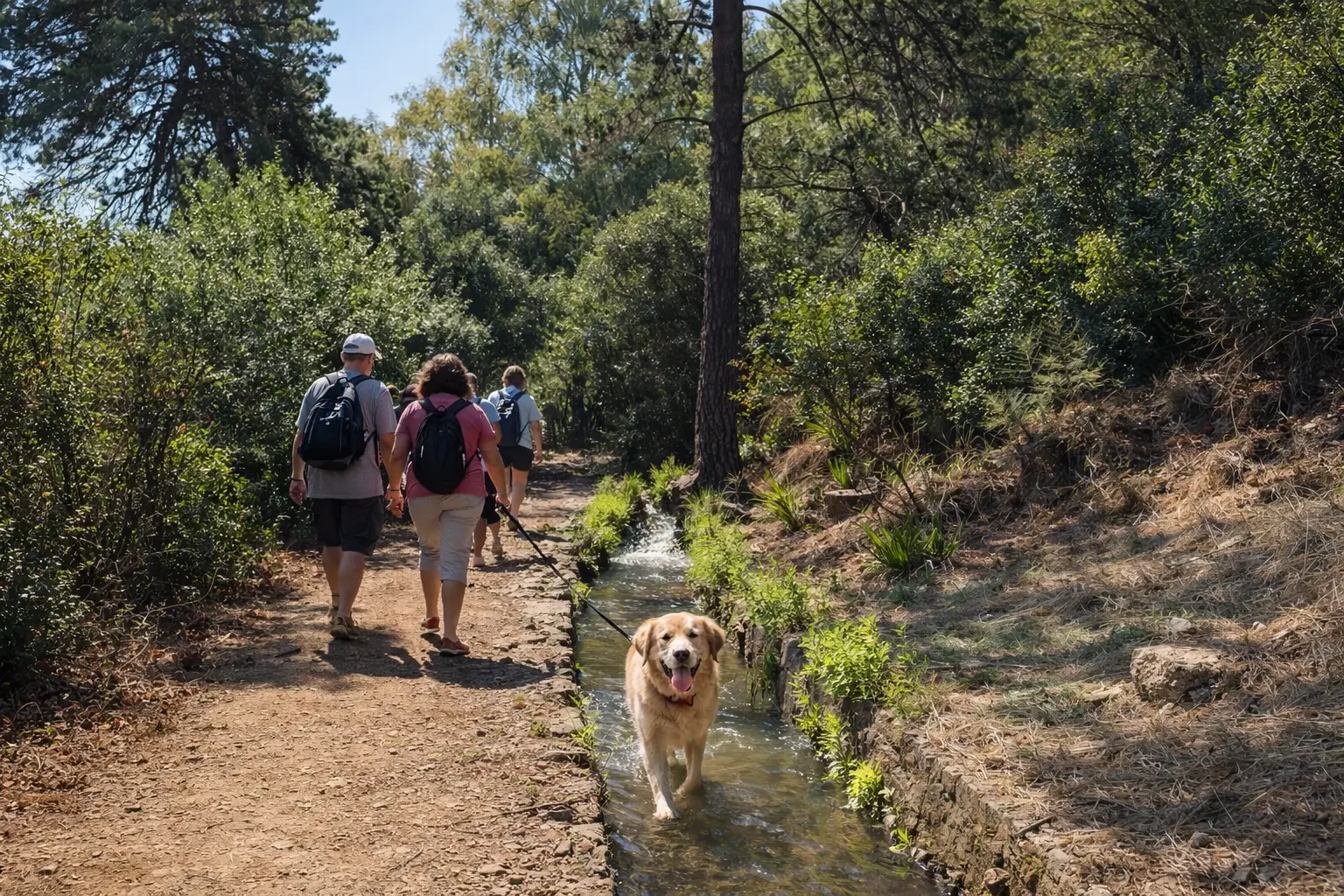
    Dog enjoying a walking trail beside the acequia in Benahavís countryside

    One of the reasons many people choose to relocate to Benahavís is the lifestyle. Surrounded by mountains, forests and open countryside, the area provides an ideal environment for dogs and other pets.

    Morning walks often take place along quiet residential roads or countryside paths, while weekends might include hikes in the nearby hills or visits to pet-friendly beaches along the coast.

    Many properties in the area also feature large terraces, gardens or private plots, giving pets plenty of space to relax.

    If you are considering a permanent move to the region, you may also find our relocation resources helpful:

    Living in Benahavís guide

    Cost of Living on the Costa del Sol

    Buying Property in Benahavís


    Practical Tips for Travelling with Pets

    Preparing well in advance is the best way to ensure a smooth journey. Veterinary documentation and blood tests can take time, so planning several months ahead is wise, especially for relocations.

    It is also important to confirm airline policies early and ensure your pet’s travel crate meets international safety standards. For long journeys, choosing direct flights where possible can help reduce stress for both the animal and the owner.

    Finally, remember that southern Spain can become very hot during the summer months. Once you arrive, ensuring your pet has access to shade, water and cooler walking times is essential.


    Is Spain a Good Place to Live with Pets?

    Woman and her pet enjoying a sunset by the beach on the Costa del Sol

    For many international residents, the answer is a resounding yes.

    Spain’s climate, outdoor culture and relaxed lifestyle create an environment where pets are naturally included in everyday life. The Costa del Sol in particular offers an exceptional combination of countryside, beaches and modern services that make living with animals both easy and enjoyable.

    Whether you are visiting for a few weeks or planning a permanent move to Benahavís or Marbella, bringing your pet is not only possible — it is often one of the best ways to fully enjoy the lifestyle Spain offers.


    Thinking of relocating to Benahavís?

    Explore our guide to property for sale in Benahavís or browse our relocation resources to learn more about living on the Costa del Sol.

    [siteorigin_widget class=”WP_Widget_Custom_HTML”][/siteorigin_widget]
  • Benahavís Property Market Report 2025 | Prices, Buyers & Trends

    Benahavís Property Market Report 2025 | Prices, Buyers & Trends


    Benahavís Real Estate Market Report 2025


    Introduction

    Benahavís, a hillside municipality overlooking Marbella on Spain’s Costa del Sol, has long occupied a distinct position within the region’s property landscape. Known for its gated communities, low-density planning, and emphasis on privacy, the municipality has consistently attracted an international buyer base that differs in both composition and motivation from neighbouring coastal towns. In 2025, these characteristics became even more pronounced. The market recorded record levels of foreign participation, sustained price growth across most segments, and a continued shift toward long-term lifestyle ownership rather than short-term speculative activity.

    This report presents a detailed analysis of the Benahavís property market in 2025, drawing on official notary and land registry data, regional demographic statistics, and market-level observations from agents, lawyers, and analysts active in the area. It examines buyer nationality and demographic trends, pricing behaviour, language and residency patterns, regulatory changes affecting ownership and rentals, and Benahavís’ relative performance within the Costa del Sol’s “Golden Triangle”. Throughout, the analysis integrates both quantitative data and qualitative market behaviour observed during the year.

    1. Buyer Nationality Breakdown in Benahavís (2025)

    Benahavís continues to stand out as one of the most international property markets in Spain. Notary figures for the twelve-month period ending August 2025 show that more than 84% of all residential property purchases were made by foreign nationals. This proportion is exceptional not only at a national level but also within Málaga province, where foreign buyers typically account for roughly one-third of transactions.

    The nationality breakdown of foreign buyers in Benahavís for 2025, based on notary and registry data, is as follows:

    Nationality % of Foreign Buyers (2025)
    United Kingdom 17.7%
    Sweden ~10%
    Belgium ~9%
    Germany ~8%
    Netherlands ~7.7%
    Other nationalities ~47%

    Registry data identifies the United Kingdom as the largest single nationality group among foreign buyers. While headline figures attribute approximately 17–18% of foreign transactions to British nationals, market-level aggregation and notarial commentary suggest that British buyers represent closer to one-third of total purchases when joint ownership structures, residency reclassification, and family purchases are taken into account. Scandinavians, particularly Swedish buyers, form the next most significant cohort, followed by Belgian, Dutch, and German nationals.

    A notable development in 2025 was the continued rise in North American buyers, particularly from the United States and Canada. Although still smaller in absolute terms than European groups, this segment accounted for an estimated 8% of transactions and is growing steadily, driven in part by Spain’s Digital Nomad Visa and the relative affordability of luxury property when compared with major US metropolitan markets. The remaining buyer base is distributed across a wide range of European and non-European nationalities, contributing to one of the most diverse buyer profiles of any municipality in Spain. This breadth of demand plays a critical role in market stability, reducing dependence on any single economy or currency.

    When viewed against regional benchmarks, Benahavís’ internationalisation is particularly striking. In Marbella, foreign buyers are estimated to account for between 35% and 40% of transactions, while in Estepona the figure is closer to 30–35%. Benahavís therefore sits well above both, reinforcing its positioning as a destination market rather than a purely domestic or commuter-driven one.

    For buyers, this international dominance translates into a market shaped primarily by global lifestyle considerations rather than local employment cycles.

    For sellers, it means pricing and presentation must resonate with an international audience whose reference points are often London, Stockholm, Amsterdam, New York, or Toronto rather than Málaga or Seville.

    2. Average Property Prices in Benahavís (2025) and Year-on-Year Changes

    Property prices in Benahavís continued their upward trajectory throughout 2025. By mid-year, the average asking price reached €5,646 per square metre, representing a year-on-year increase of approximately 14.8%. Independent portal data from Idealista and Fotocasa corroborates this trend, with year-end figures showing average prices between €5,460 and €5,510 per square metre and annual growth comfortably in double-digit territory.

    Price reporting across Benahavís in 2025 was consistent in direction, with all major sources confirming double-digit annual growth, while differing slightly in methodology and coverage. The table below brings together the most frequently cited benchmarks for the municipality overall, key property types, and several of the most recognised sub-markets within Benahavís.

    Metric / Area Price (€/m²) YoY Change (%) Source / Notes
    Benahavís (avg, Dec 2025) 5,463 +15.1 Idealista
    Benahavís (avg, Dec 2025) 5,512 Fotocasa
    Benahavís (avg, Jul 2025) 5,646 +14.8 Benahavís Collection
    Apartments (2025) 4,647 +7.86 Benahavís Collection
    Houses (2025) 4,198 +4.26 Benahavís Collection
    La Zagaleta–El Madroñal 7,570–7,681 +9.8 Ultra-prime segment
    La Quinta 6,144–6,591 +13.9
    El Paraíso 5,072–5,646 +13.2
    Los Flamingos 3,974–5,195 +5.4 Lowest Urb. in Benahavís

    This robust appreciation is attributed to several factors:

    • Sustained international demand and limited new supply, especially in prime gated communities.
    • Scarcity of developable land due to protected green zones and strict planning regulations.
    • Preference for high-quality, renovated, or turnkey properties among buyers.
    • Strong liquidity in the luxury segment, with many transactions completed in cash.


    Transaction-level data paints a similar picture. The average sale price during the period stood at €928,593, with an average built size of 239 square metres, underscoring the municipality’s luxury orientation. Price levels vary significantly by area, with ultra-prime enclaves such as La Zagaleta and El Madroñal exceeding €7,600 per square metre, while more accessible zones such as Los Flamingos remain below the municipal average.

    Apartments outperformed houses in percentage growth terms during 2025. Apartment prices rose by close to 8% year on year, while houses recorded growth of just over 4%. This divergence reflects stronger liquidity in the apartment segment and sustained demand from buyers seeking lower entry points into the Benahavís market.

    Despite strong headline growth, the Benahavís market in 2025 was characterised more by discipline than exuberance. Prices rose steadily rather than explosively, and transactions were typically concluded close to realistic market values. This has important implications for both buyers and sellers.

    From a buyer’s perspective, expectations of securing properties at deep discounts became increasingly unrealistic. The combination of limited supply, high levels of international demand, and a large proportion of cash buyers meant that well-priced properties attracted competition rather than negotiation. Opportunistic offers significantly below asking price were rarely successful unless a property was demonstrably overpriced.

    For sellers, the year reinforced the importance of accurate pricing. While the market is strong, it does not reward overambition. Properties launched materially above comparable values tended to stagnate, while those aligned with market reality transacted more efficiently, often with fewer concessions than sellers might have expected in previous cycles.

    3. Languages Spoken by Residents and Property Buyers

    Benahavís’ international profile is reflected clearly in its linguistic landscape. While Spanish remains the official language for administration and legal documentation, English functions as the dominant second language and, in many contexts, the primary means of communication among residents, buyers, and service providers. With foreign nationals accounting for close to 60% of the registered population and an even higher proportion of property owners, English is widely used in real estate transactions, community meetings, and daily life within gated communities.

    Scandinavian languages, particularly Swedish, Norwegian, and Danish, are also commonly heard, alongside Dutch and German. In the ultra-luxury segment, Arabic and Russian are increasingly present. For buyers, this multilingual environment significantly lowers barriers to entry and day-to-day integration.

    For sellers and developers, it reinforces the need for multilingual marketing, documentation, and professional support.

    Key Points:

    • Many real estate agencies, notaries, and legal professionals in Benahavís offer services in multiple languages, with English and German being the most common after Spanish.
    • International schools in the area (including those in nearby Marbella and Estepona) cater to English, German, and Scandinavian speakers, further reinforcing the multilingual environment.
    • Community events, restaurants, and local businesses often provide menus and information in several languages, reflecting the needs of a diverse clientele.


    4. Buyer Demographic Trends in 2025

    The average age of property buyers in Benahavís remained stable at approximately 52 years. The largest cohort continues to fall within the 51–60 age bracket, reflecting a market dominated by financially established individuals. This demographic profile underpins the municipality’s emphasis on quality, security, and long-term ownership rather than rapid turnover.

    Retirees from the UK, Scandinavia, Germany, and the Benelux countries remain a cornerstone of demand. Access to healthcare, a mild climate, and a sense of community continue to drive relocation decisions. Many buyers in this segment choose to register as residents, reinforcing Benahavís’ stable, year-round population base.

    Key characteristics of the Benahavís buyer profile:

    • Higher purchasing power: Buyers are typically affluent, with a preference for quality over speed and a focus on privacy, design, and wellness.
    • Long-term orientation: Most buyers are not speculative investors but are seeking stability, capital preservation, and a refined lifestyle.
    • Preference for luxury and exclusivity: The market is driven by demand for high-end villas, gated communities, and properties with panoramic views and modern amenities.


    One of the most visible shifts in 2025 was the growing presence of remote workers and digital nomads, particularly from North America. Spain’s Digital Nomad Visa has enabled a younger but still affluent demographic to establish long-term bases in Benahavís, often seeking properties with a dedicated office space.

    The rise of remote work, accelerated by the digitalization of the global workforce and the lingering effects of the pandemic, has made Benahavís an attractive destination for those seeking a high quality of life, reliable connectivity, and access to international schools and services.

    • Remote work prevalence: Nationally, around 25% of the Spanish workforce teleworks at least occasionally, with higher rates among professionals in IT, finance, and consulting. In Benahavís, the proportion is likely higher due to the international and professional profile of residents.
    • Buyer motivations: Remote workers are drawn by the area’s safety, climate, and infrastructure, as well as the ability to balance work and leisure in a tranquil yet well-connected environment.
    • Impact on the market: The influx of remote workers has increased demand for properties with home office space, high-speed internet, and proximity to amenities.


    While Benahavís has never been a high-yield investment hotspot, investor interest remains present, particularly in apartments within established golf resorts. Rental yields are generally moderate, and investment decisions tend to prioritise capital preservation and personal use flexibility rather than a
    ggressive short-term returns.

    5. Benahavís Compared to Marbella and Estepona

    In comparative terms, Benahavís outperformed both Marbella and Estepona in price growth during 2025. Average prices exceeded those of Marbella on a per-square-metre basis in several segments, while remaining significantly above Estepona.

    For buyers, this reinforces Benahavís’ position as a premium inland alternative offering more space and privacy than coastal locations.

    For sellers, it confirms that Benahavís is no longer a secondary option but a primary destination market competing directly with Marbella’s most established neighbourhoods.

    6. Notary, Registry, and Agency Commentary

    Notaries and registrars consistently highlighted the resilience of the Benahavís market throughout 2025. Although transaction volumes declined due to limited stock, demand remained strong, and prices continued to rise. The overwhelming dominance of resale properties reflects both planning constraints and the municipality’s commitment to low-density development.

    Official commentary from notaries and registrars highlights the following key points for Benahavís in 2025:

    • International dominance: The overwhelming majority of buyers are foreign nationals, with a diverse mix of origins providing market stability.
    • Transaction characteristics: Most sales are for second-hand properties (over 96%), with new builds accounting for a small fraction of transactions. The majority of buyers are individuals rather than corporate entities.
    • Legal and regulatory environment: The process for foreign buyers remains transparent and straightforward, with notaries ensuring compliance with legal requirements and registrars providing secure title registration.


    From an agency perspective, the defining feature of the year was market maturity. Buyers were informed, internationally experienced, and less driven by emotion. Sellers, in turn, were increasingly aware that realistic pricing was essential to achieving timely sales.  

    7. Transaction Volumes and Property Types

    A total of 710 residential transactions were recorded during the period. Apartments accounted for over three-quarters of sales, reflecting both availability and broader appeal. New-build transactions remained rare, reinforcing the supply-side constraints that continue to shape pricing dynamics.

    Property type:

    • Apartments: 76.8% of sales
    • Houses: 23.2% of sales

     New vs. resale:

    • Second-hand properties: 96.8% of sales
    • New builds: 3.2% of sales

    Average Property Size and Value

    • Average property size: 239 m² (built area)
    • Average transaction value: €928,593
    • Total transactions: 710 (sales)

    8. Mortgage and Financing Trends

    Although Spanish banks expanded mortgage offerings for non-residents in 2025, Benahavís remains a predominantly cash-driven market. Financing is more commonly used as a strategic tool rather than a necessity, particularly in the luxury segment.

    The key features of the range of mortgage products tailored to non-resident buyers include:

    • Loan-to-value (LTV): Typically up to 60–70% for non-residents
    • Interest rates: Slightly higher than for residents (2.9–3.5% in late 2025)
    • Documentation: Enhanced requirements for proof of income, solvency, and legal compliance
    • Multilingual support: Banks have expanded their teams and digital processes to accommodate international clients

    9. Demographic Profile: Population and Foreign Residents


    Benahavís’ registered population stood at 9,256 in 2024, with foreign residents accounting for approximately 58%. This demographic structure reinforces the municipality’s international character and supports year-round economic activity rather than seasonal fluctuation. 

    Population Statistics

    • Total population (2024): 9,256
    • Foreign residents: 5,400 (58.4% of total)
    • Main countries of origin: United Kingdom (34.8% of foreigners), followed by other Northern and Western European nations

    Age Structure

    • Average age: 40.2 years
    • % under 20 years: 23.8%
    • % over 65 years: 13.5%The relatively young average age, combined with a high proportion of foreign residents, reflects the municipality’s appeal to both families and retirees.

    10. Short-Term Rental and Tourist Licence Impact

    Regulatory changes affecting tourist rentals have had a limited but meaningful impact in Benahavís. The ability of communities to restrict short-term rentals has reinforced the residential nature of many developments and aligned well with the preferences of lifestyle-driven buyers.

    The regulatory framework for short-term rentals in Benahavís and the wider Andalusian region has become more stringent in 2025, with key changes including:

    • Community approval: Communities of owners can approve, limit, or prohibit tourist rentals by a three-fifths majority, and can impose additional fees on owners who engage in such activities.
    • Registration requirements: All tourist rentals must be registered with the Andalusian authorities and display a valid registration number in all advertisements.
    • Municipal controls: Local planning regulations may further restrict the issuance of new tourist licences in certain zones.

    Buyers are increasingly attentive to the legal status of properties and the rules of their communities before purchasing with the intent to rent. The ability of communities to regulate tourist rentals has helped preserve the tranquility and residential character of many developments, reinforcing Benahavís’ appeal to lifestyle buyers. 

    11. Transaction Process and Legal Considerations

    The purchase process for foreign buyers remains transparent and well-established. Total acquisition costs typically fall between 10% and 12% of the purchase price, and the widespread availability of bilingual legal support continues to facilitate international transactions.

    See our guides on Purchase Costs and the Purchase Process for more information.

    12. Market Outlook and Strategic Considerations

    Looking ahead, price growth is expected to moderate but remain positive. Continued supply constraints, combined with Benahavís’ global appeal, suggest ongoing support for values.

    Buyers who approach the market with realistic expectations are likely to find opportunities, while sellers who price accurately should continue to benefit from steady demand.

    13. Conclusion

    In 2025, Benahavís confirmed its status as one of Spain’s most resilient and internationally oriented property markets. Strong foreign demand, steady price growth, and a mature buyer profile have combined to create a market that rewards preparation, realism, and long-term thinking.

    For buyers, the key lesson is that Benahavís is no longer a market where deep discounts are readily available. You can search properties currently available for sale here->


    For sellers, the message is equally clear: strength does not eliminate the need for accurate pricing. As the Costa del Sol continues to evolve, Benahavís remains defined by its privacy, stability, and enduring international appeal. You can find more information on selling through Benahavis Collection here->

    [siteorigin_widget class=”WP_Widget_Custom_HTML”][/siteorigin_widget]
  • Mortgages in Spain 2026: Rates, Euribor & Buyer Tips

    Mortgages in Spain 2026: Rates, Euribor & Buyer Tips

    Mortgages in Spain 2026 outlook

    What Changes Are in Store for Mortgages in Spain in 2026?


    If you’re planning to buy a home in Spain in 2026 — or you already have a mortgage (hipoteca) — it helps to understand where interest rates, lending criteria and bank approvals are heading.

    Mortgages don’t move in isolation. They respond to wider European rate trends, housing demand, and how comfortable (or cautious) banks feel about risk. The good news is that 2026 looks less “wild” than the sharp swings many buyers have experienced recently.

    In short: Euribor-driven borrowing costs are expected to be more stable than the sharp shifts seen in recent years. However, it’s unlikely Spain returns to ultra-low mortgage pricing in 2026. For most buyers, fixed and mixed-rate deals will still feel like the default choice.

    Current context: prices, Euribor and monthly payments

    Spain’s housing market continued to see upward pressure on prices through late 2025, while Euribor — the reference index used by many Spanish banks — stayed well above the lows seen earlier in the decade.

    Euribor (most commonly the 12-month Euribor for residential lending) is the benchmark used to price many variable mortgages. When Euribor rises, monthly payments on variable-rate mortgages increase.

    Why it matters: variable-rate mortgages can become more expensive quickly when the index moves. That’s why many buyers have shifted to fixed or mixed products — predictable payments reduce stress (especially in the first years of ownership).

    Mortgage trends to watch in 2026

    Euribor
    Fixed vs variable
    Approvals
    Demand

    Several themes are likely to shape mortgages in Spain in 2026.

    First, Euribor may stabilise. Most forecasts point to a steadier range than 2025, rather than a return to near-zero levels. That means fewer nasty surprises for variable borrowers, but it doesn’t automatically mean “cheap money” is back.

    Second, fixed and mixed-rate products should stay popular. Buyers continue prioritising payment certainty — especially when relocating, buying a second home, or managing income across currencies.

    Finally, banks may become a touch more selective. Higher prices often mean larger loans, and that increases rejection risk for borderline affordability cases.

    Mortgage demand: signings have been rising

    Despite higher borrowing costs, demand has remained resilient. In practice, many buyers still prefer a mortgage over renting — particularly in areas where rents have increased and supply remains tight.

    A sustained demand/supply imbalance can keep purchase activity elevated, even if lending conditions remain more selective.

    Which mortgage types are likely to dominate in 2026?

    In 2026, fixed-rate and mixed-rate mortgages are expected to remain the default choice for many buyers because they reduce payment uncertainty.

    • Fixed-rate: predictable payments for the full term.
    • Mixed-rate (hybrid): a fixed period (often 5–10 years) followed by a variable rate.
    • Variable-rate: may only regain share if Euribor drops meaningfully — not the base-case expectation for 2026.

    Mortgage approvals: expect more scrutiny

    As property values rise, borrowers often need larger loans. That can lead banks to apply stricter affordability checks — especially where income is variable or existing debt is already high.

    What helps: stable income, low consumer debt, a strong deposit, and clean documentation (income proof, bank statements, and tax filings where relevant).

    What to consider when taking out a mortgage in 2026

    If you want one simple principle, it’s this: structure your mortgage so it still feels comfortable on a “normal month”, not just a good month.

    • Keep payments manageable: as a rule of thumb, many buyers aim to keep payments at ~30% (or less) of household income.
    • Compare offers properly: pricing and conditions vary significantly between banks and brokers.
    • Budget for the true total: include taxes, fees and mortgage setup costs — not just the monthly payment.
    • Stress-test your plan: if you choose mixed or variable, plan for higher payments once the fixed period ends.

    Also factor in associated purchase costs such as:

    • Property transfer tax (ITP) or VAT (IVA), depending on the property
    • Notary and land registry fees
    • Valuation fees
    • Home insurance (often required by lenders)

    Quick view: mortgage outlook for 2026

    Aspect Outlook
    Euribor More stable than recent spikes; unlikely to return to historic lows quickly.
    Mortgage costs Generally steady, though bank pricing may rise if competition cools.
    Lending selectivity Banks may tighten approvals for high debt-to-income borrowers.
    Most popular types Fixed-rate; mixed-rate (5–10 years fixed) increasingly attractive.
    Demand Moderate growth likely where rents stay high and supply remains tight.

    Final takeaway

    Spain’s mortgage landscape in 2026 looks set to be more stable than during the sharp shifts of recent years — but it’s not a return to the ultra-low interest environment buyers enjoyed in earlier cycles.

    Best approach: prioritise payment certainty (fixed or a well-structured mixed), prepare documentation early, and budget for all purchase costs — not just the monthly payment.

    FAQs

    Will Euribor fall in 2026?
    Forecasts vary, but the most common expectation is that Euribor will be more stable than during recent spikes. A return to ultra-low levels is not the base case outlook for 2026.

    Which mortgage type is likely to be best in Spain in 2026: fixed, mixed or variable?
    Many buyers prefer fixed or mixed mortgages for payment certainty. A mixed mortgage can suit buyers who want stability for the first 5–10 years and flexibility later. Variable rates may only become more attractive if Euribor falls meaningfully.

    How can I improve my chances of mortgage approval in Spain?
    Keep debt low, document income clearly, maintain stable bank statements, and aim to keep the mortgage payment around 30% (or less) of household income. A larger deposit also improves affordability metrics and lender confidence.

    Related resources

    Helpful next steps if you’re planning financing for a purchase in Spain:

    [siteorigin_widget class=”WP_Widget_Custom_HTML”][/siteorigin_widget]
  • Costa del Sol Short‑Term Rental Bans:  Do Property Prices Really Fall?

    Costa del Sol Short‑Term Rental Bans: Do Property Prices Really Fall?

    [siteorigin_widget class=”SiteOrigin_Widget_Hero_Widget”][/siteorigin_widget]

    Costa del Sol Short-Term Rental Bans:

    Do Property Prices Really Fall?


    The conversation around short-term rentals on the Costa del Sol has shifted noticeably over the past year. What was once a simple question of holiday income has become a more nuanced discussion about lifestyle, governance, and long-term value. Across Marbella, Benahavís and Estepona, communities now have clearer legal pathways to restrict or regulate tourist rentals — and with that has come a natural concern among buyers and owners alike: does limiting short-term rentals reduce property values?

    The evidence so far suggests something more interesting. Rather than creating downward pressure on prices, these decisions are reshaping the market into two distinct — and equally resilient — segments.

    A market that is evolving, not declining

    Since the recent legal clarifications, communities have been given greater control over how properties are used. In practice, this has not triggered widespread price corrections. Instead, it has refined buyer intent.

    Properties with established tourist licences continue to command a premium. Their appeal is clear: they offer immediate, legally compliant rental income in one of Europe’s most in-demand destinations. For investors, that certainty has tangible value, particularly in prime areas such as Marbella and the golf valleys of Benahavís.

    However, communities that choose to restrict or prohibit short-term rentals are not experiencing a loss of demand. Quite the opposite. These developments are increasingly attracting buyers who prioritise tranquillity, privacy and a more residential atmosphere — qualities that are becoming rarer, and therefore more valuable, on the Costa del Sol.

    Two buyer profiles, one strong market

    What is emerging is not a divide between “good” and “bad” investments, but a clearer distinction between two different types of ownership.

    On one side, there is the investor-driven buyer, focused on yield, flexibility and short-term returns. For this audience, properties with touristic licences remain highly desirable and are often priced accordingly.

    On the other, there is the lifestyle-driven buyer — typically seeking a second home, a relocation base, or a long-term residence. For these buyers, communities without short-term rental activity offer a sense of calm, consistency and exclusivity that can be difficult to replicate elsewhere.

    Importantly, both segments are supported by strong international demand. Buyers from across Europe, the United States and beyond continue to view the Costa del Sol as a secure and attractive destination, which helps underpin pricing across both categories.

    Price stability through clarity

    One of the less obvious effects of rental restrictions is the clarity they bring. In communities where rules are well-defined and consistently applied, buyers know exactly what they are purchasing into. That certainty reduces friction, builds confidence, and in many cases supports long-term value.

    Rather than introducing volatility, restrictions can remove ambiguity. They signal that the community has taken a considered position on how it wishes to operate — something that many buyers interpret as a sign of strong governance.

    At the same time, licensed properties benefit from a different form of clarity: the ability to generate income within a defined legal framework. This dual clarity is what allows both segments of the market to perform well simultaneously.

    The real takeaway for buyers and owners

    The idea that banning short-term rentals leads to falling property prices is, at least in the current Costa del Sol market, largely unsupported. What we are seeing instead is a more sophisticated landscape, where value is defined not just by location and design, but by the intended use of the property.

    For investors, the presence of a touristic licence remains a powerful advantage. For lifestyle buyers, communities that limit rental activity can offer a quieter, more cohesive living environment — and increasingly, that is something buyers are willing to pay for.

    Ultimately, the decision is less about market risk and more about alignment. The strongest outcomes tend to come when the property, the community rules and the buyer’s objectives all point in the same direction.

    Buyers Resources & Related Guides

    [siteorigin_widget class=”WP_Widget_Custom_HTML”][/siteorigin_widget]
  • The Benahavís Equation: Scarcity, Style & Sustainable Value

    The Benahavís Equation: Scarcity, Style & Sustainable Value

    The Benahavís Equation

    Scarcity, style and sustainable value — what really supports prices (and liquidity) in Benahavís.

    Benahavís hillside views and natural surroundings on the Costa del Sol

    Benahavís is often described as the jewel of the Costa del Sol’s “Golden Triangle” — a hillside municipality where Marbella prestige meets Andalusian calm. It attracts international buyers who want privacy, views and a quieter pace, yet still want the coast within easy reach.

    However, the best way to understand Benahavís isn’t through headlines. Resale strength here comes from a few specific forces — and when you understand them, pricing (and timing) becomes much easier to read.

    Below is a practical framework we use when advising buyers and sellers: scarcity, quality, and the features that protect demand over time.

    Scarcity as a safeguard

    Benahavís has limited developable land, and planning control tends to be tighter than in many coastal zones. That naturally constrains supply — particularly for well-located apartment stock and new resort-led communities.

    In practice, the lack of “endless new phases” is one of the quiet reasons values hold up across cycles. The market can slow, but prime homes remain prime when replacement is difficult.

    Where new supply does appear — for example around Real de La Quinta — it’s watched closely because it sets the tone for both design expectations and pricing benchmarks.

    Cooling signs: asking vs achieved prices

    One point that matters in 2025–2026 is the difference between asking prices and achieved prices. Much of the public data reflects what sellers hope to achieve — not what completes at the notary.

    That gap widens when vendors price a home as if it were turnkey, but the property needs modernisation. In the current market, premium results are still achievable, but they tend to be earned through realistic positioning, strong presentation, and a clear understanding of the buyer pool.

    In other words: Benahavís remains resilient, but it rewards accuracy more than optimism.

    Liquidity: patience rewarded

    At the top of the market — large villas with the best views, privacy and architecture — the buyer pool is smaller and more selective. That’s normal. Time on market is often part of the process, especially when homes are unique.

    For the mid-to-high segment, liquidity improves when pricing is competitive relative to condition, orientation and location. Overpricing usually does the opposite: it increases “time exposed” and weakens negotiating leverage.

    This is why two seemingly similar homes can sell months apart — and at very different outcomes.

    What protects resale value

    Across Benahavís, a few fundamentals consistently support resale value. These aren’t marketing points — they’re the features that widen your buyer pool and reduce future friction.

    • Location and orientation: sea views, south / south-west aspect, and proximity to golf tend to outperform.
    • Condition: renovated or well-maintained homes usually sell faster and closer to asking.
    • Exclusivity: gated privacy and well-run communities remain strong price supports.
    • Positioning: demand often concentrates in “core” brackets where choice is limited and buyers are active.

    Who’s buying (and why that matters)

    Northern European demand — including the UK, Benelux and Scandinavia — remains a foundation of the Benahavís market. At the same time, interest from North American and Middle Eastern buyers has become more visible, especially in the €2M–€5M range.

    That mix helps. When demand comes from several regions with different motivations (lifestyle, second homes, longer stays, or investment), the market tends to be less dependent on a single trend.

    The common thread is consistent: design-led homes, privacy, security, and value versus beachfront equivalents nearby.

    Energy efficiency is becoming a value lever

    Energy performance is moving from “nice to have” to “value lever”. Buyers increasingly ask about insulation, glazing, solar readiness, heating/cooling efficiency and year-round comfort — especially for full-time or winter use.

    Homes with smart energy management, modern HVAC or heat-pump systems and good insulation tend to appeal to a broader pool — and that typically improves resale alignment with asking price.

    Did you know? A meaningful share of €1M+ transactions in Benahavís completes without mortgage financing — one reason the market can remain steady even when borrowing costs shift.

    Benahavís: market at a glance

    Figures vary by source and reflect different methodologies (asking vs sold), but these headlines are useful as a directional snapshot:

    • Average asking price (Q2 2025): €5,071/m²
    • Baseline average sold: New — €4,325/m² | Resale — €3,576/m²
    • Growth trend: +9% (5-year) | +10% (10-year)
    • Resale share (Q2 2025): ~98% of sales are resales
    • Top zones: La Zagaleta & El Madroñal
    • Mid/high demand areas: Los Arqueros, La Quinta & Los Flamingos

    Market outlook for 2026

    The most realistic expectation for 2026 is normalisation rather than correction. Scarce supply, higher construction costs and enduring lifestyle appeal continue to support the municipality — particularly in the best micro-locations.

    In the luxury bracket, the homes that lead the next cycle are likely to be those that combine quality, presentation and sustainability features — not simply the highest asking prices.

    Takeaways for buyers and sellers

    For buyers: resales offer immediacy and established settings. Meanwhile, constrained new supply can support long-term value retention — especially in well-run communities.

    For sellers: premium pricing is achieved when condition, presentation and positioning match the market. Overpricing usually lengthens time on market and reduces negotiating power.

    Sources: Idealista (Q2 2025), Ministerio de Vivienda, and Benahavís Collection market analysis.

    © The Benahavís Collection | Holiday Homes Spain

    [siteorigin_widget class=”WP_Widget_Custom_HTML”][/siteorigin_widget]
  • Why Americans, Canadians & Brits Are Buying Property in Benahavís

    Why Americans, Canadians & Brits Are Buying Property in Benahavís


    Why Americans, Canadians & Brits Are Buying Property in Benahavís | 2025 Market Insight


    As interest rates climb across North America and the UK, and economic uncertainty continues to ripple through global markets, a growing number of buyers from the U.S., Canada, and Britain are looking beyond their borders for stability, lifestyle, and long-term value. One destination quietly gaining traction? Benahavís — a picturesque enclave in southern Spain known for its luxury real estate, natural beauty, and international appeal.

    The Global Shift: Why Buyers Are Looking Abroad

    In recent months, central banks in the U.S., Canada, and the UK have maintained elevated interest rates to combat inflation. This has made domestic borrowing more expensive and cooled local housing markets. At the same time, geopolitical tensions, cost-of-living pressures, and a reevaluation of work-life balance have prompted many to consider overseas alternatives.

    Spain — and particularly the Costa del Sol — offers a compelling mix of affordability, lifestyle, and legal pathways for non-EU buyers. Benahavís, nestled between Marbella and Estepona, stands out for its low-density planning, high-end developments, and proximity to international schools like Atalaya International College.

    Why Benahavís Appeals to International Buyers


    • Stable Property Market: Spain’s real estate market has shown resilience, with Benahavís offering strong long-term value and rental potential.
    • Lifestyle Migration: With remote work now normalized, buyers are prioritizing sunshine, safety, and wellness — all hallmarks of life in Benahavís.
    • Currency Advantage: The strength of the U.S. dollar and British pound against the euro has made Spanish property more accessible to foreign buyers.
    • Education Access: Families relocating or investing for future use appreciate the proximity to international schools like Atalaya International College, Aloha College, and Sotogrande International.
    • Residency Options: Spain’s numerous Visa options remains a draw for non-EU investors, offering residency in exchange for qualifying property purchases.

    Living the Benahavís Lifestyle

    From golf at Los Arqueros and La Quinta to hiking trails and Michelin-starred dining, Benahavís offers a lifestyle that’s both luxurious and laid-back. Properties range from modern apartments with panoramic views to gated villas with private pools and gardens. The area is just 10–15 minutes from the coast, Puerto Banús, and Marbella, yet feels worlds away in terms of tranquility and space.

    What’s Next for Buyers?

    As global interest rates remain high and domestic markets cool, the appeal of Benahavís is likely to grow. For Americans, Canadians, and Brits seeking a safe haven for capital, a better quality of life, or a strategic relocation, this Andalusian gem offers more than just sunshine — it offers a future-proof investment.

    [siteorigin_widget class=”SiteOrigin_Widget_Image_Widget”][/siteorigin_widget]

    The technical background

    North American and UK borrowers are coming off a bumpy rate cycle at home. Meanwhile, the euro area has eased materially since the 2023 peak: Euribor has fallen, the ECB is on pause, and Spanish mortgages for well-qualified non-residents remain accessible—especially at 60–70% LTV. For affluent buyers who want year-round sunshine, golf, international schools and a refined lifestyle, Benahavís is rising to the top of the shortlist. European Central Bank, euribor-rates.eu

    The macro picture (as of 20 Oct 2025)

    • United States (Fed): The Fed cut in September to a 4.00–4.25% target range and is widely expected to trim again at the Oct 28–29 meeting. Translation: US financing costs are easing from restrictive levels, but uncertainty remains into December. Federal Reserve, Barron’s
    • Canada (BoC): The policy rate was cut to 2.50% in September; the next decision is scheduled for Oct 29. Markets are debating how much easing is left. Bank of Canada
    • United Kingdom (BoE): Bank Rate stands at 4.00% after an August cut; policymakers now signal a slower pace of any further reductions as inflation proves sticky. Reuters, Bank of England
    • Euro area (ECB/Euribor): The ECB has kept rates unchanged since September, with the deposit facility at 2.00%. The 12-month Euribor—what Spanish variable and mixed mortgages often reference—is ~2.16% (17 Oct). In short: down sharply from 2023 highs above 4%. global-rates.com, European Central Bank, Reuters

    Why this matters to your Benahavís purchase

    Spanish banks typically underwrite non-resident mortgages at ~60–70% LTV, with fixed or mixed (fixed for a period, then Euribor-linked) structures. When Euribor stabilises or falls, mixed products become especially compelling for buyers who want payment visibility now and optionality later.

    Quick “rate snapshot” 

    • Fed funds: 4.00–4.25% (Sep 17); next meeting Oct 28–29. Federal Reserve
    • BoC overnight: 2.50% (Sep 17); next decision Oct 29. Bank of Canada
    • BoE Bank Rate: 4.00% (held Sep 17). Bank of England
    • ECB deposit facility: 2.00% (held Sep 11). European Central Bank
    • 12-month Euribor: ~2.16% (Oct 17 print). global-rates.com

    The lifestyle ROI 

    Beyond the maths, buyers from the US, Canada and the UK are re-weighting for quality of life—year-round climate, golf/wellness, international schooling and connectivity. Foreign demand remains a structural force in Spain (mid-teens share nationally over the last year), with Málaga province among the country’s leaders—supporting liquidity and choice across Benahavís communities. CaixaBank Research

    Case study (illustrative only):

    A €1.2M Benahavís purchase with a Spanish mortgage. Assume a 60% LTV (loan €720,000) and a 20-year term:

    • At 2.5% nominal, monthly ≈ €3,710 per €720k.
    • At 3.5% nominal, monthly ≈ €4,060 per €720k.

    Rule of thumb: every 1 percentage point on a 20-year loan moves payments by roughly €50 per month per €100k of debt. Use this to sanity-check offers as you negotiate both price and finance.
    (Note: lender offers vary by profile; this is not advice.)

    Per-€100k monthly payment guide (20-year term, illustrative):

          • 2.0% ≈ €506 | 2.5% ≈ €530 | 3.0% ≈ €555 | 3.5% ≈ €580 | 4.0% ≈ €606

    Buyer playbook for US/CA/UK clients (what to prepare now)

    • Get a Spanish NIE and open a Spanish bank account early.
    • Mortgage in principle: line up a fixed or mixed product; expect 60–70% LTV for non-residents, with terms often 20–25 years.
    • Currency plan: decide whether to stage transfers or hedge; small FX moves can affect your effective budget.
    • Legal team: independent bilingual solicitor; confirm due diligence, taxes and completion timelines.
    • Insurance & holding structure: discuss life/building insurance requirements and whether buying personally or via a company fits your tax context.
    • Residency perspective: note that Spain ended the real-estate Golden Visa on 3 April 2025—so plan stays around the standard rules or alternative residency routes if needed. El País

    What could change next? 

    • Central bank path: October/November policy meetings (Fed/BoC/BoE/ECB) and inflation prints could nudge borrowing costs. Reuters, Barron’s, Bank of Canada
    • Euribor trend: if the slowdown persists, the 12-month series could drift sideways or lower—supportive for mixed-rate Spanish products. euribor-rates.eu
    • UK inflation & BoE guidance: a slower disinflation path argues for patience on cuts; that matters for sterling sentiment and UK buyer psychology. Reuters

    Request more information

    Want to know more or arrange a viewing? Darren & Angelina — your Personal Property Concierge — will share full details and organise a private tour. Use the enquiry form on this page and we’ll be in touch promptly. 

  • Benahavís Real Estate Market Update – October 2025

    Benahavís Real Estate Market Update – October 2025

    [siteorigin_widget class=”Ert_Title_Widget”][/siteorigin_widget]


    Welcome to our Benahavís real estate market update for October 2025. If you have any questions or need any additional information, reach out and we would be happy to answer these.


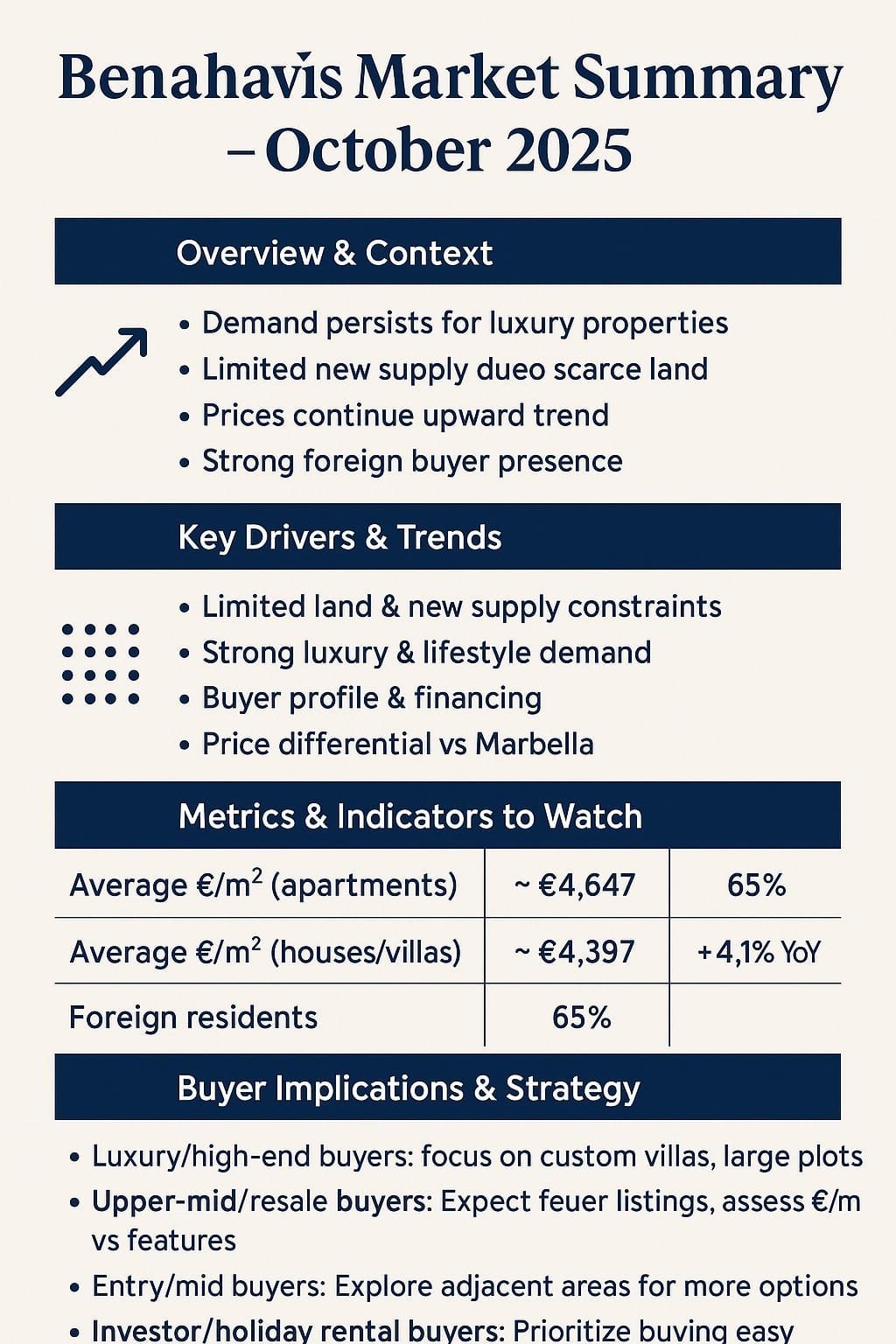
    1. Overview & Context


    Benahavís, nestled in the hills between Marbella, Estepona, and Ronda, continues to solidify its reputation as one of the most exclusive and desirable municipalities on the Costa del Sol.

    As of 2025, the average apartment prices in Benahavís are around €4,647/m², reflecting a year-on-year rise of ~7.6 %
    House (villa) prices are somewhat lower on a per-square-metre basis, (~€4,397/m²), with a slower annual growth of ~4.1 %. 

    These figures place Benahavís in the upper tier of prices in the Costa del Sol, though slightly more affordable than ultra-prime Marbella in certain zones.

    In terms of the “Golden Triangle” (Marbella, Estepona, Benahavís), recent data suggests that property price increases in that zone averaged ~11.9 % year-on-year — with Benahavís itself contributing ~10.8 % growth. 

    Also of note: Benahavís continues to be considered one of the wealthiest municipalities in Andalusia. Its average declared income is ~€43,159 (2023 IRPF), and 65% of residents are foreign nationals.

    [siteorigin_widget class=”WP_Widget_Block”][/siteorigin_widget]
    [siteorigin_widget class=”SiteOrigin_Widget_Image_Widget”][/siteorigin_widget]

    2. Key Drivers & Trends in Benahavís


    2.1 Limited Land & New Supply Constraints

    • Land for new development is scarce in Benahavís’s mountainous terrain and heavily regulated zones.

    • Developers are more selective, focusing on high-end custom villas or small boutique developments, often with large plots and premium finishes.

    2.2 Strong Luxury & Lifestyle Demand

    • Buyers are attracted to privacy, nature, views, golf proximity, and luxury amenities.

    • Many properties are second homes or holiday retreats, used seasonally rather than full-time.

    • The prestige of enclaves such as La Zagaleta boosts demand and pricing. 

    2.3 Buyer Profile & Financing

    • A high proportion of acquisitions in Benahavís are cash (non-mortgaged) purchases, especially among international buyers.

    • Swedish buyers are particularly active in the hills around Benahavís.

    • Lower local property taxes (IBI) and waste rates add to the attraction. 

    2.4 Price Differential vs Marbella

    • While Benahavís is premium, in many spots it offers a relative discount to prime Marbella coastal villas, especially for those seeking views, more land, and a quieter setting.

    • Over time, that gap is narrowing as demand intensifies.


    3. Metrics & Indicators to Watch 

    [siteorigin_widget class=”SiteOrigin_Widget_Image_Widget”][/siteorigin_widget]


    4. Buyer Implications & Strategy in Benahavís


    Luxury / High-End Buyers (≥ €1M+)

    • This is prime ground for you. Seek bespoke villas, large plots, panoramic views, and quiet exclusivity.

    • Be prepared to act decisively: the best plots are rare and go fast.

    [siteorigin_widget class=”SiteOrigin_Widget_Image_Widget”][/siteorigin_widget]


    Upper-Mid / Resale Buyers (~€500K–1M)

    • Look in transitional zones between the hills and coastal edge — you may find well-appointed apartments or townhouses.

    • Compare cost per square metre vs finishes, view, and land share.

    Entry / Mid Buyers (< €500K)

    • Options are scarce in Benahavís under this bracket. You may need to look at smaller apartments further down the slope or in adjacent municipalities.

    • Be realistic: your budget band may limit you to offsets rather than prime product.

    Investor / Holiday Rental Buyers

    • Rentals in Benahavís can command premium rates for exclusivity, longer stays, and scenic surroundings.

    • But check local licensing / rental regulations — strict regulation or HOA rules may restrict short-term letting.

    • Focus on turnkey, easy-to-manage homes with minimal upkeep (gardens, large land, slopes) to maximize net yield.

    5. October–December 2025 Outlook for Benahavís


    • Transactions likely stable to modest growth — many buyers in this bracket are steady or long-term focused.

    • Price growth should continue in the range of +5–10 %, especially for highly differentiated, well-positioned plots or villas.

    • Supply will remain tight; new listings will be few but impactful.

    • Investor sentiment remains positive for luxury / boutique markets, less so for speculative midsize developments due to terrain, costs, and local regulation.

    [siteorigin_widget class=”SiteOrigin_Widget_Image_Widget”][/siteorigin_widget]


    Thank you for your interest in our Benahavís real estate market update for October 2025

  • Benahavís Market Overview – September 2025

    Benahavís Market Overview – September 2025

    [siteorigin_widget class=”Ert_Title_Widget”][/siteorigin_widget]


    1. Residential Sale Prices


    • As of July 2025, the average asking price for residential property was approximately €5,646/m², representing a substantial 14.8% increase compared to July 2024 (€4,918/m²).

    • This has reached a peak in the two-year trend—July 2025 shows the highest levels recorded in that timeframe.


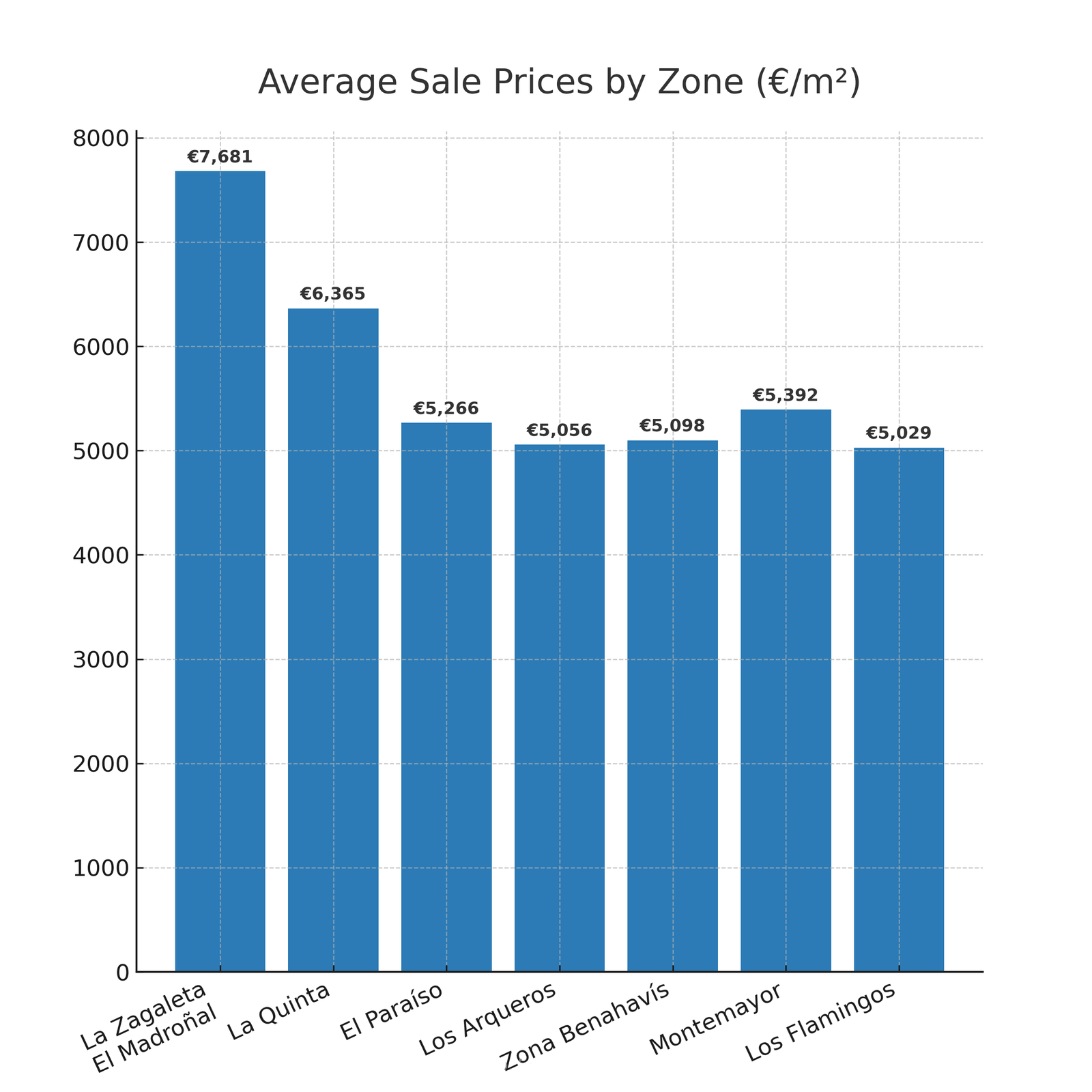
    2. Price Variations by Zone


    • La Zagaleta – El Madroñal recorded the highest average sale price: €7,681/m².

    • The lowest average price appeared in Los Flamingos, at €5,029/m².

    • Other notable zones:

      • La Quinta: €6,365/m²

      • El Paraíso: €5,266m²

      • Los Arqueros–P. del Almendro: €5,056m²

      • Zona Benahavís: €5,098m²

      • Montemayor–Marbella Club: €5,392m²


    3. House vs. Apartments in 2025


      • Apartments: ~€4,647/m², up 7.86% year-over-year.

      • Houses: ~€4,198/m², up 4.26% year-over-year.


    4. Sales Volume Trends


    • Per July 2025 market data:

      • Benahavís saw a 20.52% decrease in sales, but this decline is attributed to limited new stock, not diminished buyer interest. Demand remains robust.


    5. Broader Costa del Sol & Spain Context


    • Luxury market trend: Costa del Sol luxury homes (over €3M) increased 3.17% in 2024. The highest luxury-level values are in Benahavís, hitting €26.7M in top-tier areas.

    • Regional forecast: Analysts expect property prices across Costa del Sol to rise 5–8% in 2025.

    • National projection: BBVA forecasts a nominal housing price increase of ~4.7% in 2025; in real terms, excluding inflation, growth lies between 0.7%–1.6%


    Summary Table – Price Comparisons


    Metric Value (Approx.) Notes
    Avg Sale Price (Jul 2025) €5,646/m² +14.8% vs Jul 2024
    Apartment Avg Price (2025) €4,647/m² +7.86% YoY
    House Avg Price (2025) €4,198/m² +4.26% YoY
    Peak Zone (La Zagaleta) €7,681/m² Highest in Benahavís
    Lowest Zone (Los Flamingos) €5,029/m² Lowest in July 2025
    Sales Volume Change –20.52% Due to limited stock, not waning demand
    Regional Price Growth Forecast 5–8% Costa del Sol expectation for 2025
    National Avg Price Growth ~4.7% (nominal) Spain-wide projection

    Interpretation & Outlook for September 2025


    • Prices remain strong: Residential asking prices continue to climb—with both apartments and houses seeing healthy YoY growth.

    • Top-tier exclusivity thrives: Districts like La Zagaleta–El Madroñal remain ultra-premium; buyers targeting these areas should expect some of the highest €/m² in the region.

    • Apparent slowdown in sales volume is stock-driven, not demand-driven. Buyers are still actively pursuing Benahavís properties—supply simply isn’t keeping pace.

    • Expectation of continued upward pressure: With Costa del Sol projected to grow 5–8% this year and Spain overall trending upward (4.7% nominal), Benahavís is likely to follow suit into autumn 2025.


    Final Thoughts


    September 2025 in Benahavís paints a picture of a resilient and high-demand market—marked by climbing € per m² values, tight inventory, and enduring buyer interest, particularly in the luxury segment. Market conditions favor sellers, yet opportunities still exist for discerning buyers who move swiftly and strategically.

  • El Madroñal: Marbella’s Rising Luxury Real Estate Destination

    El Madroñal: Marbella’s Rising Luxury Real Estate Destination

    El Madroñal Luxury Property Market — Benahavís


    Luxury villas in El Madroñal, Benahavís

    Nueva Andalucía, the Golden Mile and La Zagaleta have long defined the upper end of the Costa del Sol property market. In recent years, however, attention has been quietly shifting towards El Madroñal — a gated hillside community in Benahavís that offers a different kind of luxury.

    Rather than visibility or prestige branding, El Madroñal appeals through privacy, space and consistency. Limited supply, generous plots and a mature residential character have combined to make it one of the most resilient high-end micro-markets in the area.

    Location and elevation

    Set high in the Benahavís hills, El Madroñal occupies an elevated position that brings both practical and lifestyle advantages. The setting delivers open views, cooler summer temperatures and a clear sense of separation from the busier coastal strip.

    Despite this, access remains straightforward. San Pedro de Alcántara, Puerto Banús and Marbella are all within a short drive, which makes El Madroñal viable for year-round living as well as international second-home ownership.

    Privacy, security and plot size

    El Madroñal’s gated structure and low housing density are central to its long-term appeal. Multiple controlled entrances and 24-hour security create a calm, residential environment that attracts buyers who value discretion over exposure.

    Large plot sizes play an equally important role. Homes are typically set well back from one another, allowing for mature gardens, meaningful outdoor space and a level of privacy that is increasingly difficult to find closer to the coast.

    Architecture and liveability

    Architecturally, El Madroñal is varied rather than uniform. Traditional Andalusian villas sit alongside contemporary homes designed to maximise light, views and indoor–outdoor living.

    Recent development activity has been limited but carefully absorbed by the market. Buyers increasingly prioritise comfort, energy efficiency and year-round usability over purely decorative finishes, a shift that newer properties tend to address well.

    Day-to-day amenities and lifestyle

    El Madroñal is intentionally residential, but everyday amenities are close at hand. Monte Halcones provides cafés, restaurants and essential services, while San Pedro and Marbella offer a full range of shopping, healthcare and international schools.

    Golf courses, countryside walks and inland routes towards Ronda all sit within easy reach, reinforcing the area’s appeal to buyers seeking a quieter, more balanced lifestyle.

    Market behaviour and pricing context

    El Madroñal sits firmly in the upper tier of the Benahavís market, but price behaviour here is driven more by scarcity than by trend. Supply is naturally constrained, and large-scale future development is unlikely.

    As a result, pricing tends to be resilient rather than speculative. Well-positioned homes — particularly those offering views, privacy and modernised interiors — continue to attract consistent international interest.

    What buyers should understand

    El Madroñal is not a fast-turnover market. Buyers typically approach it with a medium- to long-term horizon, prioritising lifestyle quality and capital preservation over short-term gains.

    For those priorities, the area continues to perform quietly and consistently — which is precisely why demand remains steady.

    Explore property opportunities in El Madroñal

    If you’d like help comparing current listings or understanding which parts of El Madroñal best align with your priorities, we’re happy to advise.


    View current properties in El Madroñal →

    [siteorigin_widget class=”WP_Widget_Custom_HTML”][/siteorigin_widget]