Polo on the Costa del Sol — Sotogrande, Marbella & Benahavís
The Costa del Sol is one of Europe’s best-known polo destinations, centred on the Sotogrande area yet within straightforward reach of Marbella and Benahavís. From summer tournaments watched with a glass of something cold in hand to year-round training centres, polo adds another layer to the region’s equestrian lifestyle and pairs naturally with equestrian properties Benahavis for riders who split their time between stick-and-ball, hacking and show jumping.
Why the Costa del Sol is a Polo Hub
Thanks to its climate, international flight connections and long-established clubs, the coast between
Sotogrande and Marbella has become a natural magnet for polo players and spectators. The summer
tournament season draws teams and visitors from across Europe and beyond, while milder months offer
ideal conditions for schooling, stick-and-ball and low-goal chukkas.
For many residents based in Benahavís, the combination of golf, riding and occasional trips to watch
(or play) polo in Sotogrande creates a balanced sporting lifestyle, without needing to live directly
beside the fields.
Key Polo Clubs on the Costa del Sol
The main polo activity is centred around Sotogrande, roughly an hour to ninety minutes by car from Benahavís depending on traffic and exact starting point. Three names come up again and again:
Santa María Polo Club (Sotogrande) — Long regarded as one of Europe’s leading polo venues, with multiple grass fields across sites such as Los Pinos and Río Sotogrande. The club hosts high-profile summer tournaments and international events, alongside corporate and lifestyle happenings during the season.
Ayala Polo Club — Also in the Sotogrande area, Ayala runs an extensive tournament calendar, including the International Polo Tournament with Bronze, Silver and Gold Cups, attracting players from around the world. Modern facilities and well-kept grounds make it a key reference point for serious players.
Polo Valley — A polo resort on the outskirts of Sotogrande that combines tuition, horses and relaxed Andalusian countryside living. It is popular with newcomers who want to learn polo from scratch as well as experienced riders looking for intensive training or short stays focused on the sport.
Together, these clubs anchor the Costa del Sol on the international polo map and ensure there is almost always something happening during the main season.
Polo Season & Spectator Experience
The peak polo season typically runs through late spring and summer, with highlight tournaments in July and August. Expect a mix of day and evening matches, family-friendly entertainment, hospitality areas and pop-up retail around the main fields, especially during major international events.
Many residents from Marbella and Benahavís treat polo days as full outings: driving down for an afternoon of sport, enjoying food and drinks on-site, and then heading back up the coast in the evening. It is worth checking each club’s calendar in advance, as formats and dates can vary from year to year.
Living in Benahavís, Playing in Sotogrande
One of the advantages of basing yourself in Benahavís is that you can enjoy a quiet, countryside lifestyle with quick access to both Marbella and Estepona, yet still be within realistic driving distance of the Sotogrande polo fields. For many owners, this is preferable to living directly beside the clubs, especially if family members also play golf, prefer beach clubs or work in and around Marbella.
If you ride yourself, you might split your time between local equestrian centres in Benahavís and occasional polo sessions or chukkas down the coast. Our Horse Riding & Ownership in Benahavís guide covers local riding options, livery and paperwork in more detail.
When it comes to choosing a home, it can be useful to focus on properties that combine good road access with space for horses or easy reach of boarding facilities. The equestrian properties for sale near stables in Benahavís collection is a helpful starting point if you want a base that supports both local riding and regular
polo trips.
Practical Tips for Polo Enthusiasts
Whether you plan to play or simply watch, a few practical points help you make the most of polo on the Costa del Sol:
Check club calendars for tournament dates, start times and any ticketing requirements.
Allow extra time for parking and walking to the main fields during major events.
Dress comfortably but smartly for summer evenings; wedges or flats are usually more practical than heels on grass.
If you are interested in lessons or intensive polo holidays, reach out to resorts such as Polo Valley well ahead of peak season.
For riders already based in Benahavís, combining local hacks, arena work and the occasional day of
polo in Sotogrande can be a rewarding way to enjoy the wider equestrian scene along the coast.
Thinking about a Benahavís base for golf, riding & polo?
Darren & Angelina — your Personal Property Concierge — will help you shortlist homes that work for your broader Costa del Sol lifestyle. Get in touch →
Where to Buy Equestrian Clothing, Tack & Feed — Costa del Sol & Benahavís
Benahavís sits between Marbella and Estepona, surrounded by yards, riding schools and country trails. If you keep horses on the Costa del Sol — or plan to move here — you will need reliable places for feed, bedding, tack and rider clothing. This guide highlights key equestrian shops and suppliers within easy reach of Benahavís, plus online options that deliver across the coast, and links through to equestrian properties Benahavis for buyers planning a permanent base.
Key Equestrian Stores Near Benahavís
Most horse owners based in Benahavís look first to the Estepona–Marbella corridor, where you will find a mix of large garden centres with hípica departments, specialist tack shops and on-site stores at major riding schools.
Agrojardín (Estepona) — A large garden and lifestyle centre just west of San Pedro with a dedicated equestrian section (hípica) and a well-stocked online shop. Expect everyday feed, bedding, rugs, grooming products and stable equipment, plus a selection of clothing and footwear for riders.
HB Equestrian Shop (Estepona) — A professional tack boutique located by Agrojardín, focused on higher-end brands for both horse and rider. It is a useful stop if you need quality boots, competition jackets, helmets or saddle accessories and like in-person advice from a specialist team.
Escuela de Arte Ecuestre Costa del Sol (Estepona) — As one of the region’s major equestrian centres, the facility includes on-site services for riders and horses, including access to feed, bedding and equipment alongside its livery and training operations.
Feed, Bedding & Yard Supplies
Daily horse care soon adds up, so most owners on the Costa del Sol rely on a combination of bulk deliveries and top-up purchases when they are already driving down the coast.
Feed & forage: Suppliers around Estepona and Marbella stock mainstream feed brands, baled hay and haylage, as well as supplements for joints, hooves and digestive health. Ask your vet or livery yard which local supplier they prefer and whether shared deliveries are organised.
Bedding: Shavings, pellets and straw are widely available; many yards coordinate regular deliveries so individual owners do not need to manage every order themselves.
Stable & yard equipment: Agrojardín and similar outlets carry wheelbarrows, forks, buckets, troughs, fencing materials and field accessories. Online shops fill any gaps in specialist equipment.
If you are searching for a property with space for horses, it is worth checking that delivery lorries can reach the finca easily and that there is practical storage space for feed and bedding. Our equestrian properties for sale near stables in Benahavís highlight homes where these logistics work in day-to-day life.
Clothing & Equipment for Riders
Coastal riding life can involve everything from early-morning hacks in winter to summer evenings in competition arenas, so clothing needs to cope with heat, sun and occasional cool, damp days.
Helmets & safety gear: Specialist shops such as HB Equestrian stock up-to-date certified helmets, body protectors and air vests. For fitting and safety, many riders prefer to buy these in person rather than online.
Boots, breeches & show wear: Expect a mix of everyday riding leggings, technical shirts and traditional breeches, plus jackets suitable for Spanish competition rules. The larger stores carry well-known international brands alongside mid-range lines.
Gloves & sun protection: With strong Mediterranean sunshine, many local riders favour lightweight gloves, vented hats when not mounted and quick-dry layers for yard work.
If you compete regularly or ride several times a week, it is worth visiting a couple of different shops along the coast to compare brands and sizing before settling on your favourites.
Online Tack Shops Serving the Costa del Sol
Alongside local stores, many owners in Benahavís order bulkier or more specialist items online. Spanish and EU-based equestrian shops often deliver to Málaga province within a few days, making it easy to access niche brands without leaving home.
Agrojardín online: Their web shop extends the in-store hípica range and is useful for repeat purchases of familiar feeds, supplements and stable equipment.
Specialist online tack shops: Platforms such as Zafiro Equestrian and similar Spanish or EU-based retailers carry a wide range of bits, bridles, saddle pads, competition wear and stable accessories, often with seasonal offers and rapid delivery.
Direct-from-brand orders: Some international equestrian brands ship directly to Spain, which can be helpful if you already know your sizes and preferred models.
When you first arrive, it can be helpful to buy the basics locally and then transition to a mix of local and online suppliers once you know what works for your horses in the Costa del Sol climate.
Choosing a Home with Equestrian Supplies in Mind
When you are shortlisting homes, it is worth thinking about more than just stables and turnout. Access to feed deliveries, proximity to trusted tack shops and realistic drive times to your preferred riding centre all make a real difference to day-to-day life with horses.
Our dedicated collection of equestrian properties Benahavis focuses on homes near stables, riding schools and countryside routes, with practical access for vets and suppliers. For a broader overview of the lifestyle, you may also enjoy:
Need a home that works for both horses and humans?
Darren & Angelina — your Personal Property Concierge — will match you to properties with practical access to stables, vets and suppliers. Get in touch →
Driving in Spain for Non-EU Visitors — Costa del Sol Guide (2026)
Exploring the Costa del Sol by car is one of the easiest ways to discover beaches, villages and mountain views.
Exploring the Costa del Sol by car is one of the most enjoyable ways to experience Andalucía’s beaches, mountain roads, white villages and historic towns. Whether you are visiting from the UK, US, Canada or any other non-EU country, the rules for driving in Spain are straightforward once you know what to expect.
This guide focuses on the Costa del Sol, but the core rules apply across Andalucía and the rest of Spain. Below, you will find the essentials on licence rules, age requirements for car hire, insurance, mandatory safety equipment, speed limits and how to exchange your licence if you decide to become a resident.
Visitors from the UK, US, Canada and most non-EU countries can drive in Spain using their valid national driving licence for short tourist stays. The same basic rules apply whether you are exploring Marbella, Benahavís, Estepona or other parts of the Costa del Sol.
However, additional requirements can apply depending on your country of origin and the type of licence you hold.
UK visitors
Modern UK photocard licences are accepted for short visits to Spain.
An International Driving Permit (IDP) is usually only needed if you have an older paper licence or a licence issued in the Isle of Man, Jersey or Guernsey.
Your licence must be valid and unexpired for the entire duration of your trip.
US, Canada and other non-EU visitors
Many car hire companies in Spain ask US and Canadian visitors to present both their national licence and an IDP.
Practically, carrying an IDP is strongly recommended even where it is not strictly mandatory.
If your licence is not in the Latin alphabet, an IDP or official translation is generally required.
Whatever your nationality, your licence must be valid, legible and cover the category of vehicle you intend to drive. If in doubt, confirm the requirements directly with your chosen car hire company before you travel.
Always carry your driving licence, passport, insurance and rental documentation when driving in Spain.
Key Driving Rules in Spain
Once you are on the road, driving in Spain is generally straightforward, but a few rules differ from the UK and North America. Understanding these in advance will make your Costa del Sol trip smoother and safer.
Drive on the right-hand side and overtake on the left.
Roundabouts: vehicles already on the roundabout normally have priority.
Seat belts are compulsory for all passengers, front and rear.
Using a hand-held mobile phone while driving is prohibited and heavily fined.
Children must use appropriate child seats or restraints according to their height and weight.
You must carry your personal and vehicle documents with you at all times when driving:
Passport or national identity document
National driving licence (and IDP if required)
Proof of insurance
Vehicle registration document, or rental agreement if hiring
Mandatory safety equipment
If you are driving your own car in Spain, you are expected to carry:
Reflective jackets for all passengers, accessible from inside the car
At least one warning triangle (two are often recommended)
Headlamp beam deflectors for non-EU right-hand-drive vehicles, if driving at night
Rental cars on the Costa del Sol usually come equipped with the required safety items, but it is still wise to check at pick-up.
Spain’s road network is modern and well-signed, but roundabout and priority rules may differ from your home country.
Speed Limits, Toll Roads and Low-Emission Zones
Spain’s speed limits are clearly signposted, but it helps to know the general rules before you set off from Málaga Airport or along the AP-7.
Typical speed limits
Motorways (Autopistas / Autovías): 120 km/h
Non-urban single carriageways: 90 km/h (sometimes 100 km/h where signposted)
Built-up areas: 50 km/h
Residential or calming zones: 20–30 km/h
Speed cameras are common. Fines may be applied on the spot for foreign drivers or sent later to your home address.
Toll roads on the Costa del Sol
Parts of the AP-7 and other sections of motorway near Marbella and Estepona operate as toll roads (peajes). You can usually pay:
With cash or card at crewed booths
Automatically via Telepeaje / Via-T tags (often used by frequent drivers)
Low-emission zones (Zonas de Bajas Emisiones)
Major cities such as Madrid and Barcelona already operate low-emission zones where access is restricted based on a DGT environmental sticker (0, Eco, C or B). Foreign-registered vehicles cannot easily obtain these stickers, so access to certain central streets may be limited.
Málaga is progressively preparing its own low-emission measures. If you plan to drive into the very centre of larger cities, it is sensible to check the latest rules in advance or park outside the core and use public transport.
Some Costa del Sol motorways are toll roads; watch for peaje signs and choose routes that suit your plans and budget.
Driving a Foreign-Registered Car in Spain
Many visitors choose to rent a car locally, but some drive to Spain from their home country. In that case, you must pay close attention to insurance, stickers and safety equipment.
Insurance
Before you travel, confirm exactly what level of cover your policy provides:
UK policies often include at least third-party cover for driving in the EU, including Spain.
US and Canadian policies typically do not cover driving in Europe; you may need to rely on rental insurance or specific international cover.
Consider adding comprehensive cover for extra peace of mind, especially if you are unfamiliar with the roads.
Stickers and vehicle requirements
UK-registered cars must display a UK identifier; the old “GB” stickers are no longer valid.
Ensure your number plates and any stickers are clearly visible and compliant with current rules.
Check that you have warning triangles, reflective vests and beam deflectors where required.
Car Hire on the Costa del Sol: Age Limits & Practical Tips
Málaga Airport is the main gateway to the Costa del Sol, with multiple car hire companies on site.
Hiring a car at Málaga Airport or along the Costa del Sol is usually straightforward, but the small print matters—especially age limits and surcharges.
Typical age and licence rules
Minimum age is often 21, with a full licence held for at least 12 months.
Some vehicle categories (SUVs, premium or luxury models) require drivers to be 23–25+.
Drivers under 25 frequently pay a young driver surcharge.
In some cases, drivers over 75 may need additional cover or medical documentation.
Always read the rental terms before you book. If you are unsure, contact the rental company in advance to confirm requirements for your nationality and age.
Practical tips for Costa del Sol car hire
Book well ahead for peak periods (summer, Christmas, Easter and long weekends).
Check fuel policy—“full-to-full” is often the fairest option.
Inspect and photograph the car at pick-up and drop-off, including wheels and windscreen.
If you plan to explore inland villages, Ronda or mountain roads near Benahavís, consider a car with good torque and braking performance.
Becoming a Resident in Spain: Exchanging Your Licence
Long-term residents usually need to exchange their foreign licence for a Spanish one.
If you decide to make the Costa del Sol your long-term home, your status changes from visitor to resident, and the rules for driving on a foreign licence change as well.
Driving on your foreign licence as a resident
Once you become a legal resident in Spain, you can usually drive on your foreign licence for up to six months from the date your residency is recognised. After that, you are expected to exchange it for a Spanish licence or obtain a new Spanish licence via the theory and practical tests.
Licence exchange agreements
Spain maintains reciprocal agreements with certain non-EU countries and regions:
UK: A full reciprocal agreement allows most UK licence holders to exchange without taking a driving test, provided the licence is valid and meets the criteria in force.
US & Canada: Exchange options depend on specific states or provinces; in some cases, you may need to take Spanish tests if there is no direct agreement.
Other non-EU countries: Eligibility varies; always check the current list on the DGT website or speak to a gestor (local administrative adviser).
Documents typically required include:
Valid foreign driving licence
Proof of residence in Spain (e.g. TIE card)
Passport or national identity document
Application form and payment of the corresponding fee
A basic medical and eyesight check (psicotécnico)
Procedures and fees can change, so it is wise to confirm the latest requirements with the DGT or an experienced gestor before you book appointments.
FAQs: Driving in Spain as a Non-EU Visitor
Do I need an International Driving Permit?
It depends on your country and your rental company. UK visitors with modern photocard licences generally do not need an IDP for short trips. Many US and Canadian visitors are asked to present one, and travellers from countries using a non-Latin alphabet almost always need an IDP or official translation. If in doubt, obtain an IDP before you travel.
Can I keep driving on my foreign licence after becoming a resident?
Only for a limited period. Typically, you may drive for up to six months from the date you become resident. After that, you must exchange your licence or obtain a Spanish one, depending on the agreement between Spain and your home country.
What safety equipment must I carry?
At minimum, expect to carry reflective vests for occupants, at least one warning triangle and, for non-EU right-hand-drive cars, headlamp beam deflectors if using your lights. Rental cars usually include these items, but it is worth checking at pick-up.
Are there strict drink-driving rules?
Yes. Spain’s drink-driving limits are stricter than in many countries, and enforcement is taken seriously. The safest approach is simple: if you are driving, avoid alcohol altogether.
How do I handle parking on the Costa del Sol?
In resort areas, you will find a mix of free street parking, blue-zone paid areas with time limits and underground car parks. Always check the signs carefully and pay attention to local rules, especially during busy summer months and major holidays.
Key Takeaways for Non-EU Visitors Driving in Spain
For most non-EU visitors, driving on the Costa del Sol is a straightforward and enjoyable way to explore Andalucía. With a valid licence (and IDP where required), adequate insurance, the right safety equipment and an understanding of speed limits, toll roads and low-emission rules, you can drive with confidence.
Regulations and bilateral agreements can evolve, so it is sensible to double-check official guidance from your home country and the Spanish DGT shortly before you travel. Taking a few minutes to prepare will help you focus on what really matters: enjoying the sunshine, scenery and lifestyle that make the Costa del Sol such a sought-after destination.
The conversation around short-term rentals on the Costa del Sol has shifted noticeably over the past year. What was once a simple question of holiday income has become a more nuanced discussion about lifestyle, governance, and long-term value. Across Marbella, Benahavís and Estepona, communities now have clearer legal pathways to restrict or regulate tourist rentals — and with that has come a natural concern among buyers and owners alike: does limiting short-term rentals reduce property values?
The evidence so far suggests something more interesting. Rather than creating downward pressure on prices, these decisions are reshaping the market into two distinct — and equally resilient — segments.
A market that is evolving, not declining
Since the recent legal clarifications, communities have been given greater control over how properties are used. In practice, this has not triggered widespread price corrections. Instead, it has refined buyer intent.
Properties with established tourist licences continue to command a premium. Their appeal is clear: they offer immediate, legally compliant rental income in one of Europe’s most in-demand destinations. For investors, that certainty has tangible value, particularly in prime areas such as Marbella and the golf valleys of Benahavís.
However, communities that choose to restrict or prohibit short-term rentals are not experiencing a loss of demand. Quite the opposite. These developments are increasingly attracting buyers who prioritise tranquillity, privacy and a more residential atmosphere — qualities that are becoming rarer, and therefore more valuable, on the Costa del Sol.
Two buyer profiles, one strong market
What is emerging is not a divide between “good” and “bad” investments, but a clearer distinction between two different types of ownership.
On one side, there is the investor-driven buyer, focused on yield, flexibility and short-term returns. For this audience, properties with touristic licences remain highly desirable and are often priced accordingly.
On the other, there is the lifestyle-driven buyer — typically seeking a second home, a relocation base, or a long-term residence. For these buyers, communities without short-term rental activity offer a sense of calm, consistency and exclusivity that can be difficult to replicate elsewhere.
Importantly, both segments are supported by strong international demand. Buyers from across Europe, the United States and beyond continue to view the Costa del Sol as a secure and attractive destination, which helps underpin pricing across both categories.
Price stability through clarity
One of the less obvious effects of rental restrictions is the clarity they bring. In communities where rules are well-defined and consistently applied, buyers know exactly what they are purchasing into. That certainty reduces friction, builds confidence, and in many cases supports long-term value.
Rather than introducing volatility, restrictions can remove ambiguity. They signal that the community has taken a considered position on how it wishes to operate — something that many buyers interpret as a sign of strong governance.
At the same time, licensed properties benefit from a different form of clarity: the ability to generate income within a defined legal framework. This dual clarity is what allows both segments of the market to perform well simultaneously.
The real takeaway for buyers and owners
The idea that banning short-term rentals leads to falling property prices is, at least in the current Costa del Sol market, largely unsupported. What we are seeing instead is a more sophisticated landscape, where value is defined not just by location and design, but by the intended use of the property.
For investors, the presence of a touristic licence remains a powerful advantage. For lifestyle buyers, communities that limit rental activity can offer a quieter, more cohesive living environment — and increasingly, that is something buyers are willing to pay for.
Ultimately, the decision is less about market risk and more about alignment. The strongest outcomes tend to come when the property, the community rules and the buyer’s objectives all point in the same direction.
Christmas, New Year & Three Kings on the Costa del Sol
The festive season on the Costa del Sol is a unique blend of Mediterranean sunshine, Andalusian tradition and warm, community-driven celebrations. December through early January is one of the most magical times to live or spend time in Benahavís, Marbella and the wider Costa del Sol — a period filled with lights, music, outdoor markets and cherished Spanish customs.
While northern Europe settles in for a cold winter, the Costa del Sol enjoys blue skies, alfresco lunches, mountain views dusted with snow in the distance, and a vibrant festive atmosphere that spans nearly a month.
Christmas on the Costa del Sol
Christmas in Spain is both joyful and deeply traditional. From December 1st onwards, the towns and coastal cities illuminate their streets with elaborate light displays. Some of the most famous include Málaga’s Calle Larios light show, Marbella Old Town’s lantern-lined streets and Benahavís’ charming village decorations.
The atmosphere feels cosy yet lively: families gather for tapas in decorated plazas, children enjoy festive workshops, and the smell of roasted almonds, churros and hot chocolate mixes with sea air. For expat families, the season blends warm Mediterranean days with classic holiday touches.
Key Christmas experiences include:
Christmas markets in Puerto Banús, Estepona and Málaga
Nativity scenes (“Belenes”), including the stunning traditional displays in Marbella and Benalmádena
Carols, concerts and classical music events in cultural centres and churches
Festive lunches enjoyed in 18–22°C sunshine
A day trip to the Sierra Nevada for skiing or snow play
Tip: Christmas Eve (“Nochebuena”) is the main family celebration night in Spain. Restaurants may close early, so book ahead if dining out.
New Year’s Eve (“Nochevieja”) Celebrations
New Year’s Eve on the Costa del Sol is a glamorous, lively affair — from beachfront dinners to mountain-view celebrations and fireworks along the coast. The tradition is to gather in the town square or around the dinner table and welcome midnight with Spain’s famous **“12 grapes of luck”** — one grape eaten at every chime of the clock.
Live music and dancing in Marbella, Estepona and Málaga
Champagne and firework displays across the coastline
Elegant gala dinners at hotels like Villa Padierna, Puente Romano and Kempsinki
Benahavís village celebrations with a more intimate, local feel
For families, early fireworks and children’s activities are common. For adults, beachfront clubs and luxury hotels often host events that continue well past midnight.
Three Kings (“Los Reyes Magos”) — Spain’s Biggest Festive Celebration
While Christmas Day is important, the most cherished celebration in Spain takes place on January 5th and 6th: **Three Kings Day**. This tradition commemorates the arrival of the Three Wise Men bringing gifts — and it’s the moment Spanish children look forward to the most.
January 5 — The Cabalgata Parade
On the evening of January 5th, towns across the Costa del Sol host spectacular parades. The Kings — Melchior, Gaspar and Balthazar — ride through the streets on floats, accompanied by dancers, musicians, acrobats and performers.
Children gather to catch sweets and wave at the kings. Popular parades include:
Marbella’s historic town centre parade
Málaga’s large-scale city parade
Benahavís’ family-friendly village parade
Estepona’s coastal procession
January 6 — The Day of Gifts
January 6th (“Día de Reyes”) is Spain’s gift-giving day. Families gather for a festive breakfast — often featuring the famous **Roscón de Reyes**, a ring-shaped pastry with hidden surprises.
Children receive their presents in the morning, and the day is filled with family visits, outdoor lunches and a final wave of holiday spirit before the season comes to a close.
Winter Lifestyle on the Costa del Sol
One of the great joys of spending Christmas and New Year on the Costa del Sol is the climate. With mild temperatures and clear days, winter feels uplifting rather than dark and cold. Many residents enjoy:
Beach walks in winter sunshine
Hiking in the Benahavís mountains
Outdoor terraces and festive tapas
Short drives to Ronda, Granada or Málaga
The combination of festive tradition and warm Mediterranean living creates a season unlike any other — ideal for families, holiday homeowners and anyone considering life on the Costa del Sol.
Related Lifestyle Guides
Dining on the Costa del Sol
Discover local favourites, festive dining spots and winter terrace recommendations from Marbella to Benahavís.
Education & Childcare on the Costa del Sol: A Guide for Families
The Costa del Sol has become one of Europe’s most attractive regions for international families — and education is a major reason why. Marbella, Benahavís and the surrounding areas offer an impressive network of international schools, bilingual programmes, nurseries and childcare options that support families arriving from the UK, U.S., Canada and across the world.
Whether you’re moving for work, upgrading your family lifestyle, or planning a long-term relocation, you’ll find a full ecosystem designed to help children thrive academically, socially and linguistically. Many expat children become bilingual within their first year, while parents quickly settle into friendly, supportive school communities.
This guide highlights the main school options, early years care, fees, language pathways and practical tips for choosing the right school. For more detail on specific areas, see our Costa del Sol Schools Guide.
International Schools on the Costa del Sol
The Costa del Sol is home to some of Spain’s most respected international schools, many of which follow the British, American or International Baccalaureate (IB) curricula. Annual tuition typically ranges from €6,000 to €18,000, depending on year group and school.
Below are some of the most established and popular options for families based between Marbella, Benahavís and Estepona:
Atalaya International College (AIC)
A British-style curriculum with Spanish integration, known for its strong academic foundation and modern facilities. A top choice for families living in Benahavís, Marbella, Estepona and surrounding areas. View the Atalaya School Guide →
Aloha College Marbella
British curriculum leading to IGCSEs and the IB Diploma Programme. Highly regarded for academic rigour, pastoral care and a long-established international community.
Swans International School
Offers IGCSEs and A-Levels with a focus on creativity, inquiry-based learning and modern teaching methods. Located in central Marbella with excellent arts and music programmes.
The American College in Spain
A U.S. curriculum school offering a pathway to American universities via the U.S. High School Diploma and university credit programmes.
Laude San Pedro International College
A bilingual British/Spanish curriculum with strong language support and extensive extracurricular activities. Popular with families seeking a multicultural environment.
EIC – English International College
British curriculum with excellent academic results, small class sizes and personalised attention. Known for preparing students effectively for university pathways worldwide.
Sotogrande International School
A full IB World School offering the PYP, MYP and IB Diploma. Renowned for boarding options, sports programmes and a global educational environment.
Good to know: Many schools have waiting lists, especially for Early Years and Year 7/Grade 6. Families moving to the Costa del Sol should begin applications early and schedule school tours well ahead of arrival.
School Options Around Benahavís
For families who specifically want to base themselves in or around Benahavís, two schools tend to be at the centre of most conversations:
Atalaya International College (AIC) — a bilingual international school between Benahavís, Marbella and Estepona. Atalaya School Guide →
CEIP Daidín — the state primary school in Benahavís village, ideal for families who want children fully integrated into Spanish village life. CEIP Daidín Guide →
If you are narrowing your property search around a particular school, these resources can help:
Spain offers a family-friendly childcare system with a mix of public and private options. From nursery care to bilingual preschools and in-home support, parents find a wide range of services tailored to different needs and schedules.
Guarderías (Daycare, 0–3)
For children aged 0–3, both public and private nurseries operate across the Costa del Sol. Private daycare typically costs around €300–€600/month, depending on hours, location and language options.
Infantil (Preschool, Ages 3–6)
Public preschools are free or low-cost, with optional extended hours. Many private preschools offer bilingual English–Spanish programmes and internationally aligned early years curricula, which can smooth future transitions into international schools.
Nannies & Au Pairs
English-speaking nannies and au pairs are readily available, particularly in Marbella, Benahavís and Estepona. Rates are generally competitive compared with the UK or U.S., making in-home childcare an attractive option for many families who work flexible or extended hours.
Language advantage: Young children adapt extremely quickly to Spanish life. It is common for expat children to become functionally bilingual within their first year in Spain, especially when combining local childcare with everyday Spanish routines.
Choosing the Right School or Childcare Option
When selecting a school or early years programme on the Costa del Sol, it helps to consider both educational goals and day-to-day family logistics:
With strong academic options, multicultural communities and a family-centred lifestyle, the Costa del Sol is an excellent place for children to learn, grow and thrive — especially when you align your choice of school with the right neighbourhood and home.
Related Resources for Families Moving to Spain
Costa del Sol Schools Guide
A detailed look at nurseries, bilingual schools and international colleges from Marbella to Estepona and Benahavís.
Healthcare in Spain: A Practical Guide for Expats & Buyers
Spain’s healthcare system is one of the reasons so many people choose to live or retire here. Consistently ranked among the world’s best, it combines high-quality care, modern facilities and a strong preventative approach – usually at a fraction of the cost that North Americans and many Britons are used to.
International rankings regularly place Spain within the top 10 globally for healthcare quality and outcomes, well ahead of countries such as the United States, and comparable with or better than the UK and Canada in terms of efficiency. For many expats, healthcare quickly becomes one of Spain’s greatest everyday advantages.
This chapter of our Buyer’s Guide focuses on how the system works in practice – from public and private healthcare to visa requirements and emergency services – so you can factor health cover realistically into your plans. For the wider financial picture of life here, see our Cost of Living guide for the Costa del Sol.
Why Spain’s Healthcare System Stands Out
Expats from the UK, Canada and the U.S. often describe healthcare in Spain as a “revelation”. The system emphasises accessibility, prevention and patient-first care rather than profit. As a result:
Consultations and diagnostic tests are typically much more affordable than in North America.
Waiting times are often shorter than in many public systems elsewhere.
There is a strong culture of preventive care and routine check-ups.
Most larger hospitals provide translation support for foreigners.
For buyers considering a home on the Costa del Sol, knowing you have access to a high-quality public system – with the option to supplement it privately – adds a layer of security that goes far beyond the property itself.
Public Healthcare in Spain (Sistema Nacional de Salud – SNS)
Spain’s universal public healthcare system, the Sistema Nacional de Salud (SNS), is largely funded through taxation and prioritises care that is free at the point of use. Once you are registered, you can normally access a wide range of services with no or very modest co-payments.
Typical services include:
Routine GP appointments and preventive check-ups
Specialist referrals and hospital consultations
Emergency care and hospital treatment
Screenings and long-term condition management
In major hospitals and many coastal areas, free translators or English-speaking staff are commonly available, which makes the system particularly accessible for international residents.
The Convenio Especial: Public Healthcare for Non-Working Residents
For retirees and non-working residents who are not otherwise covered, Spain offers the Convenio Especial – a public healthcare scheme available after one year of legal residency. It allows you to pay a monthly contribution in exchange for full access to the public system.
Approx. €60/month for adults under 65
Approx. €157/month for those 65 and over
The Convenio Especial can be an excellent bridge for early retirees, self-funded movers and those transitioning from private to public coverage as their circumstances evolve.
Key point for UK expats: If you are receiving a UK State Pension, you may qualify for state healthcare in Spain under the S1 form, with the UK effectively covering the cost of your Spanish public healthcare. This can significantly reduce your expenses in retirement.
Key point for Canadians & Americans: You will usually need private health insurance or access to the Convenio Especial (after the qualifying period) to be covered by the public system.
Private Healthcare in Spain
While the public system is excellent, many expats choose to supplement it with private insurance for extra convenience and flexibility. This is especially common among new arrivals, remote workers and those who prefer shorter waiting times or access to specific clinics and specialists.
Typical benefits of private healthcare include:
Faster access to specialists and diagnostic tests
Wide choice of doctors and hospitals, often with English-speaking staff in expat areas
More personalised care, often without needing GP referrals
Immediate coverage (subject to initial waiting periods), rather than building up rights over time
Cover for general medicine, emergencies, hospitalisation and, sometimes, dental or optical services
Costs are usually much lower than in North America. As a guide, premiums often range from around €50–€200 per month, depending on age, health status and level of coverage.
Most private plans do not cover prescription medication, which is typically paid for separately. However, medicine in Spain is heavily subsidised and far cheaper than in the U.S., so out-of-pocket drug costs are often manageable even for long-term conditions.
Well-known Spanish private insurers include Adeslas, Sanitas, DKV, Helvetia and Mapfre. For frequent international travellers or those who split their time between countries, global providers such as Cigna Global, Allianz and IMG can offer broader geographic cover.
Health Insurance Requirements for Visas
Most non-EU expats from the UK (post-Brexit), Canada and the U.S. will need private health insurance in place when applying for certain visas. This is true for popular routes such as the Non-Lucrative Visa and Digital Nomad Visa, and historically for the Golden Visa.
Policies must typically:
Be issued by a Spanish-based insurer (or approved international provider)
Offer full coverage equivalent to Spain’s public system
Include no co-payments (known as “sin copagos”)
Remain valid throughout your period of residency
Your immigration lawyer or gestor will usually review the policy conditions before submission. As a rule of thumb, if your insurer markets a plan as “suitable for Spanish residence visas”, it is often designed to tick these boxes. Our Residency & NIE essentials guide is a useful companion when planning timelines.
Everyday Healthcare Experience on the Costa del Sol
For many expats, the day-to-day reality of healthcare in Spain is a major quality-of-life upgrade. Where UK residents may be used to NHS delays, Canadians to long waits for specialists, and Americans to high premiums and deductibles, Spain offers a balanced model:
Accessible public care through local health centres and hospitals
The option to “top up” with private cover for faster access and extra choice
English-speaking doctors common in coastal and expat-heavy areas
Well-developed emergency services, both public and private
In practical terms, many international residents use a mix of public and private. They might rely on the public system for chronic care and routine checks, while using private providers for elective procedures, specialist consultations or simply for convenience and shorter waiting lists.
Good to Know: Helicópteros Sanitarios on the Costa del Sol
Among the many well-regarded clinics and hospitals on the Costa del Sol, one stand-out service is Helicópteros Sanitarios, a private emergency medical provider based in Marbella. Membership gives you access to 24/7 paramedics on demand and ambulance service directly to your door.
The plan typically includes:
Unlimited callouts, even for minor symptoms or reassurance
Home visits or in-clinic consultations, depending on your preference
Ambulance transfer to appropriate hospitals when needed
Air rescue coverage across the region, adding peace of mind in remote or mountainous areas
Membership fees are typically structured by household type, for example:
Individual: approx. €288–€298 per year
Couple (same address): approx. €453–€495 per year
Family (1–2 children): approx. €509–€517 per year
Large family (3+ children): approx. €530–€565 per year
Exact tariffs and coverage details can change, so it is always worth checking the latest information directly. However, the overall concept – a dedicated, medical emergency service available around the clock – is a reassuring extra layer of security for many Costa del Sol residents.
Key Takeaways for UK, U.S. & Canadian Expats
While every situation is unique, most expats follow a similar pattern when planning healthcare in Spain:
Understand how public healthcare works in your region and when you become eligible.
For UK pensioners, confirm whether you qualify for coverage via the S1 form.
For Canadians and Americans, choose visa-friendly private insurance and consider the Convenio Especial later on.
Factor in private healthcare premiums and out-of-pocket medication costs when building your retirement or relocation budget.
Combine healthcare planning with a clear view of purchase costs, taxes and everyday living expenses.
With the right structure in place, you can enjoy Spain’s lifestyle – from beach walks and mountain hikes to long lunches in the village – backed by a healthcare system that supports your long-term wellbeing.
Related Resources for Living & Retiring in Spain
Cost of Living on the Costa del Sol
Compare everyday running costs – including typical healthcare expenses – between the Costa del Sol and major international cities.
Retiring in Spain: Pensions, Social Security & Tax Treaties
Spain has become a natural choice for retirees from the United Kingdom, the United States, Canada and across northern Europe. The climate, lifestyle and healthcare system are major attractions – but so too is the ability to receive pensions and social security income while living here. This guide focuses on how state pensions, private retirement accounts and double taxation treaties work in practice when you retire to Spain.
Spain has social security coordination agreements and tax treaties in place with the United States, the United Kingdom and Canada. In practical terms, this means retirees can usually receive their state pension or social security income while resident in Spain, paid either into a home-country bank account or directly into a Spanish bank.
U.S. retirees — Social Security benefits
American retirees can continue to receive U.S. Social Security benefits while living in Spain. Payments are generally made in the usual way, with the option to:
Keep deposits going to a U.S. bank account, or
Arrange direct deposit into a Spanish bank account in euros.
It is important to inform the Social Security Administration of your new address and banking details when you relocate, and to keep this information updated to avoid interruptions in payment.
UK retirees — UK State Pension
UK citizens living in Spain can claim their UK State Pension as normal. Under the UK–EU Withdrawal Agreement, pensions for eligible UK retirees in Spain continue to be uprated annually – in other words, your State Pension increases each year as if you were still living in the UK.
The pension can be paid into a UK bank account or, if preferred, converted and paid directly into a Spanish account. Staying on top of address and banking changes with the Department for Work and Pensions (DWP) helps ensure smooth, uninterrupted payments.
Canadian retirees — OAS & CPP
Canadian retirees can receive both Old Age Security (OAS) and Canada Pension Plan (CPP) benefits while living in Spain. As with other countries, payments can usually be made:
Into a Canadian bank account, or
Directly into a Spanish bank account, converted into euros.
Service Canada should be notified of any changes in residency status, address or banking details. This reduces the risk of delayed payments or compliance queries once you have settled in Spain.
Practical tip: Before you move, ask your home-country pension authority for a written summary of your entitlements and payment options in Spain. Keep copies of all correspondence alongside your Residency & NIE paperwork.
Private Pensions & Retirement Accounts
Most international retirees also draw income from workplace pensions, personal pensions or tax-advantaged retirement accounts. These can generally be accessed while you are resident in Spain, but the tax treatment may change once you become Spanish tax resident.
Americans — 401(k), IRA & private pensions
U.S. citizens can usually continue to access distributions from:
401(k) and other employer-sponsored plans
Traditional and Roth IRAs
Private or company pension schemes
However, how those withdrawals are taxed can differ between the U.S. and Spain. Coordination between a U.S. tax advisor and a Spanish advisor familiar with the U.S.–Spain tax treaty is strongly recommended, especially if you hold Roth accounts or significant investment income.
Britons — workplace pensions, SIPPs & QROPS
UK retirees in Spain often rely on a mix of:
Workplace or company pensions
Personal pensions and SIPPs
Defined benefit (final salary) schemes
Some choose to transfer their UK pension into a QROPS (Qualifying Recognised Overseas Pension Scheme) for simplified management when living abroad. Whether a QROPS is appropriate depends on factors such as your age, pension size, scheme rules, fees and future plans.
A specialist adviser can help you compare leaving pensions in the UK with consolidating or transferring them, taking into account Spanish tax rules and the wider tax picture for owning assets in Spain.
Canadians — RRSP, RRIF & employer pensions
Canadians in Spain commonly draw retirement income from:
Registered Retirement Savings Plans (RRSPs)
Registered Retirement Income Funds (RRIFs)
Employer or defined benefit pension plans
Withdrawals are often taxable in both Spain and Canada in theory, but the Canada–Spain tax treaty determines where income is primarily taxed and what credits may apply. Careful timing of withdrawals, and deciding which account to draw from first, can make a meaningful difference over the long term.
Good to know: When planning your income strategy, combine pension advice with an understanding of purchase costs in Andalucía and ongoing community fees so your retirement budget reflects the real cost of running a home on the Costa del Sol.
Double Taxation Treaties: Not Being Taxed Twice
Spain has Double Taxation Treaties (DTTs) with the United States, the United Kingdom and Canada. These treaties are designed to ensure that the same income is not fully taxed twice in both countries, even though you may need to submit tax returns in each jurisdiction.
In practice, this usually means:
Spain or your home country is given primary taxing rights over certain types of income (for example, pensions, dividends or employment income).
Any tax paid in one country can often be credited against tax due in the other.
The exact outcome depends on the treaty, your residency status and your income mix.
Because treaty provisions are technical, most retirees benefit from working with an international tax advisor who understands both Spanish law and the rules in your home country. This is particularly important if you have income from multiple sources (pensions, rentals, investments) or plan to spend time in more than one country each year.
A good starting point is to understand when you will become tax resident in Spain and what that means in terms of global income reporting. Our Buyer’s Guide for Benahavís and Residency & NIE essentials give a practical overview of timelines and documentation.
Putting It All Together: A Simple Retirement Planning Checklist
While each situation is unique, most retirees from the U.S., UK and Canada follow a similar planning sequence:
Confirm which state pensions and private pensions you are entitled to, and how they will be paid once you live in Spain.
Discuss withdrawal strategies from 401(k)/IRA, UK pensions, RRSP/RRIF and similar accounts with a cross-border advisor.
Clarify when you will become Spanish tax resident and how double taxation treaties apply to your income.
Review your visa route – for example, using the post–Golden Visa options such as the Non-Lucrative or Digital Nomad visas.
Build a retirement budget that includes running costs, taxes, healthcare and lifestyle spending.
Our dedicated Buyer’s Checklist is a helpful companion here, covering everything from early research to completion day and key handover.
With the right structure in place, you can enjoy the benefits of retiring in Spain – from long lunches and sea views to a lower cost of living – while keeping your pension income and tax position predictable.
Related Resources for Retiring in Spain
Cost of Living on the Costa del Sol
Compare everyday costs in Benahavís, Marbella and Málaga with major international cities when planning your retirement budget.
Two classic sunshine destinations — but very different when it comes to healthcare, running costs and how far your retirement budget really goes.
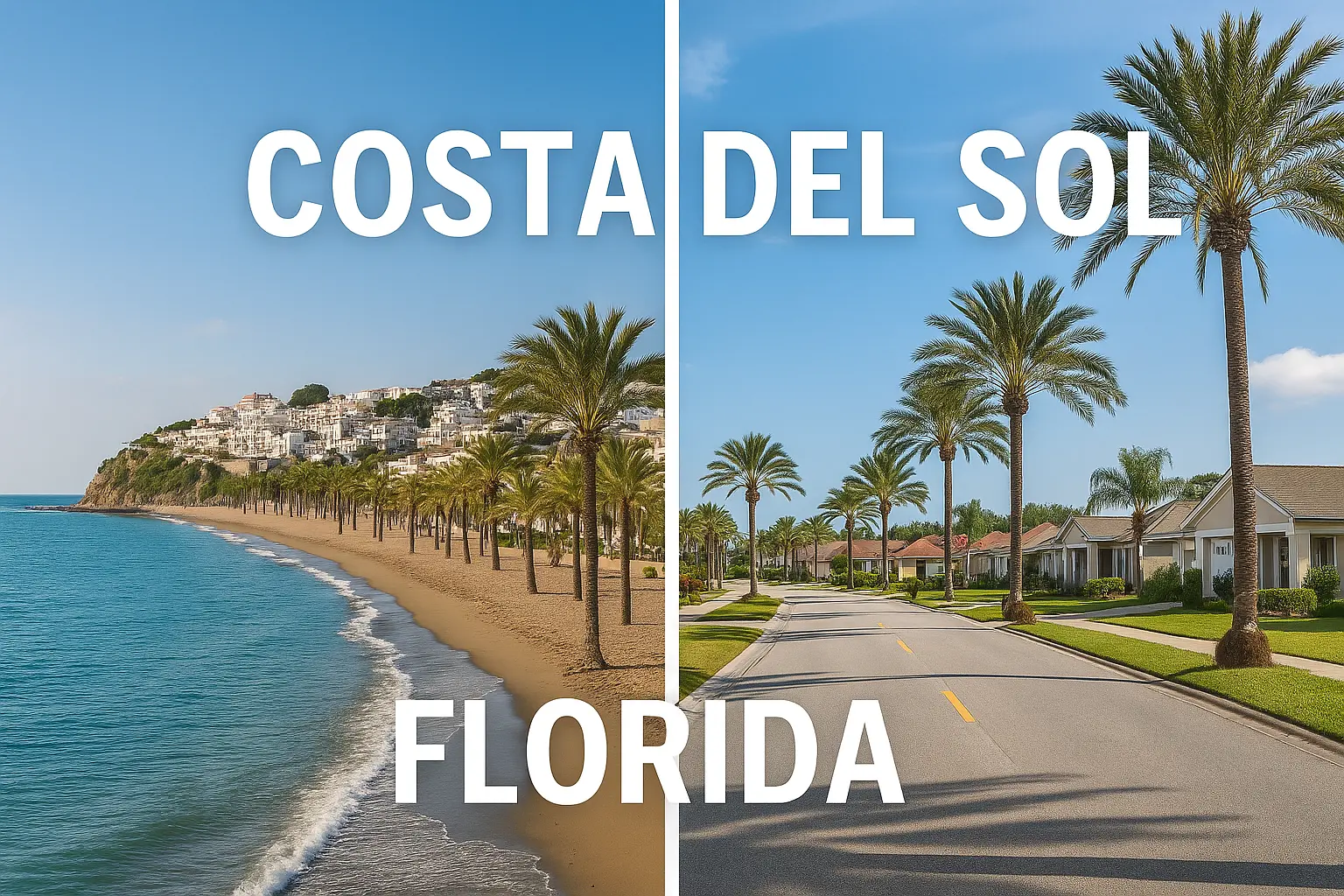
Retirement sunshine: Costa del Sol vs Florida.
For decades, Florida has been the default retirement dream for many Americans — palm-lined streets, golf communities and predictable sunshine. Meanwhile, the Costa del Sol has quietly evolved into its European counterpart, offering sea views, relaxed Mediterranean living and an increasingly international community.
On the surface, the two lifestyles appear similar. However, once you look more closely at property prices, healthcare, insurance, residency and day-to-day costs, the differences become striking.
This guide compares retiring in Benahavís near Marbella with key Florida retirement markets such as The Villages, Sarasota and Naples — using the most relevant 2026 data available.
Monthly living costs
Property purchase prices
Healthcare systems and insurance
Visa and residency options
Lifestyle and long-term practicality
Living Costs: Costa del Sol vs Florida (2026)
The key question most retirees ask is simple:
“How much do we actually need each month to live comfortably?”
Below are realistic mid-market estimates for 2026, excluding housing.
Costa del Sol (Benahavís / Marbella)
Food & dining: €600–750 (≈ $650–810)
Utilities & telecoms: €200–250 (≈ $215–270)
Car costs: €200–300 (≈ $215–325)
Private healthcare: €250–350 (≈ $270–380)
Extras & lifestyle: €250–350 (≈ $270–380)
Total: €1,500–2,000/month (≈ $1,620–2,160)
Florida Retirement Areas
Food & dining: $1,100–1,300 (≈ €1,020–1,200)
Utilities & telecoms: $400–550 (≈ €370–510)
Car costs: $500–700 (≈ €460–650)
Healthcare: $700–900 (≈ €650–830)
Extras & co-pays: $400–600 (≈ €370–555)
Total: $3,000–3,800/month (≈ €2,780–3,520)
Key takeaway: for a similar lifestyle, many retirees find total monthly costs on the Costa del Sol are typically 30–50% lower than in Florida, particularly when healthcare and insurance are included.
Property Prices: Costa del Sol vs Florida
Property pricing is more nuanced. Florida often appears cheaper upfront, but long-term ownership costs can change the equation.
Typical Mid-Market Comparisons (2026)
Benahavís (Costa del Sol):
€450,000–€2,000,000 (≈ $485,000–$2,160,000)
Florida (The Villages, Sarasota, Naples):
$360,000–$1,500,000 (≈ €333,000–€1,390,000)
At entry level, Florida can look more affordable. However, once you factor in property taxes, insurance and HOA fees, the long-term cost gap often narrows significantly.
Healthcare: Spain vs Florida
Spain: access to public healthcare plus affordable private insurance provides predictable, high-quality care.
Typical private insurance:
€250–350/month per couple (≈ $270–380)
Florida: Medicare plus supplements:
$700–900/month per couple (≈ €650–830)
In practical terms: healthcare in Spain is often significantly more predictable and can cost substantially less over time.
Read our article on heath insurance requirements for a non-lucrative visa here->
Residency & Visas
Spain offers clear routes for retirees, including the Non-Lucrative Visa and Digital Nomad Visa.
The US does not offer a dedicated retirement visa, making long-term relocation more complex for non-Americans.
Read our article on visas for retiring in Spain here->
Lifestyle: Florida vs Mediterranean Living
Florida offers convenience, structured communities and familiarity.
By contrast, the Costa del Sol — particularly Benahavís — offers a more balanced lifestyle: outdoor living, walkable environments and a slower, more social rhythm.
For many retirees, the decision is less about cost and more about overall quality of life.
How Much Do You Need Per Month?
Lean: €1,500/month (≈ $1,620)
Comfortable: €1,800–2,200/month (≈ $1,950–2,375)
High comfort: €2,500+/month (≈ $2,700+)
Even at higher spending levels, many retirees remain well below equivalent Florida costs.
Thinking About Retiring to Spain?
Get our complete guide to retiring on the Costa del Sol — including visas, healthcare, costs and where to buy.
✔ Costs breakdown
✔ Visa options explained
✔ Best areas for retirees
✔ Real property examples
Florida offers familiarity and convenience, but with higher ongoing costs
The Costa del Sol offers lower expenses, better healthcare value and a more balanced lifestyle
Spain provides clearer residency pathways for international retirees
While costs vary by lifestyle and location, most independent data suggests Spain remains significantly more affordable than the US — particularly for healthcare and everyday living.
Frequently Asked Questions: Retiring in Spain vs Florida
Is it cheaper to retire in Spain or Florida?
In most cases, retiring in Spain is significantly cheaper. Many couples find their monthly costs are around 30–50% lower than in Florida, particularly due to healthcare, insurance and everyday living expenses.
How much money do you need to retire in Spain?
A couple can live comfortably on around €1,800–2,200 per month (≈ $1,950–2,375), excluding housing. More modest lifestyles are possible from around €1,500/month.
Can Americans retire in Spain full-time?
Yes. Americans can apply for Spain’s Non-Lucrative Visa, which allows residency without working, provided income and healthcare requirements are met.
Is healthcare better in Spain or the US?
Spain offers high-quality public healthcare plus affordable private insurance. Costs are generally far lower and more predictable than in the US system.
Where is the best place to retire on the Costa del Sol?
Areas like Benahavís, Marbella and Estepona are popular due to climate, infrastructure, international communities and access to healthcare and lifestyle amenities.
“For many retirees, the Costa del Sol isn’t just cheaper — it offers a more rewarding way to live.”
Costa del Sol vs London, New York and Toronto in 2026
“Living on the Costa del Sol in 2026 costs significantly less than life in London, New York or Toronto — while offering 300 days of sunshine and a calmer, more outdoor lifestyle.”
More people than ever are asking a simple question:
“Is there somewhere I can live better — not just cheaper?”
For many, the answer is yes: the Costa del Sol. Sunshine, lower everyday costs, Mediterranean food culture and strong international communities make the region one of Europe’s most appealing places to relocate.
This guide compares the cost of living on the Costa del Sol vs London, New York and Toronto using realistic 2026 figures, so you can see how far your money really goes.
Living Costs on the Costa del Sol (2026)
The Costa del Sol remains one of Europe’s best-value regions for day-to-day living, especially when you compare it with major English-speaking cities. Mild winters help keep utility bills down, fresh produce is affordable, and household insurance is typically a fraction of what residents pay in the UK, US or Canada.
Fresh produce at Málaga’s local markets keeps weekly food costs under control.
Typical monthly spending for a couple (Costa del Sol)
For two adults living a comfortable, non-extravagant lifestyle in Málaga and surroundings, a realistic monthly budget looks like this:
Insurance (home + car combined): €650–1,050/year (≈ €55–88/month)
Typical total monthly spend (excluding rent or mortgage): €1,000–1,200
For most people moving from London, New York or Toronto, that alone is a big adjustment: bills become more predictable and manageable, and a larger share of your income goes on lifestyle rather than fixed costs.
Jump to your city
See the full cost of living breakdown, lifestyle notes and real examples:
London remains one of the world’s most expensive cities. Energy prices, transport and insurance are all significantly higher than in southern Spain, and many households feel that most of their income disappears on basics before they even think about going out.
Monthly costs for a couple in London (excluding rent)
Food & dining: £760–950/month
Utilities & telecoms: £320–450/month
Public transport (Zone 1–3 style pass): £170+/month
Typical total monthly spend (excluding rent or mortgage): £1,450–1,800 (≈ €1,700–2,100)
Property snapshot: London vs Costa del Sol
London 2-bed flat: £575,000–750,000
London 3-bed townhouse: £1.05–1.30m
Costa del Sol 3-bed townhouse: €575,000–725,000
For many London homeowners, selling a family house can fund an outright purchase on the Costa del Sol with money left over, turning a mortgage payment into additional income.
Real example: selling in London → moving to Spain
Imagine a London couple selling a £1.2m semi-detached home. After agent and legal fees, they might walk away with roughly £1.16–1.17m.
On the Costa del Sol, they buy a modern townhouse in a gated community for around €700,000, plus approximately €70,000 in purchase costs. Their total outlay is roughly €770,000.
That leaves a substantial amount of released equity which, invested modestly at 3–4% per year, can help offset monthly costs and provide a meaningful lifestyle cushion.
Monthly non-housing costs:
London: £1,450–1,800
Costa del Sol: €1,000–1,200 (often noticeably lower even with a similar lifestyle)
Summary: in this scenario, the couple lives mortgage-free, reduces monthly spending and can often cover a meaningful part of their new lifestyle from investment income alone.
New York City: Cost of Living Breakdown (2026)
New York offers incredible energy and opportunity, but everyday costs add up fast — especially groceries, eating out and insurance. For many New Yorkers, moving to Spain feels like taking the pressure off without giving up big-city connections.
Monthly costs for a couple in NYC (excluding rent)
Typical total monthly spend (excluding rent or mortgage): $2,100–2,800 (≈ €1,950–2,600)
Property snapshot: New York vs Costa del Sol
2-bed condo (Manhattan): $1.9–2.6m
Costa del Sol 2-bed apartment: €300,000–420,000
Costa del Sol detached villa: €750,000–1.15m
Real example: selling in NYC → moving to Spain
A New York couple sells a two-bedroom Manhattan condo for around $2.0m and nets roughly $1.85m after closing costs. They purchase a high-quality Costa del Sol townhouse for around €770,000 all-in (roughly $830,000–860,000, depending on exchange rate).
Capital released: often close to (or above) $1.0m. Invested at 3–4% annually, that can generate meaningful income — frequently enough to offset a large share of living costs in Spain, before considering pensions or other income.
Monthly non-housing costs:
New York City: $2,100–2,800
Costa del Sol: €1,000–1,200 (≈ $1,080–1,320, exchange-rate dependent)
Summary: many New Yorkers find they can reduce fixed expenses dramatically, turn home equity into income, and swap crowded commutes for a Mediterranean lifestyle with sunshine and outdoor living.
Toronto: Cost of Living Breakdown (2026)
Toronto’s cost of living has risen sharply over the past decade. Groceries, utilities, mobile phone plans and insurance are among the highest in the world — and homeowners also face substantial property tax and water bills.
Monthly costs for a couple in Toronto (excluding mortgage)
The figures below reflect a typical two-adult household with two cars and a detached or semi-detached home:
On top of that, most Toronto homeowners pay significant municipal charges:
Property tax: typically C$4,800–7,200/year (≈ C$400–600/month)
Water & sewage: typically C$1,300–2,000/year (≈ C$110–170/month)
When you include property tax and water, the true non-mortgage monthly cost for many Toronto households rises to around:
C$3,850–5,050 per month (≈ €2,600–3,400, exchange-rate dependent)
Property snapshot: Toronto vs Costa del Sol
Toronto 2-bed condo: C$850,000+
Toronto 3-bed townhouse: C$1.25m+
Toronto detached house: C$1.6–2.2m+ (area-dependent)
Costa del Sol 3-bed townhouse / semi-detached: €575,000–725,000
Real example: selling in Toronto → moving to Spain
A Toronto family sells a 3-bedroom detached home in a desirable neighbourhood for around C$1.55m and nets roughly C$1.49m after fees. They purchase a Costa del Sol townhouse in a modern community with pool and gardens for about €770,000 all-in.
Their everyday costs also change dramatically. Instead of spending C$3,850–5,050 each month on food, utilities, telecoms, insurance, transport, property tax and water, they now spend around:
€1,000–1,200 per month in Spain (often roughly C$1,500–2,000, exchange-rate dependent).
Summary: for many Toronto households, moving to the Costa del Sol meaningfully reduces monthly outgoings, while swapping long winters for a climate where outdoor life is possible most of the year.
The financial savings are important, but for most people the real attraction is how different everyday life feels. Instead of planning your week around bills, weather and commuting, you start planning it around daylight, terraces and time outside.
Around 300 days of sunshine per year
Outdoor cafés, coastal walks, golf and hiking as part of normal life
Excellent public healthcare and affordable private options
Safe, international communities with English widely spoken
Easy flights back to the UK, Europe, Canada and the US
Many people who move from London, New York or Toronto say the biggest change is not just lower costs, but a lighter, calmer daily rhythm: fewer long commutes, more time outside, and the feeling that they are finally getting value from the money they spend.
How much do I need per month on the Costa del Sol?
Everyone’s lifestyle is different, but these ballpark figures are a useful starting point:
Comfortable couple (excluding housing): most two-adult households live well on around €1,000–1,200 per month for food, utilities, telecoms, local transport and insurance.
Comfortable couple (including rent or mortgage): adding a mid-range long-term rental or modest mortgage, many couples find that a total budget of around €2,100–2,800 per month provides a very comfortable lifestyle in much of the Costa del Sol.
Single professional or remote worker: a single person can often cover non-housing costs on €750–950 per month, with total budgets from around €1,600–2,050 including rent (depending on location and housing choice).
These are guide figures only, but the pattern is clear: for many people relocating from London, New York or Toronto, the Costa del Sol offers a noticeably lower monthly outlay for a similar – or better – standard of living.
Final Summary: Why the Costa del Sol Wins on Cost of Living in 2026
When you combine lower living costs, better-value property, predictable household expenses, sunshine, outdoor living and a calmer pace of life, the Costa del Sol becomes one of the most compelling relocation and retirement choices for 2026.
For many people leaving London, New York or Toronto, the reality is simple: life on the Costa del Sol is not only cheaper — it is richer, healthier and more enjoyable.
“In 2026, the Costa del Sol offers a richer lifestyle — for less.” moodarse.com/